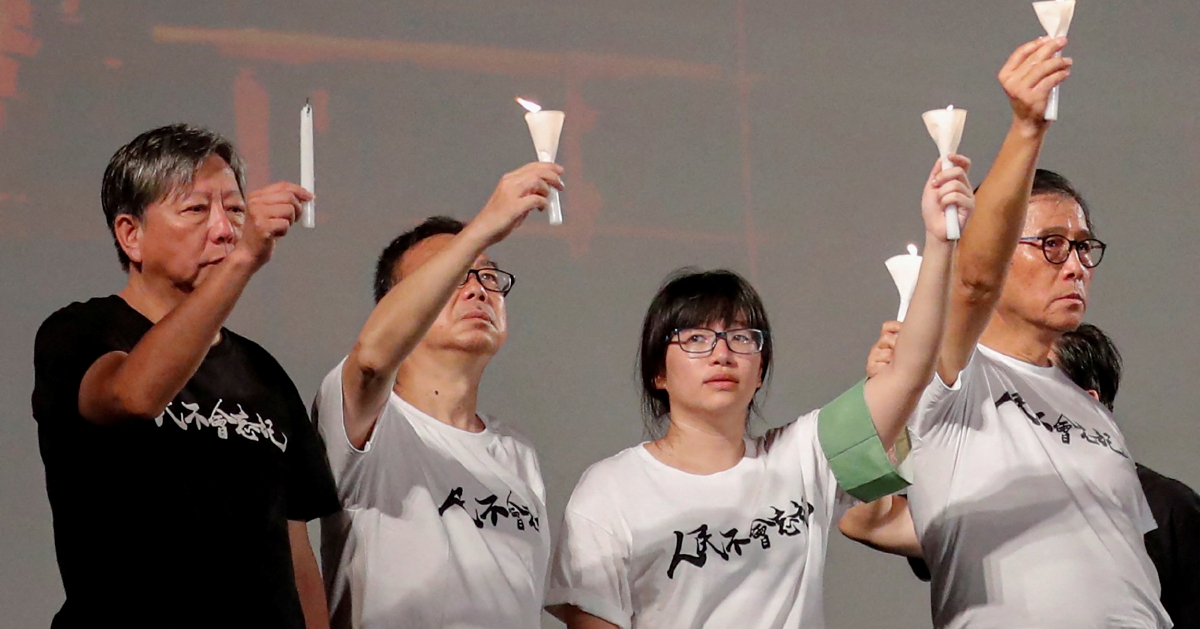
Two prominent Hong Kong activists faced guilty verdicts in court on Friday after prosecutors successfully argued they had incited subversion through their organisation of yearly candlelit vigils honouring those killed in China's 1989 Tiananmen Square military crackdown. The convictions underscore mounting restrictions on political freedoms in a territory once celebrated for its open civil society, marking a significant moment in Hong Kong's shift towards tighter governance following the 2019 pro-democracy protests.
The defendants had coordinated the June 4 memorial gatherings, which for decades served as Hong Kong's most visible public acknowledgement of the Tiananmen incident—an event that remains heavily censored and officially unmentioned on mainland China. These vigils, typically held at Victoria Park in Causeway Bay, attracted tens of thousands of participants in previous years and represented one of the few spaces where Hongkongers could openly discuss a sensitive chapter of modern Chinese history. The court's determination that organising such commemorations constitutes subversion carries profound implications for what remains permissible in terms of historical remembrance and political expression within the territory.
The charges brought against the activists reflect the application of Hong Kong's National Security Law, the sweeping legislation imposed by Beijing in June 2020. This law criminalises acts deemed to undermine national security, including subversion, secession, foreign collusion, and terrorism. While authorities maintained the law was necessary to restore stability after months of increasingly confrontational street protests, critics internationally and within Hong Kong have characterised it as a tool to suppress legitimate political speech and restrict freedoms previously guaranteed under the city's mini-constitution, the Basic Law. The conviction of activists for merely organising remembrance vigils exemplifies concerns that the law is being deployed far beyond its stated anti-terrorism objectives.
The Tiananmen vigils held special significance in Hong Kong's political landscape. Unlike mainland China, where discussion of June 4 remains heavily censored and can result in detention or prosecution, these annual gatherings represented a point of distinction where Hong Kong demonstrated autonomy in addressing historical and political matters. The vigils also served as a focal point for broader expressions of support for democracy and human rights, attracting not only those directly concerned with the 1989 events but also younger generations expressing wider pro-democracy sentiment. Their prohibition effectively severs one of the last visible connections between Hong Kong civil society and this pivotal moment in Chinese contemporary history.
For Malaysian observers, this development carries regional significance. Southeast Asia, including Malaysia, maintains complex relationships with both China and concepts of political freedoms. Hong Kong's trajectory demonstrates how quickly civil liberties can be constrained through legislation framed as necessary for security, a dynamic with potential lessons for other societies grappling with balancing security concerns against democratic openness. The application of national security laws to restrict commemoration and political expression sets a precedent that regional governments monitoring stability and security matters may either emulate or resist, depending on their governance philosophies.
The convictions also reflect broader patterns of pressure against civil society organisations and activist networks throughout Hong Kong. Multiple pro-democracy groups have disbanded under pressure from the National Security Law, prominent activists have fled the territory, and media outlets critical of government policies have faced increased scrutiny. What was once a vibrant landscape of political activism, independent journalism, and civic engagement has contracted substantially, as individuals and organisations recalibrate their activities within a narrower band of what authorities deem acceptable. The verdicts against these Tiananmen vigil organisers represent another incremental narrowing of that permissible space.
International responses to such convictions have been mixed. Western governments and human rights organisations have condemned the prosecutions as violations of freedom of expression and assembly, while Beijing and Hong Kong officials have defended the National Security Law as essential for maintaining order and preventing destabilisation. For many Hongkongers, particularly those who value historical memory and political pluralism, these legal developments represent a fundamental alteration of their city's character and prospects for retaining distinct governance characteristics. The younger generation, in particular, faces an environment vastly different from the Hong Kong their parents and grandparents knew.
The practical impact extends beyond symbolism. With the vigil organisers convicted, authorities now face fewer obstacles to preventing future large-scale Tiananmen commemorations. Police have already restricted or prevented gatherings in recent years citing pandemic concerns and security considerations. The legal precedent established through these convictions provides firmer ground for further restrictions, making it increasingly difficult for any organisation to attempt holding public remembrance events without risking prosecution. This represents a qualitative shift from past years when vigils, while sometimes contentious, proceeded with relative regularity.
The case also highlights questions about international law and obligations. Hong Kong is party to several international human rights treaties through its colonial-era inheritance, and these instruments generally protect freedom of expression and assembly. Critics argue that the National Security Law and its application through convictions like these violate those international commitments. However, Beijing's position is that national sovereignty supersedes such international frameworks when security is at stake, a stance that reflects broader debates about governance priorities in contemporary China and contested territories.
Looking forward, these convictions may influence how civil society actors throughout Asia approach politically sensitive topics. If major historical events and anniversaries can be grounds for prosecution under national security frameworks, then the scope of permissible political discourse narrows substantially across the region. For Hong Kong specifically, the verdicts suggest that the window for public dissent and alternative political expression will continue contracting, with civil society increasingly dependent on more discreet and private modes of organising and remembrance. The vigils that once filled Victoria Park with hundreds of thousands may exist only in memory.

