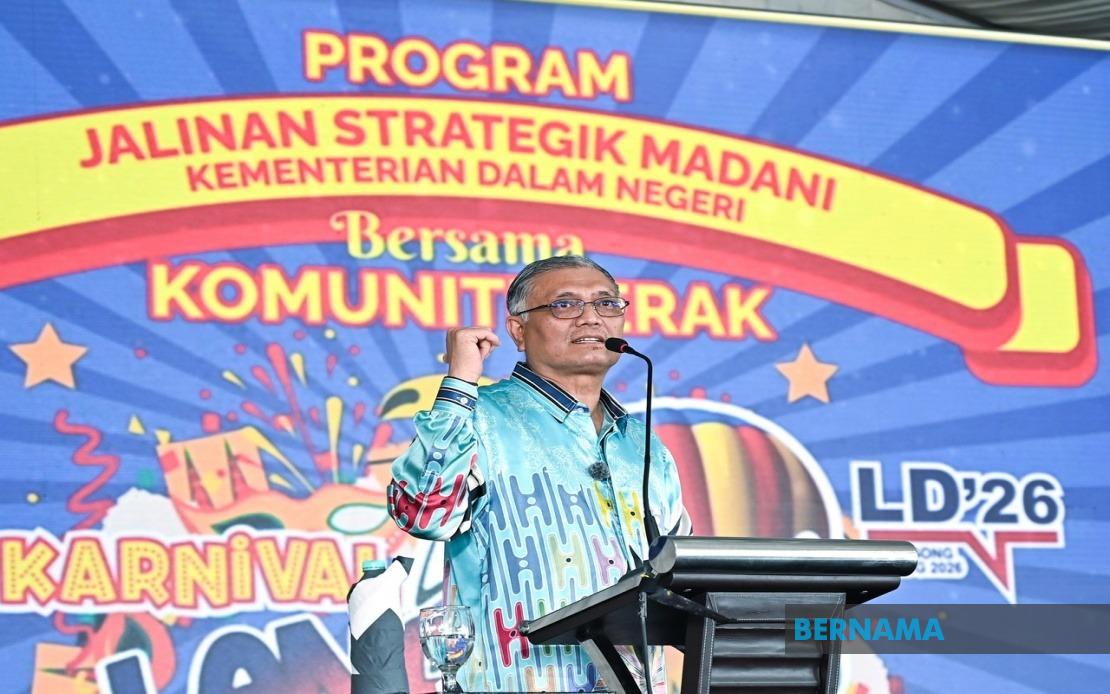
The Home Ministry has rolled out an ambitious initiative to embed government services within communities and forge stronger partnerships with local residents, using a two-day activation in Lenggong, Perak as a demonstration of its approach. The MADANI Strategic Partnership Programme, which commenced at Dataran Lenggong, represents a deliberate shift towards decentralising access to critical services that citizens ordinarily encounter only by travelling to government offices. By positioning service counters directly in public spaces alongside recreational and educational activities, the ministry seeks to normalise interaction between residents and security agencies, reducing administrative barriers that often discourage people from updating records or seeking official guidance.
Deputy Home Minister Datuk Seri Dr Shamsul Anuar Nasarah, who also represents Lenggong as its Member of Parliament, framed the programme as a response to emerging demands for more responsive governance. He emphasised that the initiative transcends mere service delivery, functioning instead as a two-way channel through which communities can articulate security concerns and agencies can gather grassroots intelligence on issues ranging from petty crime to substance abuse. This conceptualisation aligns with broader government rhetoric around the MADANI framework, which emphasises stakeholder participation in policy design and implementation rather than top-down administration.
The Lenggong activation featured a diverse schedule designed to appeal across age groups and demographics. Children engaged in colouring competitions and creative performances, while adults accessed service counters operated by the Royal Malaysia Police, the Immigration Department of Malaysia, and the National Anti-Drugs Agency. By interspersing bureaucratic functions with entertainment and community activities, organisers attempted to counteract the perception that government engagement is arduous or intimidating. Religious talks were incorporated into the programme, reflecting the ministry's recognition that faith-based leaders wield considerable influence in Malaysian communities and that security messaging resonates differently when articulated through spiritual frameworks.
A highlight of the two-day event was the Fun Ride and Fun Run, which drew approximately 1,190 participants and was coordinated by the People's Volunteer Corps and the National Anti-Drugs Agency. Rather than confining these activities to urban parks, organisers routed participants through villages surrounding Lenggong, deliberately showcasing the region's natural attributes and its status as a UNESCO World Heritage Site. This geographical strategy served multiple purposes simultaneously: it normalised outdoor recreation as a drug-free lifestyle alternative, it demonstrated government capacity to mobilise large numbers of citizens, and it leveraged Lenggong's tourism credentials to make the programme feel celebratory rather than purely institutional.
The choice of Lenggong as the launch venue carries significance beyond its administrative convenience. The district encompasses the Lenggong Valley, recognised by UNESCO for its geological and archaeological importance, yet the region historically grapples with development disparities relative to urban centres. By positioning a high-profile government programme there, the ministry signals commitment to smaller townships while tackling the perception that government accessibility correlates with population density. For residents accustomed to navigating bureaucracy through visits to state capitals, the decentralised model offers tangible convenience.
The programme's emphasis on the Immigration Department's presence reflects a strategic priority in Malaysian governance. Immigration services touch diverse populations—from diaspora communities maintaining citizenship records to foreign workers navigating permit renewals—and accessibility barriers can create compliance gaps. By bringing immigration services to Lenggong, the programme reduces transaction costs for residents while generating data on patterns of mobility, employment, and family composition that inform broader policy. Similarly, the Royal Malaysia Police's participation allows officers to build familiarity with communities they serve, potentially improving crime intelligence and community policing effectiveness.
The National Anti-Drugs Agency's prominent role in both the service delivery component and the Fun Ride and Fun Run reflects Malaysia's sustained emphasis on combating substance abuse, a priority that transcends political cycles. By embedding anti-drugs messaging within recreational activities rather than restricting it to enforcement or clinical settings, the agency attempts to shift public perception from punitive to preventive. This approach acknowledges that younger demographics particularly respond to lifestyle messaging and peer-driven engagement rather than authoritarian cautioning.
For Malaysian readers, the MADANI programme illustrates a shift in governance philosophy that privileges accessibility and two-way communication over centralised service provision. The model recognises that barriers to government engagement—whether geographical, psychological, or informational—create compliance gaps and diminish policy effectiveness. By reducing friction in accessing routine services, governments potentially increase participation in civic processes and improve data quality. However, the programme's success ultimately depends on whether participants experience genuine responsiveness to raised concerns or whether the initiative functions primarily as a public relations exercise.
From a regional perspective, Malaysia's approach resonates with broader Southeast Asian trends towards community-centred governance. Countries across the region struggle with similar challenges: dispersed populations requiring government services, security agencies seeking community intelligence, and citizens demanding accessibility without sacrificing quality. The MADANI model offers a replicable framework that other Southeast Asian nations might adapt to their contexts, though implementation quality and sustained commitment remain critical variables determining outcomes.
Looking forward, the programme's sustainability depends on embedding it within regular governance cycles rather than treating it as a periodic event. If KDN agencies establish permanent mechanisms for receiving community input and demonstrating responsiveness to raised issues, the MADANI approach could fundamentally alter the relationship between security institutions and civilian populations. Conversely, if the initiative devolves into ceremonial engagement without substantive follow-up, public cynicism regarding government intentions may deepen. The test of the programme lies not in attendance figures or service counter traffic during the two-day activation, but in whether agencies translate community feedback into policy adjustments and whether residents perceive tangible improvements in service delivery and security outcomes.

