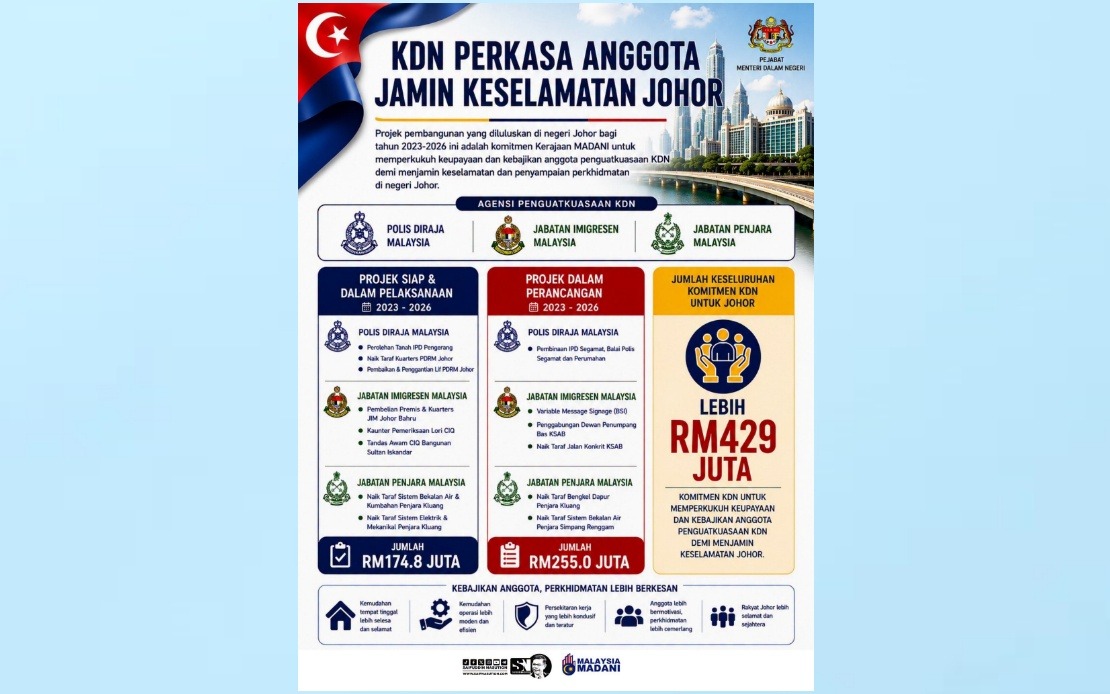
The Malaysian Home Ministry has channelled over RM429 million into Johor's enforcement sector since 2023, addressing both the immediate welfare needs of officers and the strategic modernisation of operational infrastructure across the Royal Malaysia Police, Malaysian Immigration Department, and Malaysian Prisons Department. Home Minister Datuk Seri Saifuddin Nasution Ismail outlined the comprehensive initiative, emphasising that investment in personnel conditions represents far more than incremental improvements to facilities—it forms part of a deliberate strategy to enable enforcement personnel to execute their responsibilities with greater competence, safety, and effectiveness whilst protecting public security.
The financial commitment, breaking down into RM174.8 million for projects already completed or currently progressing and RM255 million earmarked for schemes in planning phases, demonstrates the government's intention to systematically rebuild institutional capacity in the state. Saifuddin Nasution articulated a direct correlation between officer welfare and public benefit, arguing that when enforcement personnel operate from improved working environments with enhanced accommodations and contemporary operational tools, citizens experience tangible gains through superior service standards and heightened community safety. This framing positions staff investment not as an overhead expense but as a foundational element of effective governance and public protection.
Current implementation projects reveal substantial physical infrastructure expansion across Johor. The land acquisition programme for Pengerang District Police Headquarters represents a geographic extension of policing capacity into areas previously underserved, whilst the acquisition of office premises and residential quarters for the Johor Bahru Immigration Department addresses the chronic accommodation shortages affecting border management personnel. Simultaneous facility upgrades at Kluang Prison, focusing on basic infrastructure provision, signal recognition of deteriorating conditions within correctional institutions that have periodically drawn concern from oversight bodies and humanitarian organisations.
Looking forward, the planned initiatives signal ambitions for more comprehensive institutional restructuring. The Segamat District Police Headquarters project, encompassing both operational station facilities and housing complexes for personnel and their families, represents an integrated approach to establishing sustainable police presence in secondary urban centres. The consolidation of bus terminal operations at the Sultan Abu Bakar Complex addresses longstanding inefficiencies in passenger infrastructure whilst freeing resources for security enhancement. Simultaneously, planned improvements to kitchen facilities and water systems at Kluang and Simpang Renggam prisons indicate attention to conditions affecting both staff efficiency and inmate welfare—considerations that influence institutional stability and public health outcomes.
The allocation to Johor should be understood within Malaysia's broader federal resource distribution framework. Saifuddin Nasution referenced Prime Minister Datuk Seri Anwar Ibrahim's recent parliamentary statement that Johor's development and management allocation has risen substantially to approximately RM14.6 billion, compared with the preceding RM10.2 billion—an increase reflecting both demographic growth and strategic prioritisation following recent political transitions within the state. This contextualisation demonstrates that enforcement sector investment represents one component of a wider developmental strategy rather than an isolated budgetary adjustment.
For Malaysian stakeholders, the implications extend across multiple policy dimensions. Enhanced police infrastructure in districts like Pengerang and Segamat potentially addresses persistent public complaints regarding response times and crime investigation capacity in secondary urban areas, where population growth has historically outpaced institutional development. Immigration department improvements at the state's primary urban centre strengthen border integrity and facilitate legitimate cross-border commerce—considerations of heightened significance given Johor's geographic proximity to Singapore and its role as a transit corridor for regional movement. Correctional facility upgrades, whilst less visible to general public awareness, carry substantial implications for rehabilitation efficacy and staff retention within custodial services.
The welfare dimension carries particular weight within Malaysian enforcement discourse. Personnel retention in security agencies has emerged as an emerging challenge, with modest salary progression and demanding shift patterns contributing to attrition, particularly among experienced mid-career officers. By prioritising accommodation and facility improvements alongside operational modernisation, the Home Ministry addresses a structural vulnerability in human resource sustainability. Officers relieved of housing anxieties and working from functional infrastructure experience measurably higher morale and performance consistency—outcomes that translate into community benefit through improved service delivery and institutional stability.
Geographically, the distribution of projects across Johor reflects deliberate attention to institutional gaps. Pengerang, situated in the southern peninsula's industrial corridor, has experienced accelerated commercial and residential development without proportionate security infrastructure expansion. Segamat, representing the interior hinterland, has historically received relatively limited institutional investment despite serving as a commercial and administrative centre for surrounding districts. The allocation strategy therefore suggests recognition of asymmetric development patterns and conscious effort to realign institutional capacity with demographic and economic realities.
The integration of infrastructure projects across distinct agencies—police, immigration, and corrections—indicates coordinated planning rather than siloed budgeting. This inter-agency approach acknowledges that modern security challenges transcend individual institutional boundaries, requiring seamless coordination between border management, law enforcement, and custodial services. Shared infrastructure improvements, such as the KSAB terminal consolidation, create opportunities for operational synergy and efficient resource utilisation beyond what isolated agency investments could achieve.
Looking ahead, the success of this allocation will depend substantially on implementation execution and maintenance commitment. Malaysia's developmental history contains examples of infrastructure investments that deteriorated through inadequate maintenance funding, negating initial capital outlays. The Ministry's stated commitment to optimising fund utilisation warrants sustained parliamentary oversight and public accountability mechanisms ensuring that allocated resources translate into sustained operational improvements rather than temporary capacity enhancements.

