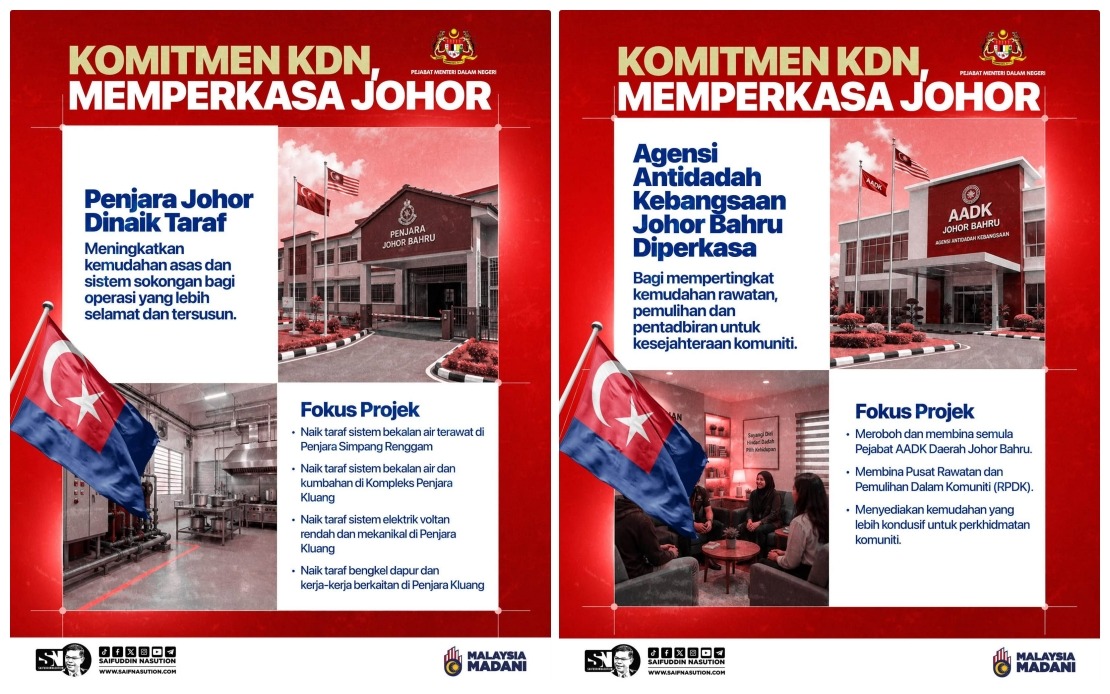
With Johor poised to elect a new state government in imminent elections, the Home Ministry has unveiled an ambitious portfolio of development initiatives spanning security infrastructure and public service modernisation across the state. Home Minister Datuk Seri Saifuddin Nasution Ismail framed the strategic investments as essential to maintaining Johor's role as a vital gateway and administrative nexus in Malaysia's southern region, where security protocols and border management directly influence the nation's broader operational capacity.
The scope of the ministry's agenda extends across multiple agencies operating within its purview, each tasked with specific facility upgrades and operational improvements. The Royal Malaysia Police will benefit from new district headquarters infrastructure in Segamat, alongside land acquisition for a corresponding facility in Pengerang. Beyond these flagship projects, the police force will see maintenance work on residential quarters and lift systems at various police installations, addressing the accumulated wear on existing premises that typically affects staff morale and operational functionality.
Border management and immigration services, traditionally critical in Johor given its proximity to Singapore and its role in international transit, feature prominently in the ministry's modernisation programme. The Sultan Iskandar Building and Sultan Abu Bakar Complex, both key immigration processing centres, are earmarked for facility upgrades designed to streamline border operations and reinforce professional standards in public-facing services. These improvements reflect recognition that outdated infrastructure can create bottlenecks affecting both legitimate travellers and security screening capacity, with downstream effects on Malaysia's regional standing.
The National Registration Department's expansion into Batu Pahat through a new district office represents infrastructure consolidation in a growing population centre, improving access to citizenship and identification services for residents previously dependent on facilities in larger urban areas. Simultaneously, the penitentiary system is receiving technical and structural upgrades, with foundational systems improvements scheduled for Kluang Prison and Simpang Renggam Prison, upgrading ageing institutional infrastructure that supports both security operations and inmate welfare standards.
The National Anti-Drugs Agency's presence in Johor will be reinforced through office redevelopment and treatment facility enhancements, signalling intensified commitment to substance abuse intervention in a state historically significant in drug trafficking networks. Such infrastructure investments typically correlate with expanded capacity for rehabilitation programmes and operational command structures, though their effectiveness ultimately depends on staffing levels and inter-agency coordination that extend beyond physical facilities.
Maritime security operations, increasingly central to regional stability discussions given sea lane vulnerabilities and transnational crime patterns, receive attention through improvements at Abu Bakar Maritime Base, including jetty upgrades and building refurbishment. The Malaysian Maritime Enforcement Agency's operational reach in Johor coastal waters connects to broader Indian Ocean security concerns and Malaysia's strategic interests in maintaining maritime domain awareness across shipping corridors and fishing zones.
Saifuddin Nasution's articulation of these projects emphasises direct public benefit and personnel welfare, a framing that addresses both constituency expectations and bureaucratic morale. The emphasis on delivering tangible outcomes from allocated budgets responds to persistent public scrutiny regarding government spending efficiency, particularly in advance of electoral cycles when performance records become subject to voter assessment. In Johor specifically, where state elections determine local governance priorities and resource allocation, infrastructure visibility functions as a political messaging tool alongside its operational utility.
For Malaysian and Southeast Asian observers, the investment pattern reveals strategic thinking about Johor's roles beyond state boundaries. As a southern anchor point in Malaysia's federal structure, and a state sharing a land border with Singapore while maintaining maritime responsibilities, Johor's security and administrative capacity affects national resilience. Upgrades to immigration and maritime facilities carry implications for bilateral relationships and regional confidence in Malaysia's border management protocols.
The timing of these announcements, coinciding with electoral activity, inevitably colours their reception. Opposition voices typically question whether infrastructure commitments represent genuine medium-term policy or election-season posturing designed to influence voting patterns. The substantive question concerns implementation timelines: whether projects commence and progress regardless of electoral outcomes, or whether political transitions generate delays and reprioritisation.
For regional context, Johor's development trajectory influences migration patterns, business confidence, and investment flows throughout Southeast Asia. Enhanced public services and security infrastructure theoretically improve the state's attractiveness to domestic and foreign investment, though actual returns depend on complementary policies regarding taxation, labour regulations, and governance consistency. The Home Ministry's investments alone cannot determine such outcomes, but they signal governmental commitment to foundational state capacity.
The multi-agency coordination implicit in these projects—spanning police, immigration, prisons, anti-drugs, and maritime operations—suggests recognition that security challenges increasingly transcend individual departmental mandates. Human trafficking, transnational organised crime, and irregular migration typically require integrated responses that infrastructure improvements must support with appropriate operational protocols and inter-agency information sharing systems.
Looking forward, the implementation of this portfolio will merit monitoring by observers assessing whether Malaysia's Home Ministry can translate capital investment into measurable operational improvements. Success metrics might include border processing times, crime clearance rates, and public satisfaction surveys, though such data rarely achieves comprehensive public disclosure. The projects represent substantial financial commitments, and their outcomes will influence perceptions regarding Home Ministry effectiveness and, by extension, broader government competence in delivering stated policy objectives.

