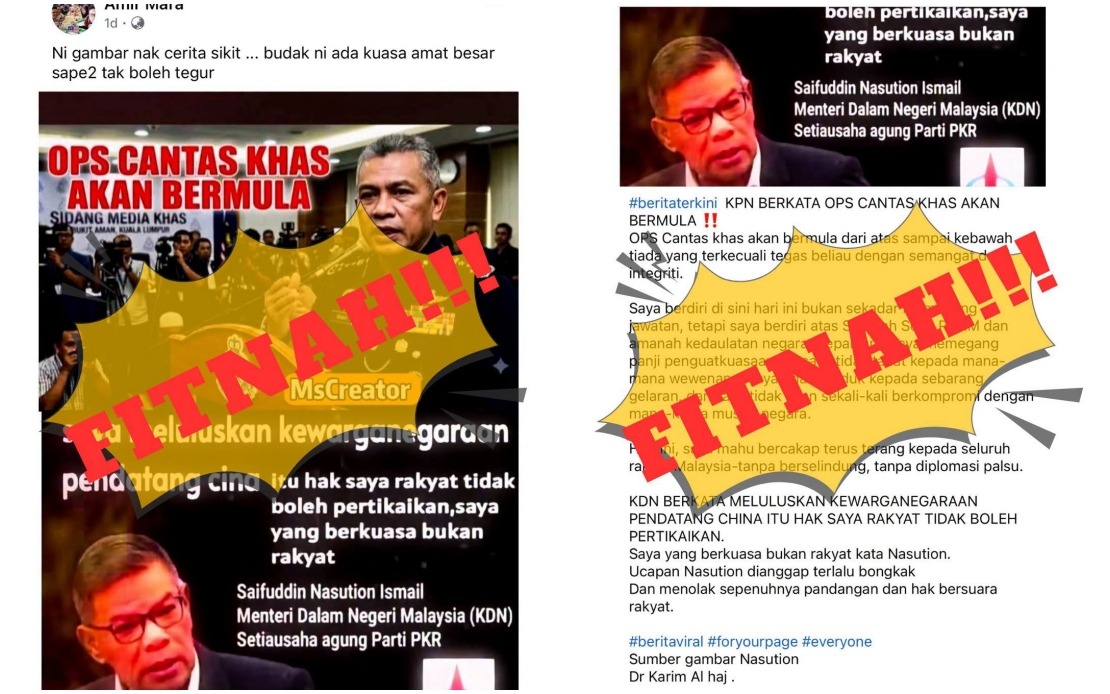
Home Minister Datuk Seri Saifuddin Nasution Ismail has issued a firm rebuttal to persistent claims that the Ministry of Home Affairs (KDN) conducted mass citizenship grants to foreign nationals, including allegations involving 1.2 million Chinese residents. Speaking in Putrajaya on August 19, the minister emphasized that he has comprehensively addressed these allegations on multiple occasions, yet misinformation continues to circulate through recycled social media content despite previous official clarifications.
The Home Minister's statement underscores a mounting concern about the deliberate spread of unsubstantiated narratives regarding citizenship matters—a sensitive topic that intersects with immigration policy, national identity, and demographic anxieties in Malaysia. Saifuddin Nasution stressed that his office has consistently provided explanations grounded in verifiable facts and official documentation, yet certain quarters persist in amplifying discredited claims through videos, posters, and social media posts that had already been publicly corrected.
This pattern of misinformation resurfacing reflects broader challenges facing Southeast Asian democracies, where viral falsehoods can gain traction faster than official rebuttals. The minister's concern extends beyond reputational damage to individuals or institutions. He identified a more insidious risk: the erosion of public confidence in state institutions themselves, a consequence that could have destabilizing effects on national cohesion and security.
The proliferation of such claims across social media platforms highlights the vulnerability of citizenship and immigration narratives to manipulation. These issues carry particular weight in Malaysia's multicultural context, where demographic composition remains a touchstone for political discourse and community relations. Misinformation campaigns exploiting these sensitivities can swiftly inflame tensions along ethnic lines, as Saifuddin Nasution cautioned, potentially disrupting social harmony and order.
The minister's call for responsibility extends to all stakeholders in the information ecosystem. He urged citizens to pause before sharing unverified claims and instead cross-reference information with authoritative government sources. This appeal for media literacy reflects a recognition that public institutions alone cannot contain misinformation without active citizen participation in demanding accuracy and truth.
Saifuddin Nasution's remarks also targeted those who might exploit such sensitive topics for partisan advantage or personal visibility on social media platforms. By framing the issue in terms of political opportunism and sensation-seeking, the minister attempted to delegitimize further circulation of the allegations, suggesting that their perpetuation serves narrow interests rather than legitimate public discourse.
The distinction between facts and falsehoods that the Home Minister emphasized carries particular weight in immigration and citizenship matters, where public perception can significantly influence policy debates and electoral outcomes. When erroneous data enters the public consciousness and becomes embedded in political narratives, correcting the record becomes exponentially more difficult, even when government agencies provide official documentation and evidence.
The Home Ministry's position reflects a defensive posture against what officials view as coordinated or opportunistic efforts to undermine institutional credibility. The repeated nature of these allegations—despite previous denials and clarifications—suggests that combating such misinformation requires sustained effort beyond one-time rebuttals. Saifuddin Nasution's emphasis on the documented nature of his earlier explanations indicates that officials believe the record is clear, yet public understanding remains fragmented.
For Malaysian residents and regional observers, this controversy underscores the ongoing tension between official narratives and alternative claims circulating in digital spaces. The Home Ministry's assertion that facts and data should prevail assumes a shared commitment to truth-seeking among all parties, though the persistence of these allegations suggests some segments of the public remain unconvinced by official sources or skeptical of institutional integrity.
The minister's call for responsible social media use reflects growing international concern about digital platforms' role in amplifying divisive content. Malaysia, like many developing democracies, grapples with balancing free expression against the need to prevent harmful misinformation that could undermine social stability and institutional trust.
Moving forward, the challenge for authorities lies in developing more effective strategies for countering false narratives beyond simple denials. This may require proactive disclosure of relevant data, transparent communication about citizenship procedures, and engagement with community leaders and media organizations to establish authoritative information channels that citizens find credible and accessible.

