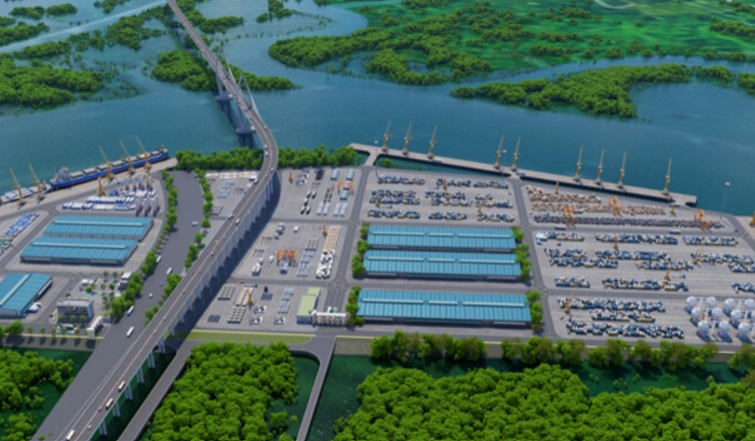
Ho Chi Minh City has commenced work on a major port development that underscores Vietnam's commitment to strengthening logistics infrastructure in its most economically vibrant region. The groundbreaking ceremony for the QTM International Port, a project valued at nearly VNĐ6.9 trillion (US$261 million), took place on July 5, signalling the city's determination to expand maritime capacity and improve connectivity across southern Vietnam's industrial corridor.
The facility will be situated within the Phu My Ward section of the broader Cai Mep-Thi Vai deep-water port complex, a strategic location that leverages existing infrastructure and proximity to major shipping lanes. The port's design specifications are ambitious: it will feature an annual throughput capacity of 16 million tonnes, distributed across a site spanning more than 80 hectares. Construction will unfold across two distinct phases, with completion targeted for 2034, allowing for systematic development and phased operational rollout that can adapt to evolving market demands.
The infrastructure component represents a significant modernisation effort. The completed port will include eight berths capable of accommodating large vessels of up to 60,000 deadweight tonnes, with design flexibility that permits future modification to handle ships reaching 100,000 DWT. Complementing the port facilities will be an integrated warehousing and logistics centre exceeding 190,000 square metres, creating a comprehensive ecosystem for cargo consolidation, distribution, and value-added services.
The investment reflects concrete response to shifting economic circumstances within Ho Chi Minh City. Recent administrative consolidation, which merged three adjacent localities into the municipal structure, has fundamentally altered transport requirements. Officials recognise that this territorial expansion has generated substantially higher demand for moving manufactured goods, raw materials, and finished products through the city's transport networks. Such structural changes necessitate corresponding expansion of port capacity to prevent bottlenecks that could constrain economic growth.
Quantifiable evidence supports the urgency of this expansion. During the first half of this year, cargo volumes transported through sea and inland waterway systems in Ho Chi Minh City increased by 7.3 per cent, demonstrating accelerating movement of goods that will strain existing capacity without corresponding infrastructure investment. Hoang Nguyen Dinh, vice chairman of the HCM City People's Committee, articulated this imperative during the ceremony, emphasising that the city must build a modern, integrated logistics network with robust connections to both regional and international markets to accommodate swelling demand.
The project gains additional significance when viewed through Vietnam's broader economic lens. Deputy Prime Minister Pham Gia Tuc highlighted that logistics expenses currently consume between 14 and 16 per cent of Vietnam's gross domestic product, a substantial drag on export competitiveness. Modern port infrastructure reduces handling costs, accelerates cargo movement, and improves reliability—factors increasingly critical as Vietnamese manufacturers compete globally. By lowering logistics expenses, port expansions like QTM contribute directly to enhancing export sector profitability and resilience.
Government officials have set an ambitious timeline for project execution. Deputy Prime Minister Tuc called on developers to accelerate construction and achieve operational status for the initial phase within 11 months, a compressed schedule designed to support Ho Chi Minh City's economic growth objectives, including achieving double-digit expansion rates. This aggressive timeline reflects confidence in the project's viability and determination to capture near-term economic benefits.
Ho Chi Minh City's maritime position provides substantial competitive advantages for port development. The city commands approximately 110 kilometres of coastline and operates one of Vietnam's largest maritime transport systems. The existing Cai Mep-Thi Vai complex ranks among the world's major container port hubs and maintains direct shipping services to Trans-Pacific and European trade routes, providing QTM with immediate access to global commerce networks that enhance its utility for Vietnamese exporters and importers.
The port's strategic position within Vietnam's economic geography deserves emphasis. As Ho Chi Minh City consolidates its role as the nation's primary economic engine, enhancing its logistics infrastructure becomes vital to sustaining growth momentum. The QTM port will serve not merely local demand but facilitate broader regional commerce, positioning southern Vietnam to capture increased trade flows within Southeast Asia and beyond. Investment in such infrastructure demonstrates government recognition that sustained economic competitiveness requires continuous modernisation of foundational systems that enable efficient commerce.

