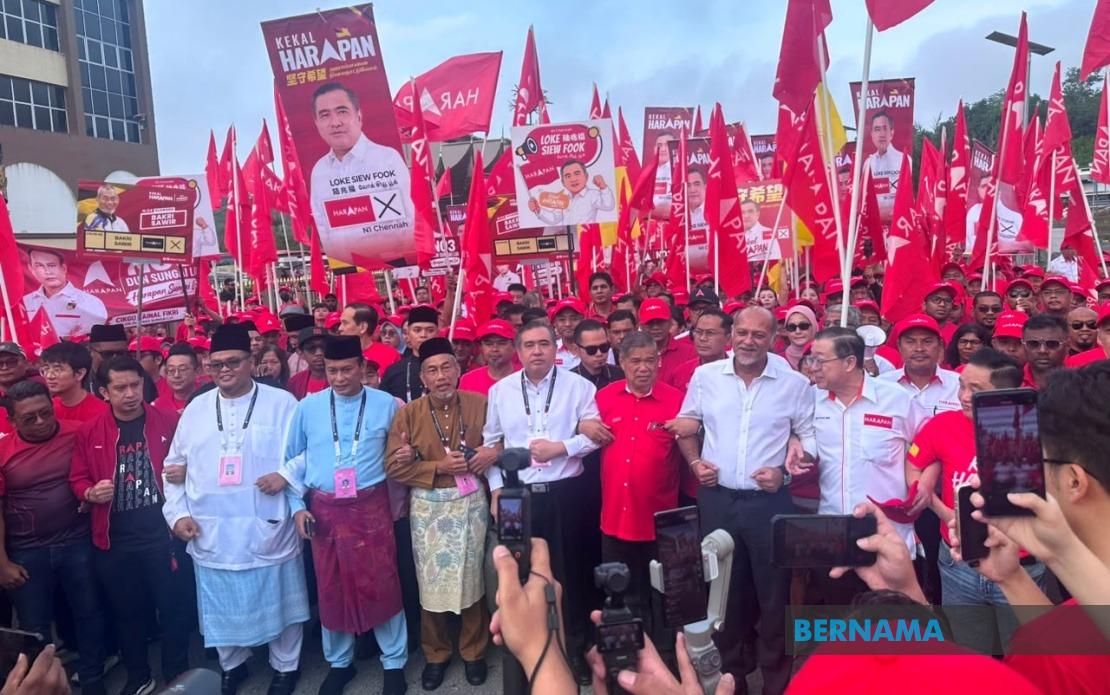
Senior figures from Pakatan Harapan orchestrated a coordinated show of support across Negeri Sembilan on July 18 as the coalition's election hopefuls formally submitted their nomination papers for the 16th state legislative assembly election. The strategic deployment of high-ranking PH leaders to multiple nomination centres underscored the coalition's determination to consolidate its hold on the state, where it controls the government following its 2023 victory. The carefully choreographed presence of ministers, party officials, and state heavyweights signalled both confidence in the coalition's electoral prospects and an effort to galvanise grassroots momentum ahead of the August 1 polling day.
Transport Minister Anthony Loke, who serves as DAP secretary-general, filed his nomination papers for the Chennah state seat in Jelebu, arriving at the Dewan Besar Kuala Klawang nomination centre at 8.30 am. His presence was reinforced by a constellation of party leadership, including DAP chairman Gobind Singh Deo, party adviser Lim Guan Eng, and Amanah president Mohamad Sabu. This concentration of senior figures around a single candidacy underscored the symbolic importance of the Jelebu district and reflected the need to project unity among PH's three major coalition partners as the election campaign intensified.
In the Jempol district, the arrival of Deputy Communications Minister Teo Nie Ching, who also heads the DAP's women's wing, signalled attention to the Bahau state seat nomination. She accompanied fellow PH candidate Teo Kok Seong as he lodged his papers at the Jempol District and Land Office. Communications Minister Fahmi Fadzil subsequently arrived to shepherd four additional PH nominees across constituencies including Serting, Palong, Jeram Padang, and Bahau itself. This multi-pronged approach to candidate support demonstrated the coalition's intention to contest across diverse electoral battlegrounds rather than concentrate resources narrowly.
Among the four candidates Fahmi accompanied, Teo held incumbent status from the previous general election in the Bahau seat, whereas Yaacob Mahmood, Muhammad Zahin Zinal Abidin, and Manivanan Gowin represented fresh faces seeking entry into the state legislature. This blend of experienced and emerging candidates reflected a deliberate PH strategy to balance continuity with renewal, allowing sitting representatives to leverage their track records while introducing new talent that might resonate with voters seeking fresh perspectives on governance.
Negeri Sembilan's state government was represented directly through Menteri Besar Aminuddin Harun, who arrived at the Port Dickson District Administration Complex nomination centre at 8.30 am to file for the Linggi state seat. His entourage included DAP deputy secretary-general Hannah Yeoh, PKR secretary-general Fuziah Salleh, and the Prime Minister's political secretary Farhan Fauzi. This gathering of federal and state party machinery illustrated how the nomination day transcended a mere administrative formality, functioning instead as a platform for demonstrating governmental coherence and political synergy at multiple administrative levels.
The Menteri Besar's attendance alongside three incumbent state assemblymen—Yew Boon Lye from Chuah, Choo Ken Hwa from Lukut, and Dr G Rajassekaran defending Sri Tanjung—reinforced the narrative of an incumbent administration seeking renewal based on demonstrated governance records. The decision to have sitting representatives formally refile suggests confidence in their electoral performance while acknowledging the competitive pressures that govern contemporary Malaysian state politics, where voter volatility has intensified since the 2023 general election.
Minister of Entrepreneur and Cooperatives Development Steven Sim coordinated six additional PH candidate nominations at the Wisma Majlis Bandaraya Seremban nomination centre, accompanied by Selangor State Legislative Assembly Speaker Lau Weng San, Bukit Gelugor MP Ramkarpal Singh, and PKR vice-president R. Ramanan. This particular gathering demonstrated how PH mobilised leadership resources beyond Negeri Sembilan's boundaries, drawing on prominent figures from neighbouring Selangor to amplify the coalition's electoral message and create visual representations of cross-state party coordination.
The nomination day activities occurred within a political context shaped by Negeri Sembilan's recent electoral history. The state assembly was dissolved on June 5 following approval from Yang Dipertuan Besar Tuanku Muhriz Tuanku Munawir, initiating the formal election cycle that culminates in the August 1 polling date, with early voting scheduled for July 28. In the 15th state election held in 2023, PH secured 17 of the 36 available seats, granting the coalition operational control of the legislature despite lacking an overwhelming supermajority. Barisan Nasional captured 14 seats whilst Perikatan Nasional won five, establishing a competitive tripartite contest that suggests the August 1 election will likely prove closely contested.
PH's 2023 performance, whilst securing governmental control, revealed underlying electoral vulnerabilities that the coalition must address. With only 17 seats out of 36, the government operates without substantial buffer against defections or shifting voter sentiment. The substantial opposition presence—combining BN's 14 seats and PN's five—means PH cannot afford complacency or take core constituencies for granted. The high-profile nomination day activity therefore reflected not merely ceremonial confidence but strategic necessity to energise party machinery, reassure grassroots supporters, and signal to wavering voters that the coalition possesses both governmental competence and internal cohesion warranting continued electoral support.
The deployment of ministers and high-ranking party officials across multiple nomination centres served multiple communicative functions beyond the formal filing of candidacy papers. Each appearance generated local media attention, provided photographic opportunities for party communications machinery, and demonstrated governmental commitment to specific constituencies. For voters in districts visited by federal ministers or state leaders, the symbolic message conveyed that Putrajaya and the state capital took their electoral preferences seriously and possessed confidence in PH's candidates to represent their interests effectively.
Looking ahead to the August 1 polling day, the coordinated nomination day activities established templates for campaign intensity that PH likely intends to sustain throughout the intervening period. The visible unity among DAP, PKR, and Amanah—PH's three major components—suggested the coalition has successfully navigated any internal tensions that might have emerged during candidate selection and is now projecting consolidated party discipline. In Malaysian state elections, where voter decision-making often hinges on local factors, perceived party unity and visible commitment from higher levels of government frequently influences electoral outcomes, particularly among swing voters assessing whether to maintain incumbent administrations or embrace alternative political configurations.

