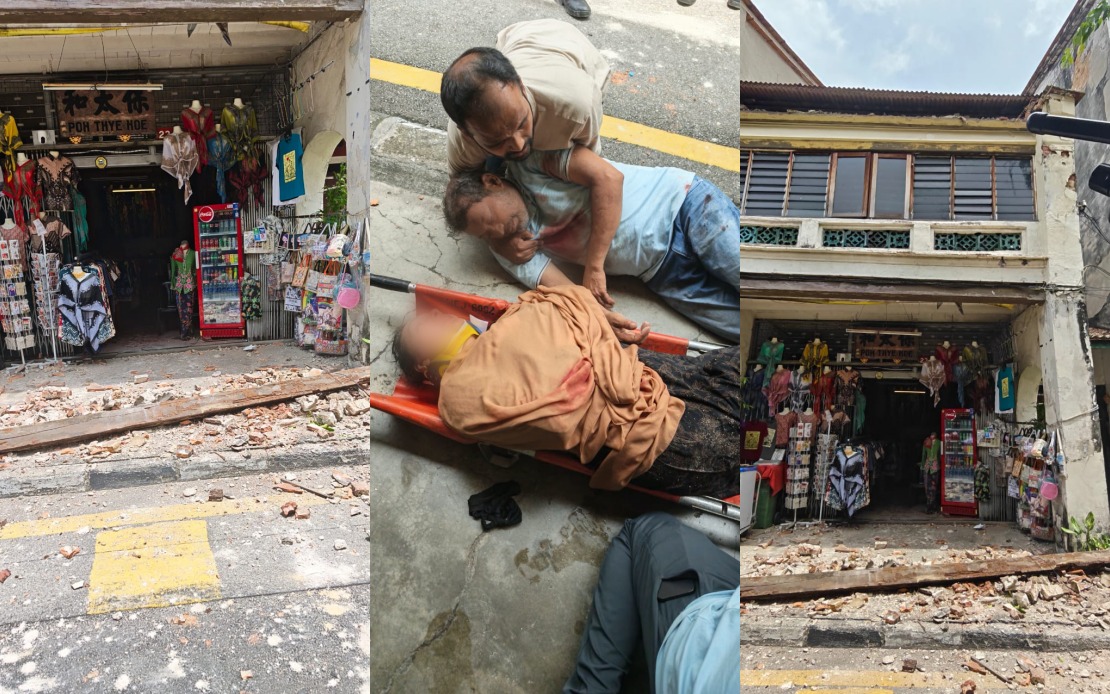
A structural failure at a historic building along Armenian Street in George Town has left two tourists nursing injuries and raised fresh concerns about the maintenance of Penang's ageing heritage stock. The incident occurred on August 4 when stones and timber from a deteriorating first-floor beam fell unexpectedly onto Mohamad Ammtar, 66, and Fatimah, 55, both visiting from Sri Lanka. Emergency responders reached the scene within minutes of the 1.11 pm distress call, with health ministry personnel providing immediate care before both victims were transported to Penang Hospital for further evaluation and treatment.
According to John Sagun Francis, assistant director of operations at the Penang Fire and Rescue Department, firefighters from the Lebuh Pantai station attended the scene and secured the area. The building in question, which housed a grocery operation on its ground floor, appeared to have been underutilised in its upper sections, suggesting a lack of active maintenance and regular structural oversight. The timing proved especially unfortunate for the two tourists, who had been scheduled to return to Sri Lanka the following day and were now facing an unexpected medical emergency during what should have been a leisurely visit to one of Southeast Asia's most culturally significant heritage destinations.
The collapse has thrust into sharp focus a persistent vulnerability in George Town's tourism infrastructure. While the UNESCO World Heritage Site attracts tens of thousands of international visitors annually, many of the eighteenth and nineteenth-century structures that constitute its primary appeal have received uneven levels of upkeep. Pedestrians wandering through narrow streets lined with shophouses and colonial-era buildings face genuine risks that have largely gone unquantified and unaddressed in coordinated fashion. This incident demonstrates that the danger is not theoretical but immediate and potentially serious.
State Tourism and Creative Economy Committee chairman Wong Hon Wai moved swiftly to signal governmental concern, announcing that both George Town World Heritage Incorporated and the Penang Island City Council (MBPP) would issue mandatory advisory notices to all heritage property owners across the state. The directive represents a significant escalation in official oversight, acknowledging that voluntary compliance and individual owner initiative have proven insufficient to ensure public safety. Wong's comments indicate that the state government recognises structural deterioration as a systemic rather than isolated problem requiring coordinated intervention across the heritage district.
The official response carries particular weight given the economic and cultural dimensions at stake. George Town's designation as a UNESCO World Heritage Site generates substantial tourism revenue and international prestige for Penang. A reputation for unsafe conditions would damage both visitor confidence and the state's competitive positioning against other regional heritage destinations. Wong emphasised that the government takes the incident seriously not merely because tourists were harmed, but because the breach occurred in a location explicitly recognised for its heritage value and frequented by both domestic and international guests.
Authorities have initiated contact with the Sri Lankan High Commission in Kuala Lumpur to coordinate support for the injured tourists and their families. This diplomatic engagement underscores official recognition that the incident carries implications beyond Penang's borders. While injuries in this case appear non-critical, a more serious outcome could have generated significant international complications and reputational damage for Malaysia's tourism sector. The proactive coordination suggests officials understand the potential for this incident to circulate negatively through international travel networks if not handled transparently and with genuine concern for affected parties.
Wong indicated that the state government is awaiting comprehensive investigative reports from relevant authorities to establish the precise cause of the structural failure. This determination will likely prove crucial in shaping future regulatory responses. The investigation should reveal whether the collapse stemmed from inadequate maintenance, design defects in the original structure, weather-related stress, or cumulative deterioration reflecting extended periods without professional inspection. Each scenario carries different implications for remedial action and prevention of similar incidents.
The broader challenge facing Penang's heritage preservation efforts involves reconciling multiple competing demands. Property owners often struggle with the expense of maintaining century-old structures while operating small commercial enterprises with tight profit margins. Regulatory requirements must be balanced against the financial viability of businesses operating from heritage premises. Yet public safety cannot be negotiated away. The state government's decision to mandate systematic inspections represents an acknowledgement that market forces and individual property owner judgment cannot be relied upon to maintain acceptable safety standards.
The announcement of inspection requirements signals a potential shift toward more active government involvement in heritage building management. While specifics remain unclear, such programmes typically involve professional engineers assessing structural integrity, identifying deficiencies, and issuing remediation orders with compliance deadlines. Enforcement mechanisms and financial support mechanisms for owners unable to fund necessary repairs will likely prove crucial to the programme's success. Without clear pathways for assistance, property owners facing expensive repairs might attempt to circumvent compliance or allow buildings to deteriorate further.
For Malaysian property owners throughout the region, this incident carries a cautionary lesson about liability exposure and the importance of professional maintenance. Heritage building ownership carries not only the satisfaction of preserving historical structures but also legal responsibilities toward public safety. Insurance considerations, property values, and personal legal exposure all hinge on demonstrable evidence of proper maintenance and regular professional inspection. The incident in George Town will likely prompt increased insurance scrutiny and may drive premium increases for heritage properties lacking comprehensive maintenance documentation.
The geographic context of Armenian Street amplifies the significance of this incident. As one of George Town's most photographed and visited streets, it concentrates foot traffic from multiple international and domestic tour groups daily. The collapse therefore affected an area of particularly high pedestrian density during peak visiting hours. Had the debris fallen during a busier period, or had a heavier piece become dislodged, consequences could have proven substantially more severe. This proximity to high-volume tourist pathways underscores why heritage district safety management deserves priority attention and resources.
As investigations proceed, the state government faces pressure to translate concern into concrete action. The inspection advisory represents an initial response, but sustained implementation will determine whether this incident catalyses meaningful improvement in heritage building safety standards. Penang's reputation as a premier heritage destination depends on protecting both its architectural legacy and the safety of those who come to experience it. The measures now underway will likely set precedents for heritage site management not only throughout Penang but across the wider region.

