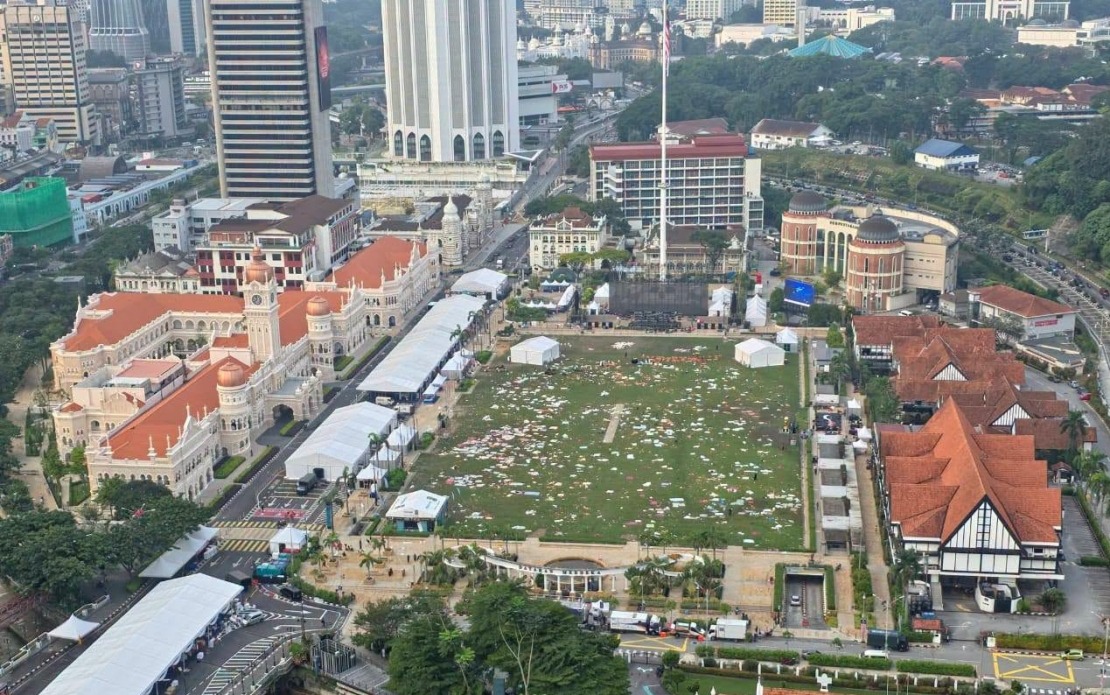
Federal Territories Minister Hannah Yeoh has praised the dedicated efforts of Kuala Lumpur City Hall workers who restored Dataran Merdeka to its former state following extensive littering that occurred during a public screening of the 2026 FIFA World Cup final. The cleanup operation underscores a broader conversation about the division of labour between government agencies and ordinary citizens in maintaining Malaysia's most iconic spaces.
Yeoh's commendation of DBKL staff was accompanied by a pointed reminder to the public that keeping shared spaces clean represents a fundamental civic responsibility that cannot be delegated solely to municipal workers. In a Facebook post, she articulated a distinction between the legitimate expectation of quality public services—a right taxpayers have earned—and the tendency to shift all maintenance duties to government employees. The minister stressed that this delineation is not merely administrative but speaks to the character and maturity of a nation's populace.
The incident at Dataran Merdeka illustrates a persistent tension in urban management across Malaysia and the broader Southeast Asian region. While city authorities maintain an obligation to provide professional cleaning and maintenance services, the volume and nature of post-event litter often exceeds reasonable operational expectations. By framing the issue as one of personal responsibility rather than service failure, Yeoh positioned the cleanup as an opportunity to examine public behaviour and cultural attitudes toward shared resources.
Dataran Merdeka holds significance that extends far beyond its function as an event venue. As the physical heart of Malaysia's independence and national identity, the space commands a symbolic importance that Yeoh invoked when describing it as a repository of the nation's history and a reflection of the capital's standing on the world stage. When the merdeka square becomes visibly degraded by rubbish, the damage is not only aesthetic but carries implications for how Malaysia presents itself internationally during major global events.
The minister's intervention also reflects broader aspirations embedded within the Malaysia MADANI framework, which emphasises not government unilateralism but rather a social contract in which both state institutions and citizens fulfill their respective obligations. Under this conceptualisation, national progress cannot be measured by infrastructure and development alone; it must encompass the habits, values, and behavioural norms that characterise society. A clean public space, maintained by conscious public action, becomes a marker of civilisational maturity.
Yeoh's messaging aligns with Prime Minister Anwar Ibrahim's frequently articulated position that development must be holistic and include measures of social responsibility and environmental stewardship. The Prime Minister has argued that nations advancing materially while regressing morally or socially ultimately undermine their own progress. The state of Dataran Merdeka after the World Cup screening provided an uncomfortable case study in this principle.
The practical dimension of the cleanup operation reveals the resource constraints faced by DBKL and similar municipal bodies across Malaysia. Deployment of additional sanitation teams, overtime costs, and equipment allocation following large public events represent significant budgetary pressures. When preventive action—citizens disposing of rubbish appropriately—is absent, reactive costs escalate. By appealing to public conscience, Yeoh sought to reframe waste management as a cost-sharing exercise in which prevention is infinitely preferable to remediation.
This episode also carries implications for Malaysia's capacity to host major international events successfully. The 2026 FIFA World Cup will involve matches and activities across multiple venues and cities. If large-scale public gatherings routinely result in environmental degradation requiring emergency cleanup operations, the nation risks projecting an image of disorganisation or inadequate civic culture. Yeoh's intervention thus serves a preventive purpose for future events.
The invocation of home and domestic space—"Kuala Lumpur is our home. Don't dirty our own home"—represents a rhetorical strategy intended to foster emotional investment in public spaces. Unlike abstract appeals to civic duty, framing the capital as a shared home taps into the same care instincts that prompt individuals to maintain their private residences. The metaphor bridges the gap between personal and collective responsibility by suggesting they operate on the same emotional and ethical plane.
Yeoh's statement also implicitly challenges a transactional view of citizenship prevalent in many societies, where individuals see themselves primarily as taxpayers entitled to services rather than as stakeholders obligated to contribute through daily actions. This perspective shift is particularly relevant in Malaysia, where rapid urbanisation has sometimes outpaced the development of corresponding civic consciousness in newly expanded urban centres. Recognising that service delivery and personal responsibility are complementary rather than mutually exclusive represents an important maturation of public discourse.
The response from DBKL itself, in efficiently managing the cleanup, demonstrated institutional competence and commitment. However, Yeoh's framing ensures that institutional performance is not allowed to become a substitute for individual behaviour change. Government agencies will continue performing essential maintenance functions, but the minister's intervention sends a signal that escalating expectations of service quality must be accompanied by rising standards of public conduct.
Moving forward, this incident provides a template for how Malaysian officials might address environmental and maintenance challenges in public spaces—not through blame-shifting or service reduction, but through appeals to shared national identity and collective self-interest. The success of this approach will likely depend on whether the message resonates beyond the immediate controversy and translates into changed behaviour at future large gatherings and events across the capital and beyond.

