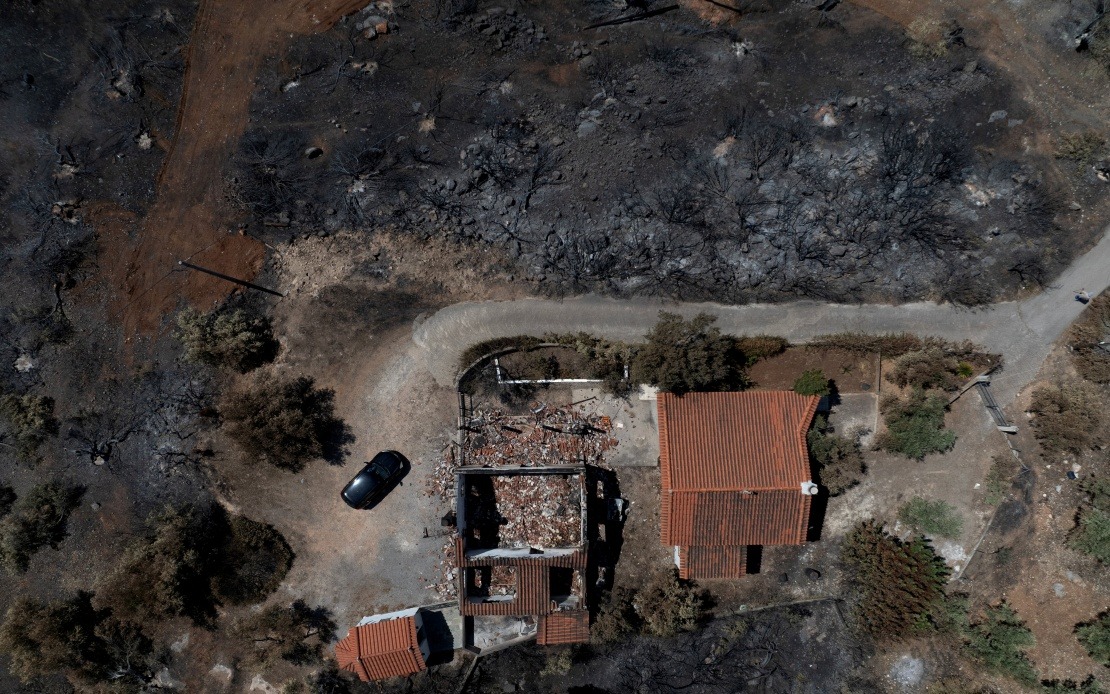
Greece has activated its most severe fire alert system for Thursday across three strategically important regions: Attica, Viotia, and Evia, including the capital Athens, reflecting the extraordinary danger posed by unseasonably severe weather conditions and tinder-dry vegetation. The General Secretariat for Civil Protection, which operates under the Climate Crisis and Civil Protection Ministry, has classified wildfire risk at the highest level—Category 4—signalling that authorities expect conditions capable of rapidly spreading uncontrollable fires across vulnerable landscapes.
The red alert framework represents a comprehensive mobilisation of Greece's disaster-response infrastructure, with the National Civil Protection Mechanism shifting into full operational mode. This involves coordinated deployment of personnel from the fire service, police force, and military branches conducting systematic patrols across at-risk terrain using both ground teams and aerial reconnaissance assets. The scope of preparation underscores the gravity of meteorological forecasts and the lessons learned from previous devastating fire seasons that have periodically swept across the Greek Mediterranean region.
To contain potential fire spread, authorities have implemented preventive traffic and access restrictions affecting vehicles and visitors attempting to enter forests and ecologically sensitive zones throughout the three designated regions. These measures aim to reduce accidental ignition sources and ensure that areas most vulnerable to catastrophic fire behaviour remain minimally disturbed during the critical forecast period. Simultaneously, officials have issued public advisories urging residents to refrain from any activities capable of igniting flames, from outdoor cooking to discarding cigarettes inappropriately.
The heightened alert emerges amid ongoing firefighting operations in multiple locations across the region. On Wednesday alone, emergency responders contained a wildfire that erupted near Korpi in the southeastern periphery of Athens, demonstrating the continuous threat level even as authorities prepare for Thursday's projected peak conditions. The Driggia area blaze, which ignited in low vegetation around 1:45 pm local time, required deployment of 52 firefighters including three specialised forest commando units, fourteen ground vehicles, four helicopters, and two water-dropping aircraft. Operations coordination involved thermal and optical drone surveillance while local water tankers supplemented aerial bombardment efforts, and an arson investigation team was mobilised to establish whether the fire resulted from deliberate action.
More troubling is the sprawling wildfire that began the previous week and has evolved into a major threat straddling the Viotia-Attica border. This multi-day conflagration has consumed approximately 14,424 hectares according to satellite monitoring by the European Union's Copernicus system, creating a fire footprint larger than many municipalities and generating significant air quality concerns across broader regions. The scale of this blaze reflects how rapidly Mediterranean fires can propagate under favourable atmospheric conditions and how resource-intensive suppression efforts must become to contain such incidents.
The ongoing Viotia fire has already exacted a human toll that extends beyond structural damage and ecological loss. During aerial combat operations against this sprawling blaze on Sunday, two firefighting helicopters collided midair in a tragedy that claimed the lives of a Danish pilot and a Greek aerial coordinator. The incident illustrates the extraordinary risks that emergency personnel voluntarily undertake while attempting to suppress conflagrations, particularly when multiple aircraft operate simultaneously over challenging terrain and in conditions where visibility and coordination become increasingly difficult. Such fatalities invariably prompt reviews of operational protocols and safety procedures across European firefighting services.
From a Southeast Asian perspective, the Greek wildfire crisis offers instructive parallels to challenges faced periodically across the Indonesian archipelago, Malaysia, and neighbouring regions, where transboundary haze and land-fire dynamics create both environmental and public health emergencies. Mediterranean fire dynamics differ substantially from tropical peatland combustion, yet the underlying vulnerability factors remain consistent: climate-driven shifts in precipitation patterns, extended dry seasons, vegetation stress, and the finite capacity of national emergency services to simultaneously manage multiple large fires. Greece's mobilisation strategy, emphasizing preventive restrictions and forward-deployed resources before conditions reach critical severity, reflects international best practices increasingly adopted across vulnerable regions globally.
The timing of the Greek red alert arrives during a broader European summer marked by intensifying heat waves and fire activity from Mediterranean countries through Scandinavia, prompting climate scientists to emphasise that these patterns reflect long-term warming trajectories rather than isolated anomalies. For regional observers in Malaysia and Southeast Asia, such developments underscore how climate change intersects with forestry management, land-use policy, and emergency preparedness systems across diverse geographical and economic contexts. The financial and human costs of large-scale wildfires—including suppression expenses, ecological recovery, air quality mitigation, and reconstruction—accumulate rapidly and often exceed initial budgetary allocations.
Greece's current posture of maximal alertness through Thursday reflects institutional learning from previous seasons when delayed recognition of extreme conditions permitted small fires to metastasise into region-threatening infernos. By pre-positioning resources, restricting public access to vulnerable zones, and maintaining continuous surveillance of fire-prone terrain, authorities aim to intercept ignition events before they achieve scale. Whether Thursday's forecast conditions materialise into widespread conflagrations or whether preparedness prevents major incidents, the declared red alert remains a demonstration of how modern civil protection systems attempt to manage the growing intersection between climate change and disaster risk across inhabited landscapes.

