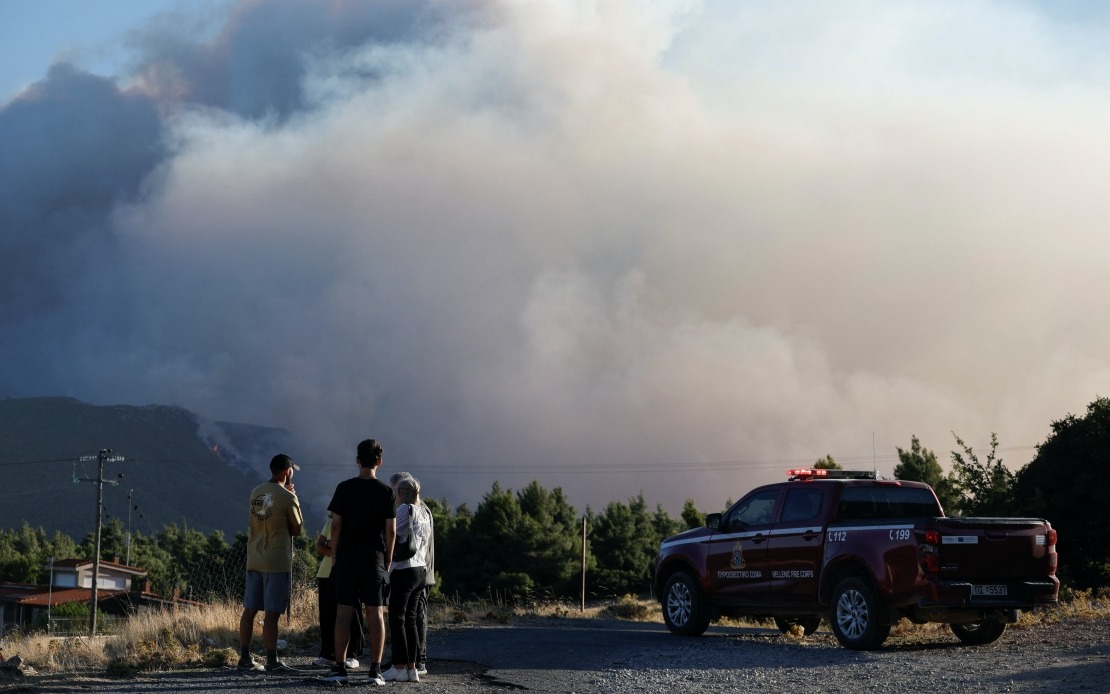
A sprawling wildfire raging west of Athens has forced Greek emergency services into a major mobilisation, with the crisis intensifying as flames advance eastward toward populated areas. The fire, which has consumed the Kithairon Mountains region overnight, represents one of Greece's most serious conflagrations in recent memory, drawing hundreds of emergency personnel and military support to contain the threat.
The scale of the response underscores the severity of the situation. At least 500 firefighting personnel are engaged in suppression efforts, bolstered by reinforcements from Romania and France who have deployed crews to assist their Greek counterparts. Military vehicles, heavy equipment, and volunteer responders worked through the night attempting to contain the advancing flames across terrain made increasingly difficult by strong winds that have pushed the fire's edges erratically across the landscape.
Weather conditions have proven a significant obstacle to containment efforts. Powerful wind gusts repeatedly drove the flames forward at accelerated speeds, particularly in the Veniza and Psatha areas where the fire's impact has been most devastating. The unstable conditions forced firefighting operations to pause during darkness, resuming only at daybreak when aerial assets could effectively rejoin the campaign. Aircraft and helicopters, grounded overnight, returned to action at first light, spraying water and retardant across threatened zones to slow the fire's progression.
The proximity of the flames to populated zones has created an urgent situation for local authorities. Megara, a city situated approximately 50 kilometres west of Athens proper, now faces direct threat as the fire moves inexorably eastward. With the flames reported to be only a few kilometres from the city's boundaries, evacuation protocols and defensive measures have likely been activated to protect residents and critical infrastructure. The potential for the fire to breach into suburban Athens would represent a dramatic escalation with severe consequences for the metropolitan region.
Investigations into the fire's origins have identified intentional misconduct as a contributing factor. Authorities have so far arrested 13 individuals across the country on charges related to negligent arson, suggesting that human carelessness or deliberate action played a role in initiating or exacerbating the crisis. These arrests reflect broader patterns of wildfire causation across the Mediterranean, where inadequate fire prevention awareness and occasional criminal negligence have repeatedly triggered major incidents during fire season.
The damage already sustained paints a grim picture of the wildfire's destructive capacity. Meteorological estimates cited in Greek media outlets indicate that approximately 10,000 hectares of land have been destroyed across the northwestern and western regions surrounding Athens. This vast area encompasses forests, agricultural land, and potentially rural settlements, representing significant environmental and economic losses. The precise extent of property destruction remains unclear as the situation unfolds, though preliminary assessments suggest extensive devastation.
Greece is simultaneously grappling with multiple fire fronts across its territory. The island of Cephalonia is experiencing its own major wildfire, though authorities assess that no towns currently face imminent threat there. More positively, the wildfires that consumed portions of Crete appear to have been largely extinguished, though not before exacting a heavy toll. Media reports indicate that up to 200 homes were destroyed in the Crete fires, and several communities were forced to evacuate their populations as the flames approached.
For Malaysian and Southeast Asian observers, the Greek wildfire crisis illustrates the escalating severity of climate-driven environmental emergencies affecting developed nations across the Mediterranean and beyond. Southern Europe has increasingly experienced extreme heat and drought conditions that create ideal conditions for rapid wildfire propagation, a pattern that regional meteorologists attribute partly to broader climatic shifts. The international coordination required to manage such crises—with Romanian and French crews supporting Greek operations—demonstrates how catastrophic natural disasters transcend national boundaries and demand cooperative responses.
The episode also highlights vulnerabilities within urban planning and emergency management frameworks even in relatively advanced European economies. Cities and towns positioned near forested or mountainous terrain face periodic exposure to wildfire risk, a reality that demands sophisticated early warning systems, evacuation capabilities, and resource pre-positioning. The speed with which these fires can advance toward populated zones, as demonstrated by the Megara situation, leaves narrow windows for effective emergency response.
Longer-term implications for Greece and other Mediterranean nations point toward the necessity of enhanced fire prevention infrastructure, forest management practices, and investment in aerial firefighting capabilities. The financial and human costs of reactive wildfire suppression, while sometimes unavoidable, are substantially greater than costs associated with proactive risk reduction and landscape management. As climate patterns continue shifting, communities throughout Southern Europe are discovering that traditional approaches to land management and emergency preparedness may prove insufficient for emerging challenges.

