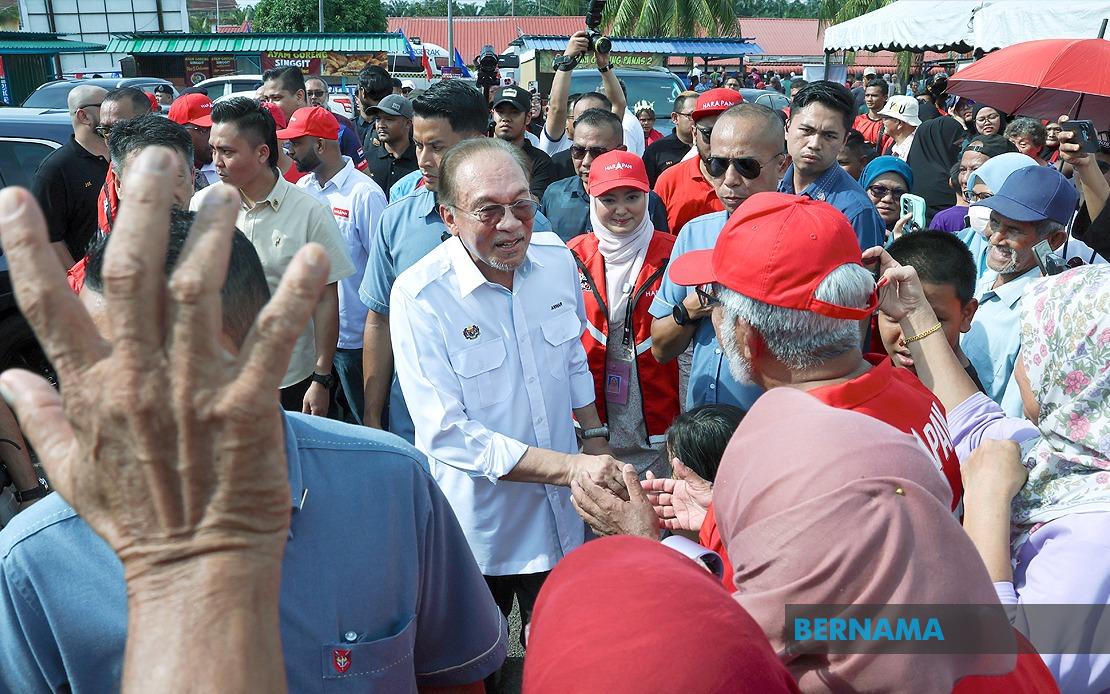
A grandmother's determination to see her grandson's dream realized has resulted in an encounter that may well become a defining moment in the boy's childhood. Rosimah Mohammad, 58, from Kampung Pudu in Segamat, undertook an unconventional journey on her motorcycle through oil palm plantations to bring Muhammad Afif Ikhwan, her nine-year-old grandson, to a public programme where Prime Minister Datuk Seri Anwar Ibrahim was scheduled to appear. The effort proved worthwhile when young Muhammad Afif not only shook hands with his idol but was invited onstage to stand beside the Prime Minister during his speech at Felda Palong Timur on Sunday.
For Muhammad Afif, the anticipation leading up to the encounter was almost unbearable. His grandmother recalled how the child struggled to sleep the night before, his mind consumed with the possibility of finally meeting the person he had admired from afar. The anxiety and excitement that gripped him spoke volumes about what this moment represented—not merely a chance encounter with a political figure, but validation of a deeply held aspiration. When the family arrived at the venue, Rosimah and her grandson positioned themselves strategically along the path to the stage, hoping for at least a glimpse of the Prime Minister.
What transpired exceeded even their most optimistic expectations. As Anwar made his way toward the stage, greeting constituents along the route, young Muhammad Afif summoned the courage to push through the crowd and extend his hand. The Prime Minister responded warmly to the boy's gesture, grasping his hand in greeting. But the interaction did not end there. Recognizing the child's genuine enthusiasm, Anwar made the impulsive decision to invite Muhammad Afif onto the stage to accompany him during his address to the gathered crowd. For Rosimah, watching her grandson stand beside the nation's leader represented the culmination of months of hope and a single day of determined effort.
The emotional weight of the moment was not lost on those present. Rosimah described the visible transformation in her grandson's demeanor as he ascended the stage—the shock, the joy, the overwhelming realization that his dream had materialized in ways he could scarcely have imagined. The memory has already become precious to the young boy, who reportedly clutches the shirt he wore that day to his chest each evening, a tangible reminder of an encounter that transcended the ordinary.
Word of this touching story eventually reached the Prime Minister's office, prompting further action. Rather than allowing the encounter to fade into memory, Anwar requested that a formal follow-up visit be arranged. PKR deputy information chief Siti Aishah Shaik Ismail represented the Prime Minister during a visit to Muhammad Afif's home in Kampung Pudu, delivering a carefully selected assortment of gifts. The package included a bicycle, a school bag, and a pair of shoes—practical items chosen with the understanding of what a nine-year-old boy would value and use. These gifts were presented at Anwar's specific instruction, underscoring that the gesture was driven by the Prime Minister's own desire to further acknowledge the boy's earnest admiration.
The story serves as a reminder of the impact that political leaders can have on young citizens when they respond authentically to genuine expressions of respect and interest. In an era often characterized by cynicism toward public figures, the straightforward admiration of a child and the receptiveness of a leader to that admiration created a moment of genuine human connection. This encounter between a boy and the nation's Prime Minister transcends typical political theater, offering instead a glimpse of the influence that such figures can wield in shaping the aspirations and memories of young Malaysians.
For residents of Segamat and the broader Johor region, this story also highlights the accessibility of national leadership. The fact that a Prime Minister would take time during a public programme to engage meaningfully with a young constituent demonstrates a willingness to step outside formal protocol to acknowledge the hopes of ordinary citizens. This interaction, captured in a single handshake and a brief stage appearance, represents a form of democratic engagement that many in Southeast Asia find increasingly rare.
Rosimah's decision to use her motorcycle as a vehicle of opportunity, literally traversing through agricultural land to reach the venue, speaks to the lengths that Malaysian families continue to go in pursuit of their aspirations. The oil palm estate journey, rather than being an obstacle to her plan, became part of the narrative of determination and love that characterizes her willingness to support her grandson's dreams. Such stories, when amplified through media coverage, reinforce certain cultural values around family support and the pursuit of meaningful goals.
The follow-up visit and gift presentation ensure that this experience extends beyond a fleeting moment at a public event. By returning to Muhammad Afif's home community, the Prime Minister's office effectively validated the significance of the encounter and demonstrated that the boy's admiration had made a genuine impression. In a political landscape where constituent engagement is often measured through formal channels and institutional frameworks, this personalized approach offers a different model of connection.
Moving forward, Muhammad Afif will carry multiple layers of memory from this experience—the initial journey with his grandmother, the momentary connection with his idol, the unexpected stage appearance, and now the gifts delivered to his home. Each element reinforces the narrative of a dream realized through a combination of family support, chance, and the willingness of a national leader to engage authentically. For a nine-year-old boy in a small community in Segamat, such memories become foundational to how he understands his place within the broader Malaysian political landscape and his relationship to figures of national importance.

