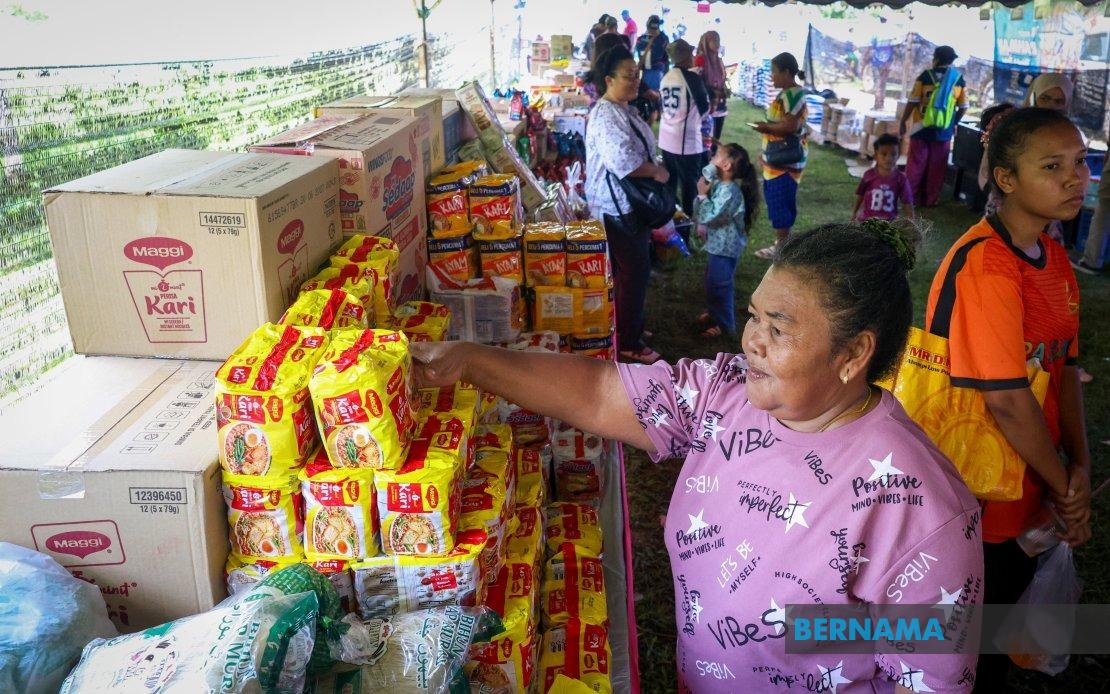
More than 1,000 Temiar Orang Asli residents at the Pasik Resettlement Scheme (RPS) in Gua Musang are now benefiting from subsidised essential goods brought directly to their community through the Rahmah MADANI Sales Programme (PJRM), a government initiative aimed at easing the financial strain on low-income households across Malaysia's remote settlements.
Before this programme's arrival at Pasik RPS, residents faced a gruelling two-and-a-half-hour journey to Kampung Jerek whenever they needed to purchase basic necessities. Kampung Ayong resident Ramli Chimbong, 51, described the practical hardship this created for his community. Beyond the physical exhaustion of the extended travel, villagers incurred substantial additional expenses—vehicle rental, meals, and miscellaneous costs—that often totalled at least RM600 per trip. These hidden expenses effectively multiplied the original price of goods, making even government-subsidised products feel unaffordable to families living on modest incomes.
The arrival of PJRM at Pasik RPS represents a meaningful shift in accessibility for these remote communities. Ramli noted that the price differential between local village merchants and the programme's offerings is dramatic. A nine-kilogramme bag of rice, which typically sells for RM40 in neighbourhood shops, costs only RM29 through PJRM—a saving of approximately 28 percent on a staple food item. This substantial reduction carries real implications for household budgets in an area where income opportunities remain limited and living costs have risen significantly.
The logistical operation unveiled by SMS Maju Solution, the company managing the Pos Pasik distribution point, demonstrates the scale of government investment in reaching underserved populations. For the initial programme rollout, the company transported 100 different types of essential goods, including 300 bags of rice, 300 trays of eggs, and 300 chickens. The turnout began early in the morning, with residents queuing from 9 am onwards, indicating strong demand for affordable supplies within the settlement. SMS Maju Solution owner Sabariah Mohamed Sayuti observed that many residents retained substantial balances in their Rahmah Basic Contribution (SARA) accounts—between RM300 and RM800—suggesting that previous barriers to access rather than insufficient credit had prevented wider programme uptake.
The SARA system, which credits eligible households with subsidised purchasing power through their MyKad identification, appears to have functioned effectively as a distribution mechanism. Sabariah noted that instances of depleted SARA balances were relatively rare among Pasik residents, implying that the community had been unable to utilise these government credits due to geographical isolation. The arrival of a mobile distribution point effectively unlocked this dormant purchasing capacity, converting paper entitlements into tangible consumer benefits.
Operational challenges nevertheless accompanied the programme's expansion into remote areas. The rocky and muddy road conditions at Pasik RPS proved demanding, resulting in a punctured tyre on one of the supply vehicles. This incident underscores the infrastructure disadvantages facing Orang Asli settlements and suggests that sustained programme delivery may require ongoing logistical investment and vehicle maintenance reserves. Yet despite these obstacles, the willingness of service providers to absorb such challenges indicates a broader government commitment to inclusive economic policy.
Nenggiri assemblyman Mohd Azmawi Fikri Abdul Ghani framed the PJRM expansion as part of a wider strategy to stabilise living costs in rural areas experiencing rapid inflation. Rural and remote communities typically face a cost-of-living penalty—higher retail markups, transportation surcharges, and limited competition among vendors—that urban consumers avoid. Government-sponsored bulk purchasing and direct delivery programmes partially address this structural inequality by compressing price margins at the point of sale.
The broader policy context reveals evolving government thinking around targeted assistance. Rather than universal subsidies that benefit all income groups, programmes like PJRM concentrate resources on verified low-income households, improving fiscal efficiency. The focus on Orang Asli settlements specifically acknowledges that this population faces compounded disadvantages—historical marginalisation, limited economic opportunities, and geographic isolation—that conventional market mechanisms do not adequately address.
For Malaysian readers observing regional development patterns, the Pasik RPS initiative demonstrates how decentralised service delivery can extend state capacity into areas government systems traditionally struggled to reach. The reliance on private sector partners like SMS Maju Solution, combined with government-issued purchasing credits, creates a hybrid model that leverages both public resources and commercial logistics expertise. This approach holds potential applicability across Southeast Asia's dispersed indigenous and rural populations.
Looking ahead, Mohd Azmawi Fikri's call for programme expansion to all Orang Asli settlements signals official recognition that current coverage remains incomplete. With multiple recognised Orang Asli settlements across Peninsular Malaysia, systematic rollout could affect several hundred thousand individuals. This represents both a fiscal commitment and an implicit acknowledgment of how market-driven distribution systems inadvertently exclude the poorest and most isolated communities.
The Pasik RPS programme ultimately illustrates a modest but meaningful policy response to intersecting challenges of rural poverty, inflation, and geographic disadvantage. By bringing subsidised goods directly to communities rather than requiring residents to travel to urban distribution points, the government reduces transaction costs and improves programme effectiveness. Whether scaled expansion can maintain this service quality while controlling costs will shape the initiative's long-term viability as a model for inclusive rural development.

