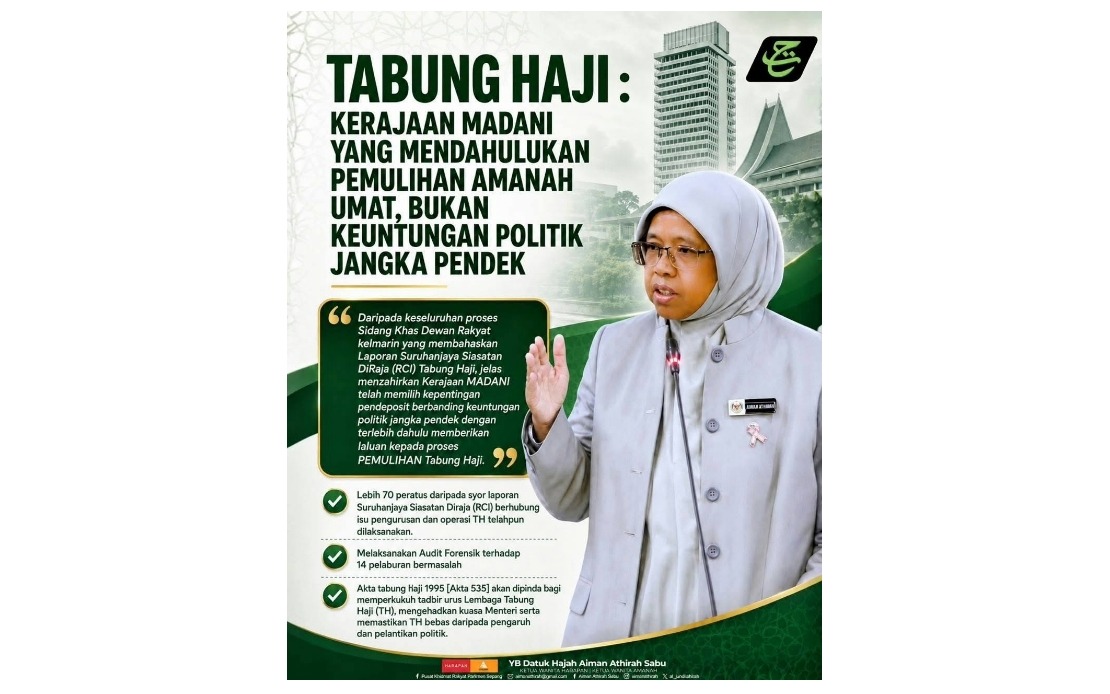
The federal government's measured approach to disclosing findings from the Tabung Haji Royal Commission of Inquiry reflects a deliberate choice to shield depositors' interests from political opportunism, according to Datuk Aiman Athirah Sabu, the Deputy Minister of Housing and Local Government. Speaking through a Facebook post on August 12, she articulated the administration's rationale for exercising caution with the report's release, emphasising that precipitous disclosure could jeopardise the stability of an institution safeguarding the savings of more than 10 million Malaysians.
The strategic restraint stems from hard-learned lessons. In 2018, panic withdrawals totalling over RM6 billion swept through Tabung Haji following revelations of governance deficiencies, demonstrating how institutional vulnerabilities can trigger cascading financial distress among retail depositors. By prioritising stabilisation measures ahead of full transparency, the government aims to prevent a recurrence of such destabilising events whilst simultaneously addressing systemic weaknesses. This dual imperative—restoring institutional health whilst managing public perception—represents the underlying tension in handling sensitive developments affecting a fund that occupies unique cultural and religious significance for Malaysia's Muslim majority.
Tabung Haji operates as more than a conventional savings institution. Its role as custodian of deposits earmarked for the hajj pilgrimage—the fifth pillar of Islam—elevates its institutional importance beyond mere financial considerations. Aiman Athirah underscored this distinction, arguing that governance decisions concerning Tabung Haji cannot be evaluated through the narrow lens of political advantage or media cycles. Instead, she contended, such decisions demand calibration around the institution's capacity to fulfil its sacred trust toward millions of Malaysian Muslims aspiring to perform one of their faith's most important obligations.
The government's broader strategy encompasses tangible remedial action. During a special parliamentary sitting, Second Finance Minister Datuk Seri Amir Hamzah Azizan disclosed that Tabung Haji had accumulated approximately RM13 billion in losses attributable to 14 troubled investments, with seven entirely wiped out. The government had absorbed RM10.2 billion through a 2018 rescue mechanism involving Urusharta Jamaah Sdn Bhd, whilst Tabung Haji itself absorbed a further RM2.6 billion in impairment losses spanning 2018 to 2025. These figures underscore the magnitude of historical mismanagement now being systematically addressed.
Progress in financial recovery furnishes grounds for qualified optimism. Tabung Haji's investment income reached a record RM4.64 billion in 2025, whilst profit distribution ratios expanded substantially from 1.25 per cent in 2018 to 3.5 per cent last year. Critically, the cost of hajj packages has been maintained at RM33,000 across three consecutive seasons despite inflationary pressures in management expenses, insulating depositors from tariff escalation. These metrics suggest that institutional recovery is gaining momentum, providing a firmer foundation upon which to eventually release investigative findings without triggering fresh instability.
Government officials have already signalled implementation of the Royal Commission's recommendations on a substantial scale. Minister in the Prime Minister's Department (Religious Affairs) Dr Zulkifli Hasan revealed during the special parliamentary sitting that more than 70 per cent of inquiry recommendations concerning Tabung Haji's management and operational frameworks have been executed. Amongst these measures are forensic audits of the 14 troubled investments, designed to furnish comprehensive documentation of losses, causal factors, and accountability mechanisms. Such investigative rigour, though administratively intensive, aims to prevent future institutional capture and restore public confidence systematically.
Legislative strengthening underpins the government's governance agenda. The administration has committed to amending the Tabung Haji Act 1995 to recalibrate power distributions, curtail ministerial discretion, and erect firewalls against political encroachment. These structural reforms address root causes rather than merely treating symptoms. By institutionalising independence and professional management standards, successive governments would find it progressively difficult to instrumentalise Tabung Haji for political purposes or to implant loyalists into decision-making structures—problems that earlier inquiries and oversight reports have identified repeatedly.
Criticism from certain political quarters has complicated the disclosure timing question. Parti Islam Se-Malaysia (PAS) and Parti Wawasan Negara (Wawasan) have questioned why the full report remains unpublished, framing the delay as obfuscation. Aiman Athirah countered these objections as politically motivated rhetoric divorced from institutional realities. She characterised the controversy as fundamentally distinct from ordinary administrative matters, noting that the Yang di-Pertuan Agong Sultan Ibrahim's own intervention underscored the seriousness of governance lapses uncovered. Royal engagement suggested that findings transcended typical bureaucratic shortcomings, warranting careful rather than rushed disclosure.
Opposition lawmakers' decision to walkout during the special parliamentary sitting drew particular criticism from Aiman Athirah, who characterised the gesture as irresponsible given the delicate balancing act between transparency and stability. She implied that partisan posturing over procedural timing detracted from substantive focus on depositor welfare and institutional reform. The disagreement reflects broader tensions between demands for immediate full disclosure and arguments for sequenced, stabilisation-conscious information release—a dichotomy particularly acute when public institutions have been compromised and confidence restoration remains fragile.
The Malaysian context amplifies these tensions uniquely. Tabung Haji occupies an irreplaceable position in facilitating religious obligations for millions whilst channelling substantial savings flows through formal financial architecture. Unlike purely commercial institutions, Tabung Haji failure would reverberate not merely through balance sheets but through the deferred aspirations of families across the country whose hajj journeys depend upon accumulated savings. This distinctive social-religious dimension justifies governance frameworks differing from those applied to conventional banks or investment vehicles, though without compromising ultimate transparency or accountability.
Regional observers monitoring institutional reform across Southeast Asia will find the Tabung Haji trajectory instructive. Many developing economies across the region manage state-linked savings institutions entrusted with culturally significant deposits. The manner in which Malaysia navigates disclosure, remediation, and reconstruction of depositor confidence could establish precedents and lessons applicable elsewhere. The integration of forensic investigation, legislative amendment, and sequenced transparency represents a model responsive to both institutional health and public trust—though success ultimately depends upon whether recovery metrics translate into sustained credibility and whether governance reforms prove resistant to future political pressure.
Moving forward, the government's credibility increasingly hinges on delivering legislative amendments, completing forensic audits, and eventually releasing the full Royal Commission report alongside comprehensive reform implementation. Aiman Athirah's defence of current strategy implicitly acknowledges that indefinite deferral would itself erode confidence. The administration must demonstrate that measured pace reflects genuine institutional stabilisation rather than political convenience—a distinction that disclosure timing and reform advancement will ultimately determine.

