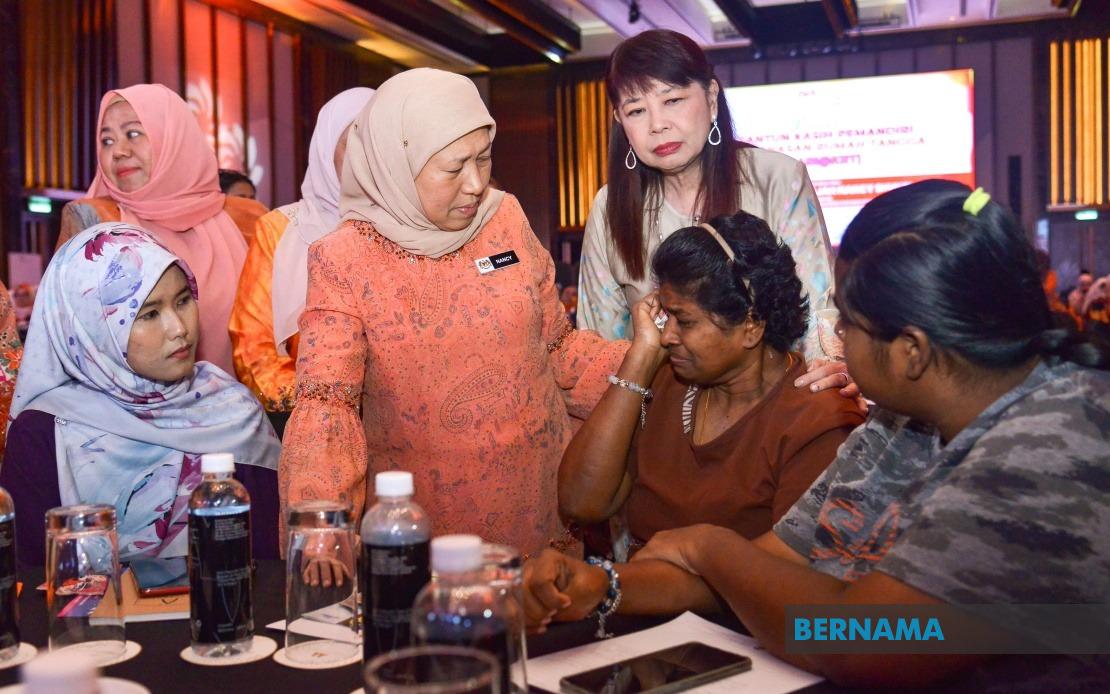
The Ministry of Women, Family and Community Development has officially launched SARI@KRT: Road to Eliminate Violence Against Women (EVAW) 2026, an ambitious initiative aimed at providing comprehensive support to roughly 1,400 survivors of domestic violence throughout Malaysia. According to Minister Datuk Seri Nancy Shukri, the programme represents a strategic shift in how the government addresses one of the nation's persistent social challenges, moving beyond awareness campaigns towards active rehabilitation and empowerment of affected individuals.
The initiative will recruit a minimum of 100 participants from each state, with a carefully structured approach that integrates three core pillars: strengthening psychosocial support services, providing robust legal assistance, and creating pathways for economic independence. Shukri emphasised that the government's overarching philosophy is to ensure victims no longer endure their suffering silently, but instead receive comprehensive guidance and confidence-building support to help them overcome the psychological trauma associated with abuse.
The minister articulated a vision extending beyond conventional victim support frameworks. She stressed that the programme aims to demonstrate to survivors that solutions exist for every crisis they encounter, provided they access the appropriate institutional channels and support systems. This approach acknowledges that recovery from domestic violence involves not merely immediate safety measures, but sustained intervention addressing emotional rehabilitation, legal rights, and long-term financial independence. The government's commitment, Shukri stated, encompasses guiding participants towards self-reliance and facilitating their transition into safer, more autonomous lives.
Recent statistics from the Royal Malaysia Police reveal a troubling escalation in domestic violence incidents. Between January and June 2024, authorities recorded 4,014 cases nationwide, representing a notable increase from the 3,678 cases reported during the identical period in 2023. This eight-percent rise underscores the magnitude of the challenge facing Malaysian society and validates the urgency of comprehensive intervention programmes like SARI@KRT. The geographic distribution of cases indicates significant regional variation, with Johor experiencing the highest concentration at 721 incidents, followed by Selangor with 614 cases and Perak with 405 cases during the first half of the year.
Analysis of causative factors provides valuable insight into domestic violence dynamics in Malaysia. Misunderstandings and communication breakdown emerged as the predominant triggers, accounting for approximately 1,967 cases or nearly half of all incidents. Substance abuse issues followed as the second leading factor, contributing to 444 reported cases, while financial stress accounted for 378 incidents. These statistics suggest that relationship quality, economic pressures, and substance-related problems form an interconnected web of vulnerability factors that increase the likelihood of violent confrontation within households.
Shukri presented an important interpretative framework regarding the rising case numbers, suggesting that increased reporting statistics may partially reflect greater public consciousness about domestic violence and increasing willingness among victims to seek institutional intervention. Rather than viewing the rise solely as a worsening social problem, she positioned it partly as evidence of successful awareness campaigns and shifting cultural attitudes that encourage survivors to report abuse rather than enduring violence in silence. This nuanced perspective acknowledges that institutional visibility of domestic violence partly reflects changing victim behaviour and societal attitudes rather than an exclusive reflection of rising incident rates.
Financial abuse emerged as a particular area warranting ministerial attention. Shukri identified situations where husbands possess financial capability but deliberately withhold household support, forcing spouses to independently shoulder all family expenses, as constituting a distinct form of abuse. This recognition broadens the traditional understanding of domestic violence beyond physical or emotional harm to encompass economic coercion and control. She emphasised that financial responsibility for families represents a shared obligation requiring commitment from both spouses, and that deliberate failure to provide support when capable constitutes exploitative behaviour requiring intervention.
To facilitate survivor participation in legal proceedings, the Ministry has established a special financial allowance programme enabling domestic violence survivors to attend court hearings related to child maintenance claims. This practical support mechanism addresses a significant barrier that previously prevented many survivors from pursuing legitimate legal remedies. By removing the financial obstacles to court participation, the government acknowledges that access to justice requires not merely legal frameworks but also concrete resources enabling disadvantaged individuals to navigate judicial systems effectively.
The SARI@KRT programme represents a comprehensive policy response addressing multiple dimensions of domestic violence support. By integrating psychosocial rehabilitation, legal assistance, and economic empowerment within a single coordinated framework, the initiative recognises that survivor recovery involves simultaneous attention to emotional healing, rights protection, and financial independence. The targeting of at least 100 participants per state ensures that support reaches beyond major urban centres to encompass survivors throughout Malaysia's diverse geographic and socioeconomic landscape.
For Malaysian readers, the programme's significance extends beyond immediate victim support to implications for family stability, gender equality, and social cohesion more broadly. Domestic violence imposes substantial economic costs through healthcare utilisation, legal system expenditure, and lost productivity, while inflicting immeasurable human suffering. The SARI@KRT initiative signals the government's recognition that addressing violence within households requires systematic, adequately resourced intervention rather than piecemeal responses. Whether the programme achieves its ambitious targets will significantly influence Malaysia's capacity to reduce family violence prevalence and support survivors' successful reintegration into productive social and economic roles.

