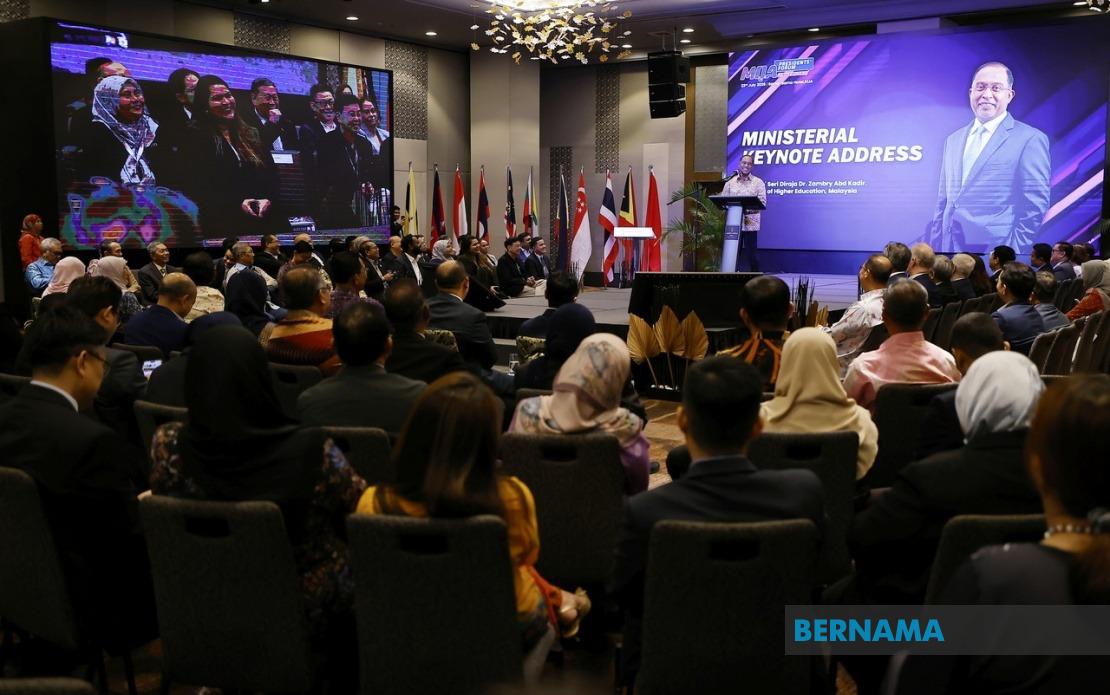
Datuk Seri Dr Zambry Abd Kadir, Malaysia's Higher Education Minister, has underscored the government's unwavering commitment to protecting academic freedom and nurturing intellectual discourse within the nation's universities. Speaking at a public lecture hosted in Putrajaya on July 23, Zambry emphasized that tertiary institutions must function as platforms where varied perspectives can be examined and contested in an atmosphere of mutual respect and responsibility.
The minister's remarks came during a lecture titled Muslim Identity in a Globalised World, delivered by Columbia University professor Dr Joseph A. Massad. This event exemplified the ministry's broader strategy of inviting prominent international scholars to engage with Malaysian academic communities and contribute to global conversations on complex issues. Such initiatives, Zambry suggested, form a crucial part of strengthening the nation's position within the international academic ecosystem.
According to Zambry, academic freedom inherently carries with it a corresponding obligation of intellectual responsibility. Universities cannot operate as spaces where anything goes; rather, they must function as environments where rigorous debate is conducted with civility, evidence-based reasoning, and genuine consideration for alternative viewpoints. This framing acknowledges a fundamental tension in contemporary higher education—the balance between unfettered expression and accountability—that remains particularly relevant for Malaysian institutions navigating complex social and political landscapes.
Malaysia's distinctive position as a plural and multicultural society, Zambry argued, makes the promotion of informed dialogue and cross-cultural understanding through academic engagement not merely desirable but essential. The nation's history of religious, ethnic, and cultural diversity offers both opportunities and challenges for universities seeking to facilitate substantive intellectual exchange. When citizens and scholars engage seriously with ideas rooted in different traditions and perspectives, the potential emerges for deeper mutual comprehension and more sophisticated policy-making.
The minister acknowledged that disagreement and differing opinions are inevitable, particularly in an era dominated by rapid technological change and the proliferation of social media platforms. Artificial intelligence and digital communication tools have democratized the spread of information while simultaneously fragmenting the spaces where shared understanding traditionally developed. Yet Zambry suggested that Malaysians have historically demonstrated a capacity to disagree on specific matters while maintaining broader agreement on foundational principles and shared values.
Zambry's invocation of the phrase "we agree to disagree"—a concept deeply embedded in multicultural societies—underscores a philosophical approach that attempts to balance individual conviction with social cohesion. Rather than treating disagreement as a threat to national unity, this framework treats it as an inevitable and manageable feature of diverse societies. This perspective carries implications for how Malaysian universities structure their academic policies, from student conduct expectations to faculty hiring and research prioritization.
The Higher Education Ministry, Zambry indicated, plans to continue actively recruiting distinguished international scholars and facilitating their engagement with Malaysian academic communities. This open-door approach to global intellectual exchange reflects a particular vision of how Malaysia might position itself regionally and globally—not as a country that restricts idea-sharing or limits exposure to foreign intellectual traditions, but as one that welcomes rigorous engagement with scholarship from around the world. Such positioning has strategic implications for Malaysia's soft power and its attractiveness to international students and researchers.
The lecture by Professor Massad, focusing on Muslim identity within an increasingly globalized context, represents precisely the type of international scholarly engagement that Zambry characterized as beneficial. Issues surrounding religious identity, secularization, and global cultural integration have profound implications for Malaysia, a Muslim-majority nation with significant non-Muslim populations. By providing platforms for distinguished foreign scholars to examine such topics, Malaysian universities can benefit from comparative perspectives while contributing their own insights to global academic conversations.
Zambry's emphasis on evidence-based reasoning and civil discourse takes on heightened significance in an information environment marked by misinformation and polarized rhetoric. By insisting that robust debate must be grounded in evidence and conducted with respect, the minister articulated a commitment to maintaining academic integrity at a time when the epistemological foundations of universities face pressures from multiple directions. This stance implicitly acknowledges that academic freedom exists not as an absolute value but within a framework of professional standards and ethical obligations.
The government's positioning on academic freedom also reflects broader international trends. Universities globally face complex negotiations between protecting intellectual inquiry and addressing concerns about harmful speech, ideological imbalance, or research that some constituencies find objectionable. Malaysia's approach, as articulated by Zambry, attempts to thread this needle by endorsing freedom while insisting on responsibility. Whether this framework proves sufficient to navigate future tensions between openness and concerns about divisive discourse remains an open question for Malaysian higher education.
The invitation to prominent international speakers and Zambry's rhetorical defense of academic freedom suggest that Malaysian policymakers recognize the competitive pressures facing the nation's universities in attracting talent and maintaining research quality. Regional competitors, particularly Singapore and Australia, have successfully positioned themselves as hubs for world-class research partly through maintaining strong protections for academic inquiry. Malaysia's efforts to articulate similar commitments may reflect recognition that talent and resources increasingly flow toward institutions where scholars feel empowered to pursue research free from excessive constraint.

