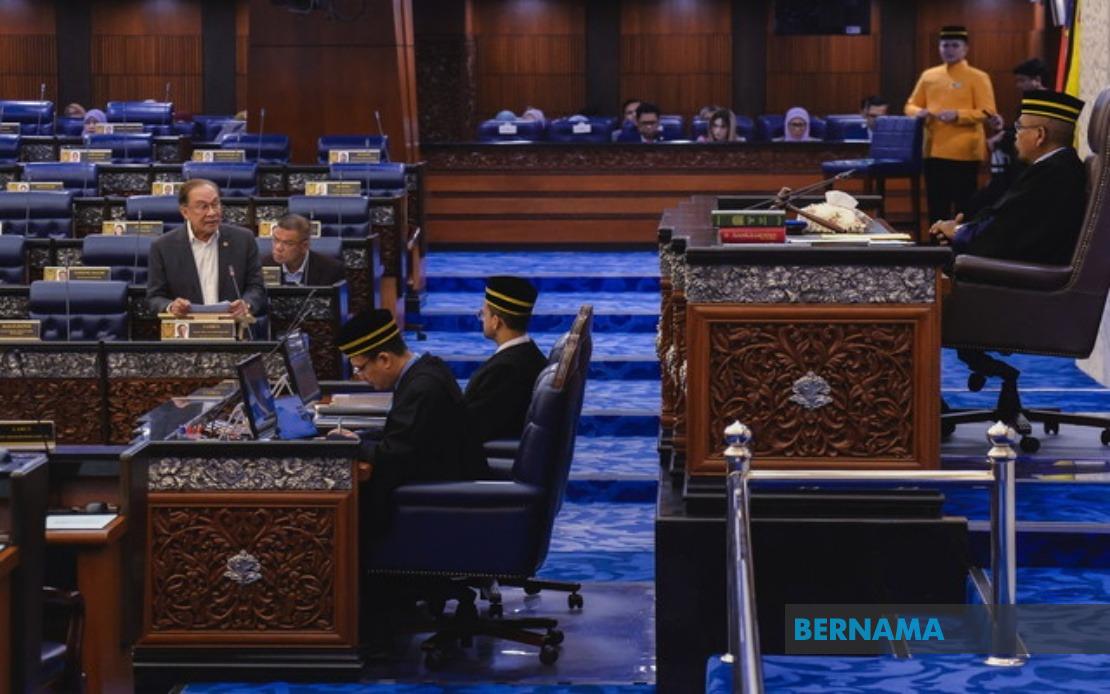
Prime Minister Datuk Seri Anwar Ibrahim has reinforced the electoral framework governing government conduct during election campaigns, emphasising that the announcement of new projects and policies is strictly prohibited once nomination day has been declared. The clarification came during parliamentary question time, addressing concerns raised about enforcement mechanisms ahead of the state elections scheduled for Johor, Melaka and Negeri Sembilan.
The restriction is anchored in Section 24B of the Election Offences Act 1954, a statutory provision designed to maintain electoral fairness and prevent incumbent administrations from leveraging government resources to gain electoral advantage. According to the Prime Minister, this prohibition applies uniformly across all levels of government infrastructure, encompassing city councils, state authorities and federal institutions alike. The overarching principle seeks to create a level playing field where electoral outcomes are determined by political merit rather than the distribution of development projects as electoral incentives.
Anwar's restatement of this position underscores the government's commitment to maintaining electoral integrity, particularly as Malaysia approaches a period of intensive state-level campaigning. The electoral calendar has triggered heightened scrutiny regarding potential breaches of election conduct rules, with opposition figures and watchdogs monitoring for infractions. The Prime Minister's unequivocal language—describing the government's position as "unchanged"—suggests a determination to enforce compliance across all governmental tiers and to resist political pressures to circumvent these restrictions.
The practical application of these rules presents nuanced challenges for administrators managing development portfolios. While new announcements remain forbidden, the Prime Minister clarified that projects previously approved or allocated funding under earlier federal budgets may be promoted or progressed during the campaign period. This distinction permits governments to highlight existing commitments without technically breaching electoral law, though it requires careful documentation to demonstrate that project approvals predate the nomination period. For developers and contractors, this creates an administrative burden of establishing clear approval timelines.
The question raised by Datuk Seri Dr Shahidan Kassim from the Perikatan Nasional-controlled constituency of Arau reflected persistent concerns within Parliament about enforcement mechanisms. The enquiry specifically sought clarity on how compliance would be monitored and what consequences await organisations that contravene these restrictions. Such questions highlight ongoing tension between political actors seeking to maximise electoral visibility for government achievements and institutional safeguards designed to prevent abuse of state machinery.
Malaysia's approach to regulating government conduct during elections reflects Commonwealth electoral traditions adapted to the country's federal structure. Unlike single-tier systems, the Malaysian federation requires coordination across federal, state and local governmental layers, complicating enforcement. Previous election cycles have witnessed disputes regarding the interpretation of what constitutes a "new" project, with ambiguity often exploited by incumbent administrations to blur the boundaries between permissible announcements and prohibited ones. The current clarification attempts to reduce interpretive discretion.
For Southeast Asian observers, Malaysia's electoral regulatory framework demonstrates a relatively developed institutional approach to preventing the abuse of state resources. However, effectiveness depends less on legislative clarity than on the willingness of electoral commissions and law enforcement agencies to investigate complaints and impose penalties. The Malaysian Electoral Commission's independence and investigative capacity remain contested issues within democratic reform circles, with civil society organisations occasionally questioning whether enforcement matches rhetorical commitments.
The implications for the upcoming state elections extend beyond symbolic compliance. Johor, Melaka and Negeri Sembilan represent distinct political contexts with different incumbent parties and competitive dynamics. In Johor, where Barisan Nasional maintains control, the constraint limits the state government's ability to mobilise development announcements strategically across marginal constituencies. The effect potentially narrows the incumbent's electoral toolkit, shifting campaigns toward messaging and organisational intensity rather than tangible project promises.
Business sectors dependent on government contracts and development allocation face operational uncertainty during campaign periods. Construction firms, consultancies and suppliers accustomed to receiving project notifications must adjust expectations and planning horizons when nomination days are announced. This creates quarterly volatility in the development pipeline, with implications for employment planning and investment decisions by private sector actors operating in these states.
The enforcement question remains technically unresolved despite the Prime Minister's clarification. Election Offences Act provisions carry penalties, but the burden of proof requires demonstrating that an announcement constitutes a "new" project rather than a previously scheduled one. Given the documentary practices of government agencies, establishing such distinctions often hinges on procedural technicalities susceptible to competing interpretations. The Electoral Commission possesses investigative authority but operates with constrained resources relative to the scale of governmental activity across federation structures.
For political parties in opposition, these restrictions simultaneously constrain incumbents and limit their capacity to promise alternative development trajectories. The framework essentially freezes substantive policy competition during campaign periods, shifting focus toward rhetorical appeals and institutional critique rather than contrasting development visions. This limitation arguably disadvantages challengers seeking to mobilise support through specific project commitments while simultaneously protecting their future governing capacity from retrospective legal challenge.
Anwar's parliamentary statement reflects broader governance imperatives facing his administration. As federal Prime Minister, he must enforce standards applicable to opposition-held states while managing expectations within Barisan Nasional-controlled territories. Inconsistent enforcement would invite accusations of partisan application, undermining the electoral commission's perceived neutrality and the government's credibility on institutional matters. The emphasis on uniform standards across all governmental levels serves to reinforce an appearance of principled governance transcending partisan interest.
Moving forward, the clarification establishes a documented benchmark against which subsequent conduct will be evaluated. Opposition parties and electoral observers will reference these statements when challenging any announcements during the campaign period, raising the political and legal costs of circumvention. Whether this translates into meaningful enforcement remains contingent on the Electoral Commission's investigative vigour and the government's willingness to permit accountability mechanisms to operate without partisan interference.

