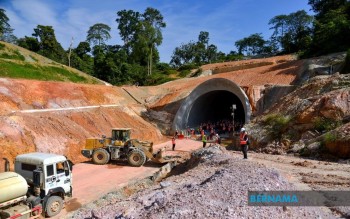
The Malaysian government has greenlit a substantial development agenda for Pasir Puteh parliamentary constituency in Kelantan, allocating RM207.2 million across 46 projects scheduled for implementation in 2026 and beyond. The investment package represents a strategic effort to transform the constituency into a regional economic powerhouse by harnessing the transformative potential of the East Coast Rail Link, one of Southeast Asia's most significant transport infrastructure initiatives.
Deputy Economy Minister Datuk Mohd Shahar Abdullah outlined the government's vision during parliamentary questioning, emphasising how the approved initiatives would establish supporting infrastructure for industrial and logistics activities anchored around the ECRL's cargo handling facilities. The approach reflects a deliberate shift toward leveraging major transport infrastructure as catalysts for broader regional development, rather than treating such projects in isolation. This philosophy has gained traction across Malaysia's federal planning frameworks, as policymakers increasingly recognise that transport hubs can serve as epicentres for clusters of complementary economic activities.
The centrepiece of this development strategy involves preparing land and constructing foundational infrastructure for Pasir Puteh's downstream industrial area. This designation typically encompasses manufacturing and processing facilities that add value to raw materials or finished goods, supported by adjacent storage, warehousing, and distribution networks. By clustering these activities around the ECRL cargo station, planners aim to create efficiency gains through reduced transport distances and integrated logistics management. The proximity of these facilities to maritime assets, particularly the Tok Bali Supply Base, creates what development specialists term a "logistics triangle"—where rail, port, and industrial infrastructure reinforce each other's utility and attractiveness to investors.
Mohd Shahar highlighted the integrated planning approach underpinning these initiatives, specifically referencing the ECRL Integrated Land Use Master Plan (PGTA-ECRL). This comprehensive framework coordinates railway station development with surrounding commercial, industrial, and residential zones to maximise synergies and prevent fragmented, inefficient land use patterns. The strategy positions the Pasir Puteh ECRL Station as a dual-function facility capable of handling both passenger services and substantial cargo volumes, thereby generating multiple revenue streams and employment opportunities from a single infrastructure asset.
For Malaysian policymakers, the Pasir Puteh initiative represents an important test case in regional balancing. Kelantan, as a relatively less developed state on Malaysia's northeast coast, has historically experienced slower economic growth and higher unemployment than the Klang Valley or Penang. By directing substantial capital toward ECRL-adjacent development, the federal government signals commitment to narrowing geographical prosperity disparities. This mirrors similar initiatives across other ECRL stations, though Pasir Puteh's combination of cargo facilities and nearby maritime infrastructure creates particularly compelling development prospects compared to some other locations along the route.
The investment strategy explicitly targets job creation and private sector interest. The government anticipates that improved infrastructure, combined with the accessibility advantages offered by the ECRL, will attract manufacturing and logistics companies seeking locations beyond Malaysia's congested western corridor. Companies in petrochemicals, food processing, marine-related industries, and international trade facilitation represent likely anchors for such a hub. Successful development could generate both direct employment in industrial and port operations and indirect opportunities in supporting services, construction, and professional services.
Mohd Shahar's emphasis on the synergy between rail and port capabilities addresses a critical insight in contemporary supply chain management. The proximity of rail and maritime transportation allows companies to diversify their shipping options, negotiate better rates, and respond flexibly to market demands. This multimodal accessibility can prove decisive when multinational corporations select locations for regional distribution centres or manufacturing plants. Southeast Asia's growing importance in global supply chains, particularly as companies diversify away from China-dependent production networks, creates genuine opportunities for well-positioned Malaysian constituencies.
Implementation timeline represents a crucial factor in assessing whether these ambitions materialise. Projects under the 13th Malaysia Plan (13MP) will commence this year and extend through 2030, providing an eight-year window for construction, occupation, and operational maturation. This timeframe aligns with medium-term business planning horizons for many companies, though development economists note that industrial clusters typically require 5-10 years of post-completion operation before reaching full productivity potential. The extended timeline reflects realistic expectations about infrastructure development pacing in Malaysian contexts.
The government has committed to systematic progress monitoring through the MyRMK system, with regular reporting to parliament. This transparency mechanism addresses historical concerns about project delays and cost overruns in Malaysian infrastructure development. Regular parliamentary updates create accountability pressures on implementing agencies and provide early warning systems if projects encounter difficulties. For investors considering Pasir Puteh-based operations, such institutional oversight offers some assurance regarding infrastructure completion and functionality.
Mohd Shahar's broader framing around 13MP implementation emphasises principle-based development tailored to each locality's comparative advantages. Rather than imposing identical development templates across constituencies, this approach recognises that Pasir Puteh's strength lies in logistics and downstream industrial activities, while other constituencies might prioritise tourism, agriculture, or technology sectors. This differentiated strategy, if executed competently, could yield more efficient development outcomes than uniform approaches lacking sensitivity to local circumstances and potential.
The Pasir Puteh investment package carries implications extending beyond Kelantan's borders. Success in developing ECRL-adjacent logistics hubs influences broader patterns of regional development across the corridor, from Selangor through Terengganu. Other constituencies along the route may seek comparable allocations and parallel developments. The competitive dynamics created could generate productive innovation in how communities and state governments partner with federal authorities to maximise ECRL utilisation beyond original passenger service assumptions.
For Southeast Asian observers, Malaysia's approach to ECRL development offers instructive lessons about post-construction infrastructure value maximisation. Merely completing rail lines represents only the foundation; genuine economic impact emerges when complementary land use, industrial planning, and logistics infrastructure align cohesively. The Pasir Puteh initiative demonstrates growing Malaysian sophistication in this integrated infrastructure-development philosophy, a capability increasingly essential as major transport projects proliferate across the region.

