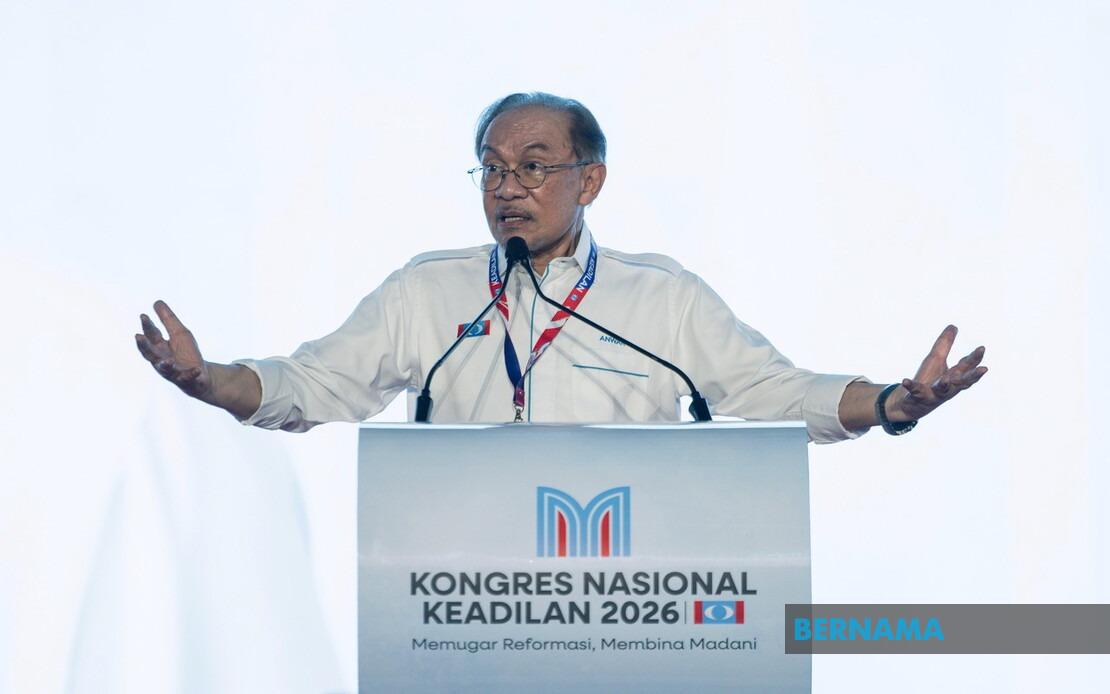
Prime Minister Datuk Seri Anwar Ibrahim has unveiled a significant fiscal initiative aimed at strengthening direct assistance to communities across Malaysia, announcing an additional RM1 million allocation designated for every parliamentary constituency nationwide. The funds will be deployed to tackle immediate local priorities without the delays typically associated with bureaucratic processes, marking what officials describe as a deepening of the MADANI Government's commitment to tackling poverty and alleviating financial pressures at the community level.
The announcement, made during his closing address at the 2026 PKR National Congress in Melaka on August 16, represents a tangible expansion of the government's support framework beyond existing welfare programmes. Anwar emphasised that this supplementary allocation complements an already substantial safety net encompassing the Sumbangan Tunai Rahmah and Sumbangan Asas Rahmah initiatives, which collectively represent a RM16 billion commitment to household economic support. The distinction between this new allocation and existing schemes lies in its direct channelling mechanism, which is designed to minimise administrative friction and enable faster response to locally identified needs.
The timing of this announcement carries particular significance for Malaysia's evolving economic policy landscape. With the government having reduced the hardcore poverty rate to 0.09 per cent, the administration is signalling a shift from purely poverty eradication towards broader cost-of-living relief mechanisms that extend across multiple income brackets. This reflects recognition that middle-income households, particularly the M40 segment, face mounting financial pressures despite not qualifying as technically impoverished under conventional metrics.
Anwar, who holds the dual portfolios of Prime Minister and Finance Minister, framed the allocation as evidence that the government prioritises translating macroeconomic achievements into tangible improvements at the household level. The MADANI administration has positioned itself as committed to comprehensive welfare without community-based discrimination, implementing initiatives spanning school assistance, subsidised essential goods through Rahmah sales, and housing financing support. The new constituency allocation represents a mechanism through which such aspirations can be operationalised more rapidly and responsively.
The allocation structure itself merits examination in the Malaysian political context. By distributing funds equally across all parliamentary constituencies regardless of geographic size or population, the government ensures that constituencies with smaller populations receive proportionally greater per-capita support. This approach potentially addresses historical grievances in less densely populated regions, including rural areas and constituencies with significant indigenous or minority populations, where infrastructure gaps and service deficiencies have been longstanding concerns.
From a procedural standpoint, the direct channelling of funds specifically targets the reduction of bureaucratic delays that have historically impeded swift responses to community needs. Malaysian constituencies frequently grapple with local challenges—flooding, inadequate water supply, deteriorating community facilities—that warrant rapid attention. The allocation removes intermediary approval layers, enabling local representatives and authorities to deploy resources according to immediate circumstances rather than waiting for centralised budgetary cycles or departmental clearances.
The announcement also signals strategic messaging directed at PKR party machinery and grassroots operatives. Anwar explicitly urged party leaders and branch-level functionaries to undertake ground-level engagement, explaining available government assistance and ensuring that eligible recipients understand and access allocated benefits. This instruction reflects concerns within government about policy-implementation gaps, wherein programmes exist but targeted beneficiaries lack awareness or encounter administrative barriers preventing utilisation. By positioning party infrastructure as conduits for information dissemination and programme accessibility, the government attempts to bridge this communication divide.
For Malaysian voters and constituencies, the allocation presents immediate practical implications. Parliamentary representatives, whether from government or opposition benches, will now command additional discretionary resources to address constituent grievances. This distribution mechanism potentially reduces the partisan advantage traditionally enjoyed by ruling coalition MPs, as opposition members can equally access and deploy the allocated funds. Such a structure may enhance political accountability, as representatives of all affiliations face constituent expectations regarding the deployment of these resources.
The broader policy context underscores that this allocation represents incremental adjustment rather than fundamental restructuring of Malaysia's welfare apparatus. Existing programmes—Rahmah initiatives, school assistance, housing support—remain in place. The RM1 million per constituency augmentation functions as an additional valve through which resources flow downward, without displacing established mechanisms. This cumulative approach suggests the government views poverty alleviation and cost-of-living support as requiring multifaceted interventions rather than reliance upon single-instrument solutions.
Sustainability questions necessarily emerge regarding the long-term fiscal implications of expanding direct allocations. While the government emphasises that existing allocations have not been reduced, the incremental expansion of direct disbursement mechanisms carries cumulative budgetary consequences. For a nation managing inflation, exchange rate pressures, and revenue collection challenges, understanding how such allocations fit within medium-term fiscal frameworks becomes relevant for evaluating government economic credibility.
The announcement's reception within Malaysia's political economy will likely diverge along partisan and analytical lines. Government supporters will characterise it as evidence of responsiveness to grassroots demands and commitment to inclusive growth. Critics may scrutinise whether allocations adequately address structural impediments to poverty reduction or represent temporary relief insufficiently addressing systemic challenges. Economic observers may assess whether such direct disbursements constitute efficient resource allocation or represent consumption-focused spending at the expense of productive investment.
For constituencies across Peninsular Malaysia, Sabah, and Sarawak, the practical manifestation of this allocation will ultimately determine its political and social efficacy. Representatives must navigate competing priorities—infrastructure repair, welfare assistance, capacity building—in deploying finite resources. The success of this initiative will be measured not merely by allocation announcement but by tangible improvements in community circumstances, efficiency of disbursement mechanisms, and equitable distribution across diverse constituency needs and demographics.

