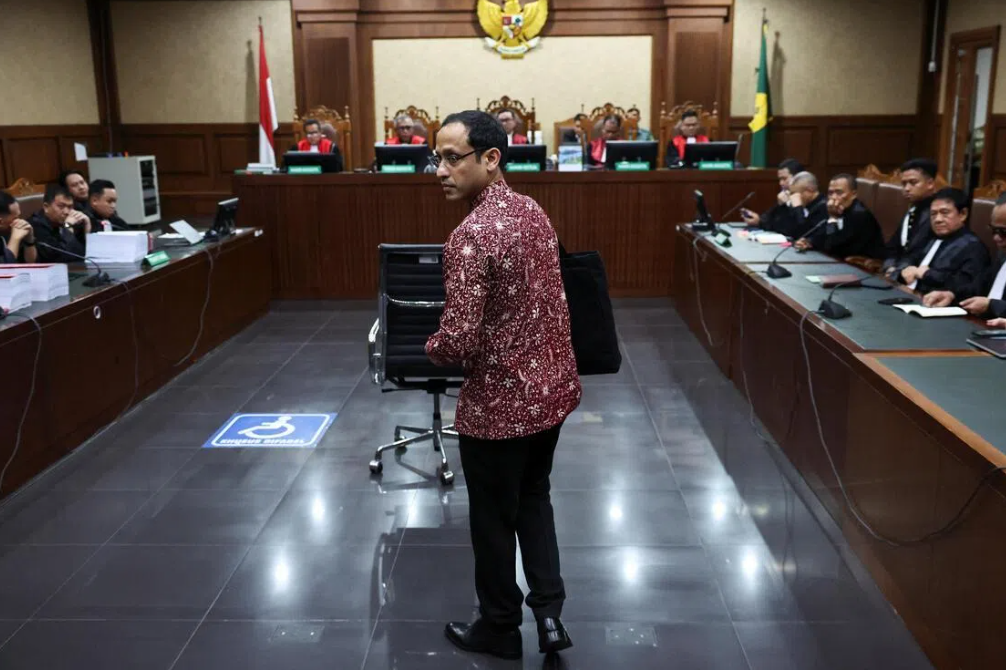
Indonesia's corruption courts have delivered a stunning verdict that marks the downfall of one of the nation's most celebrated technology entrepreneurs. On June 30, judges handed down a 10-year prison sentence to Nadiem Makarim, the Harvard-educated founder of ride-hailing giant Gojek, for his role in a laptop procurement scheme launched when schools across the archipelago shifted to remote learning. The sentence represents a dramatic fall for a figure once heralded as representing a new breed of reform-minded leaders in Indonesian governance, and raises uncomfortable questions about the intersection of business interests and public policy in the world's largest Muslim-majority democracy.
The Jakarta Corruption Court imposed penalties extending well beyond the custodial sentence. Nadiem was ordered to pay a fine of 1 billion rupiah, equivalent to approximately US$56,000, alongside restitution of 809.6 billion rupiah—roughly US$45 million—reflecting the court's assessment of state losses incurred through the scheme. An additional five-year prison term would be imposed should he fail to settle the restitution amount, effectively doubling his potential incarceration period. The financial burden underscores the magnitude of the alleged misappropriation and signals the court's determination to recover public funds diverted through improper procurement practices during a period of national crisis.
Chief Judge Purwanto articulated the court's reasoning in language that emphasised the gravity of the charges. The three-judge panel concluded that Nadiem had deliberately exploited his ministerial authority to benefit specific corporate interests, finding that his conduct involved "an abuse of authority intended to unlawfully benefit certain parties." The verdict specifically identified that Nadiem "consciously and intentionally directed the Chromebook procurement policy," driven by motivation to "strengthen the strategic business relationship between Google and the corporation he founded." This analysis proved particularly damaging to Nadiem's defence, as it situated his actions not as isolated misjudgements but as purposeful manipulation of state resources for private advantage—conduct the judges characterised as fundamentally incompatible with ministerial obligations.
The trajectory leading to this conviction began with considerable promise. Before his 2019 appointment as education minister under then-president Joko Widodo, Nadiem had established himself as Indonesia's foremost technology entrepreneur. Gojek, which he founded, evolved from a motorcycle taxi service into a comprehensive digital ecosystem encompassing courier delivery, food service, and financial transactions through its GoPay platform. By 2019, the company had achieved unicorn status—valuation exceeding US$10 billion—and represented the apex of Indonesian startup achievement. His recruitment into the cabinet was intended to inject technological sophistication and entrepreneurial dynamism into government operations, a vision that initially appeared to vindicate itself through digital initiatives across the education sector.
The central controversy involved procurement of approximately 1.1 million Chromebook laptops between 2020 and 2022, a period when Indonesian schools had no alternative to online instruction. Prosecutors alleged that this programme inflicted approximately 2.18 trillion rupiah in state losses whilst funnelling roughly 809 billion rupiah to Nadiem personally through transactions involving PT Aplikasi Karya Anak Bangsa, Gojek's parent company. The prosecution further contended that Google's financial stakes in Gojek influenced the Chromebook-centric approach to educational digitalisation—a connection Nadiem categorically rejected whilst Google itself avoided indictment. These allegations crystallised a broader concern about whether technology leaders can adequately separate commercial interests from public-interest responsibilities when holding elected office.
Prosecutors had pursued a more severe outcome, requesting an 18-year sentence alongside substantially larger financial penalties. The court's leniency relative to these demands may reflect either evidentiary limitations or judicial assessment that certain aggravating factors were not definitively established. Nonetheless, the 10-year sentence substantially exceeds sentences commonly imposed for comparable corruption offences in Indonesian courts, signalling that judges regarded this case as involving particularly egregious breaches of public trust. The discrepancy between prosecutorial requests and judicial outcomes also highlights ongoing tensions within Indonesia's anti-corruption architecture regarding proportionality and consistency in sentencing practices.
Nadiem's defence rested on multiple pillars. He maintained categorical innocence throughout proceedings, asserting that charges were baseless and that the Chromebook programme was implemented with genuine intention to maintain educational continuity during an unprecedented disruption. His legal team emphasised that approximately 97 per cent of the 1.1 million laptops had reached 77,000 schools by 2023, underscoring substantial delivery against stated objectives. They further argued that no personal financial gain accrued to Nadiem and positioned the entire initiative as a good-faith response to emergency circumstances rather than an orchestrated scheme for self-enrichment. In early June 2026, Nadiem's counsel requested full acquittal, contending the prosecution had failed to establish culpability beyond reasonable doubt.
Yet the prosecution presented documentary evidence that undermined these assertions. The Attorney-General's Office referenced pre-2019 ministry studies concluding that Chromebooks would prove ineffective in remote and rural zones lacking reliable internet infrastructure—a prescient assessment that raised questions about why such warnings were apparently disregarded. Prosecutors additionally highlighted an August 2019 group chat discussion concerning a Chromebook-focused digitalisation strategy prior to Nadiem's formal cabinet appointment, suggesting improper coordination between his private and public spheres. These communications, rather than isolated mistakes, suggested a pattern of decision-making that privileged particular technological solutions and commercial relationships over pedagogical suitability for Indonesia's diverse geography.
The trial transcended typical corruption proceedings in its cultural resonance and public engagement. Dozens of Gojek drivers attended court sessions, visibly demonstrating solidarity and affirming their founder's character—a manifestation of workplace loyalty that contrasted sharply with institutional allegations. The proceedings drew livestreamed audiences and generated calls for organised public viewing, whilst the court received amicus curiae briefs supporting Nadiem's case. These dynamics reflected broader divisions within Indonesian society regarding whether to interpret Nadiem as either a visionary unfairly persecuted for modernisation efforts or a cautionary tale of unchecked corporate influence within government structures. His strategic presentation—appearing in a Gojek driver jacket before transitioning to formal batik attire—communicated deliberate messaging aimed at humanising him beyond the corruption allegations.
Nadiem's family background added another dimension to public perceptions of the case. His father, Nono Anwar Makarim, ranks among Indonesia's most distinguished legal practitioners, whilst his maternal grandfather participated in Indonesia's independence struggle. This prominent positioning within Indonesian elite circles potentially magnified both sympathetic and critical public responses, with supporters viewing the prosecution as targeting an exceptional figure whose contributions warranted forgiveness, whilst critics perceived his family prominence as potentially generating inappropriate judicial leniency. The conviction therefore carries symbolic weight transcending individual culpability, touching upon questions of whether Indonesia's anti-corruption mechanisms function with consistency regardless of defendants' social standing.
As trial proceedings concluded, Nadiem reframed the case as encompassing implications beyond procurement disputes. In a June 23 defence plea delivered before sentencing, he argued that the verdict would shape whether young Indonesians perceived public service as a viable career path and whether talented professionals would risk government appointments. Addressing the judges, he stated: "Youth across all of Indonesia, and the diaspora in every corner of the world, await your answer to the question echoing in their hearts: 'Is this country still safe for us to serve?'" This framing positioned the trial as a referendum on Indonesia's capacity to attract elite professionals into governance roles—a consideration with substantial relevance for institutional capacity-building and talent recruitment across Southeast Asia more broadly.
The conviction carries substantial implications for Malaysia and the broader regional context. Technology entrepreneurs increasingly occupy ministerial positions throughout Southeast Asia, and the Nadiem case demonstrates the complexity of managing potential conflicts between private business interests and public responsibilities. Malaysian policymakers observing this trial may derive cautionary lessons regarding governance structures needed to insulate procurement decisions from commercial bias, particularly when digitalisation initiatives intersect with government contracts. The case equally underscores the importance of transparent communication regarding procurement criteria and deliberate institutional separation between technology leaders' private commercial portfolios and their public-sector decision-making authority. As digital transformation accelerates across Southeast Asia, establishing robust governance frameworks that prevent similar controversies will prove essential for maintaining public confidence in both entrepreneurial leadership and institutional integrity.

