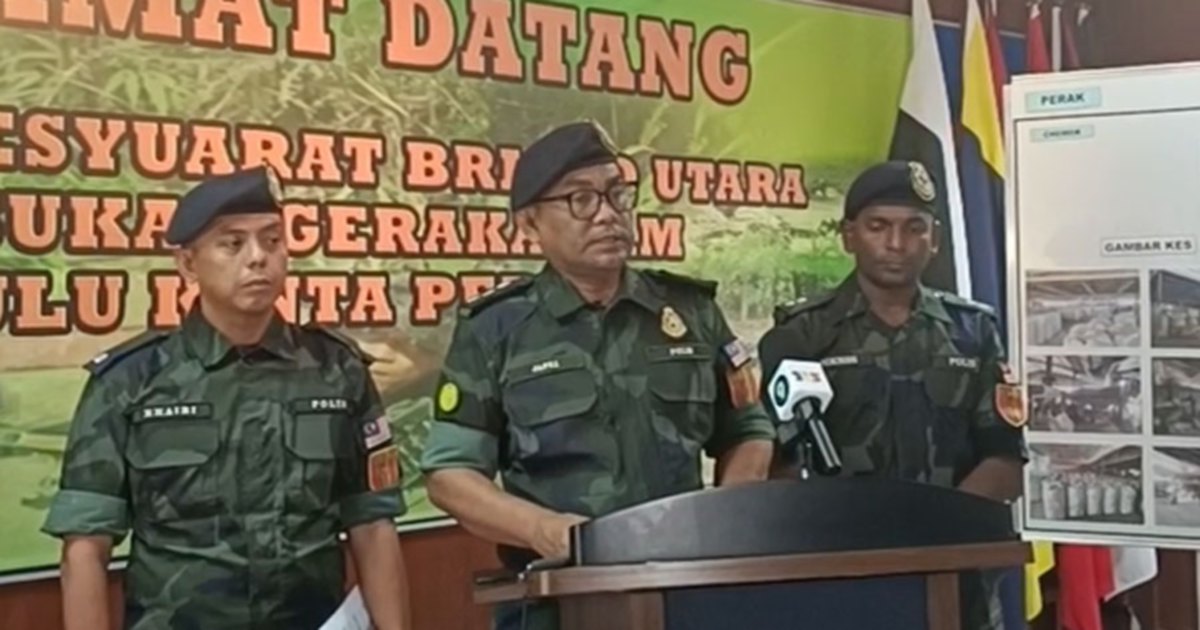
The General Operations Force Northern Brigade has moved decisively against organised illegal mining networks operating across the border regions of Perak and Kedah, seizing substantial quantities of minerals and industrial equipment valued at RM31.7 million and apprehending 30 individuals suspected of involvement in unauthorised mineral extraction and processing operations.
This coordinated enforcement action represents a significant escalation in efforts to combat the underground mining sector, which continues to pose environmental and economic challenges across Malaysia's northern states. The operation targeted both the extraction phase and the processing infrastructure that typically transforms raw minerals into marketable commodities, suggesting a comprehensive disruption strategy aimed at dismantling complete supply chains rather than merely addressing surface-level activities.
Illegal mining has emerged as a persistent challenge for Malaysian authorities, particularly in resource-rich regions where rugged terrain and porous state boundaries complicate regulatory oversight. The Perak-Kedah corridor has historically attracted unlicensed mining operations due to its substantial mineral deposits and proximity to processing centres. Beyond the immediate economic loss represented by unsanctioned extraction, these operations extract significant environmental and social costs, including habitat destruction, water contamination, and disruption to legitimate business operations in surrounding areas.
The scale of confiscated materials suggests that the detained suspects were engaged in operations with meaningful commercial intent rather than small-scale, opportunistic ventures. Equipment seizures typically indicate investment in substantial processing capabilities, implying that these networks had established distribution arrangements and generated considerable profit margins. The geographic spread across two states indicates coordination between operators, suggesting hierarchical organisation that extends beyond individual site management.
For Malaysian policymakers, the operation underscores the continued necessity of robust enforcement mechanisms despite existing regulatory frameworks. The GOF Northern Brigade's capacity to mount such comprehensive operations depends on sustained funding, personnel, and intelligence-gathering resources. The interagency coordination required to conduct simultaneous raids across multiple jurisdictions reflects the complexity of countering activities that deliberately exploit administrative boundaries and regulatory grey zones.
The environmental implications of illegal mining extend far beyond the immediate operational areas. Unregulated extraction disrupts soil structure and hydrological systems, while inadequate processing infrastructure often results in toxic runoff contaminating water sources that downstream communities depend upon. In the Perak-Kedah region, such contamination carries particular significance given the agricultural activities and urban water supply systems in proximity to known mining regions.
The detention of 30 individuals will likely generate investigation leads extending into supply chains, financial networks, and equipment suppliers that enable such operations. Law enforcement agencies frequently discover that illegal mining networks integrate with broader criminal ecosystems involving money laundering, document fraud, and corruption of local administrators. The value of such enforcement actions often extends beyond immediate asset recovery to the intelligence gathered regarding operational methodologies and personnel networks.
From a regional perspective, this crackdown aligns with Southeast Asian governments' increasing attention to natural resource security and environmental protection. Cross-border illegal mining has become a transnational issue, with some operations involving foreign nationals and international financing. Malaysia's enforcement efforts contribute to broader regional capacity-building in combating organised resource extraction crimes, while also protecting the country's long-term mineral wealth from depletion through unauthorised channels.
The recovery of RM31.7 million in assets represents immediate economic value, but the broader significance lies in operational disruption. Each enforcement action raises the risk calculus for prospective operators, increasing insurance costs and uncertainty that deter new entrants to the sector. Sustained, visible enforcement contributes to normalisation of regulatory compliance as a business prerequisite rather than an optional expense for profit-conscious operators.
Authorities have signalled through this operation that enforcement capacity extends throughout the northern states and across administrative boundaries. The coordination required for simultaneous multi-state operations demonstrates that illegal mining networks cannot rely on territorial fragmentation to evade detection. Prospective operators must anticipate that equipment investment and operational setup carry significant seizure risks, fundamentally altering the profitability calculations that motivate underground mining activities.
Looking forward, the challenge for Malaysian enforcement agencies involves translating tactical successes into strategic disruption of the supply chains and financial networks that enable sustained operations. Intelligence gathered from arrested individuals and seized equipment may reveal vulnerabilities in how mineral commerce integrates with legal marketplaces, potentially yielding enforcement opportunities targeting demand-side actors and middlemen who transform illegally extracted materials into commercial commodities.
The GOF Northern Brigade's operation exemplifies the resource-intensive nature of contemporary organised crime enforcement. Future efforts to sustain pressure on illegal mining will require continued investment in surveillance capabilities, forensic investigation expertise, and intelligence analysis alongside traditional enforcement personnel. The coordination demonstrated in this operation provides a model for addressing other transnational resource crimes affecting Malaysia's northern regions.

