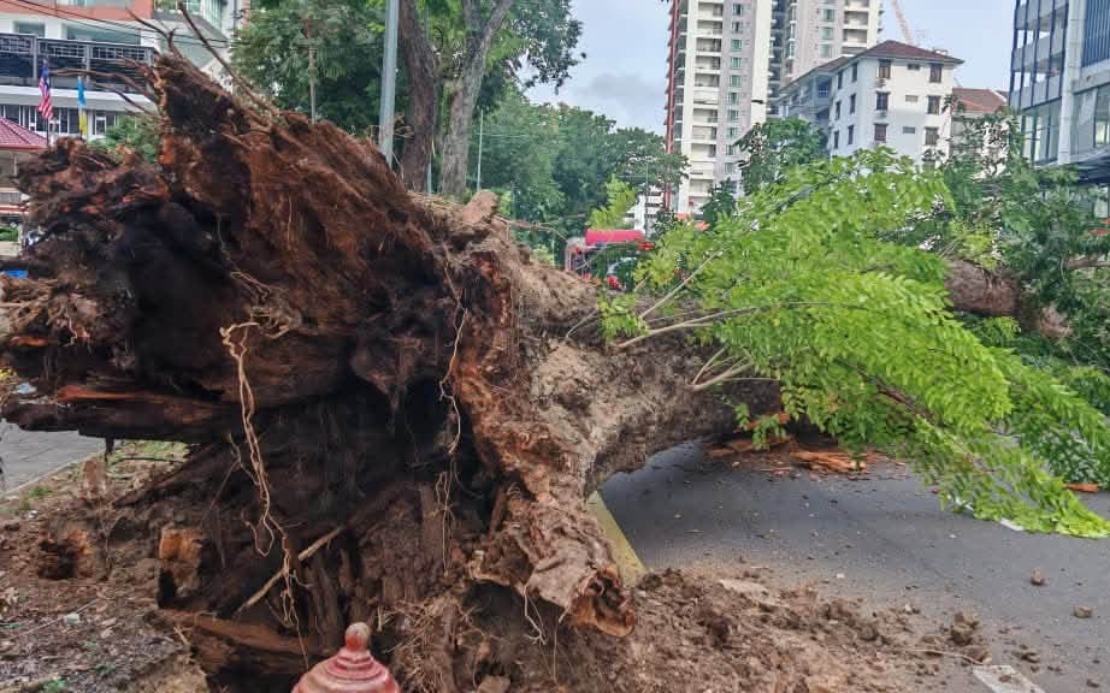
A towering 28-metre Angsana tree that had stood for nine decades along Jalan Macalister in George Town fell without warning on a calm morning in August, crushing a vehicle and injuring three occupants. The incident has prompted municipal authorities to scrutinize how environmental pressures and structural deterioration can render even mature urban trees into sudden hazards, raising questions about proactive arboricultural management in Malaysian cities.
Mayor of Majlis Bandaraya Pulau Pinang (MBPP) Datuk A. Rajendran attributed the collapse to a convergence of biological and environmental factors that had progressively weakened the specimen of Pterocarpus indicus. Internal examinations revealed that approximately 30 per cent of the tree's root system had succumbed to rot, whilst cavity decay had consumed roughly 40 per cent of the base trunk. These structural defects alone might not have triggered failure under normal circumstances, but when combined with chronic soil compaction around the base and the severely restricted growing space available, the tree's ability to resist the load of its own height—and any additional stress—deteriorated sharply.
What distinguishes this case is that meteorological conditions were not contributory factors. There were no reports of heavy rainfall or strong winds in the vicinity at or preceding the 9 am incident, meaning the tree collapsed under its own structural vulnerability rather than being toppled by external natural forces. This detail underscores a critical distinction for urban tree management: trees can fail not because of storms or extreme weather, but because the conditions in which they grow—and the maintenance practices applied—determine their longevity and stability.
The involvement of infrastructure upgrading works added another layer of complexity to the tree's predicament. Urban development activities, whilst necessary for city progress, frequently alter soil conditions and root systems in ways that are irreversible and cumulative. MBPP's assessment indicated that the various works conducted around the tree over time had compounded the naturally constrained growing environment, making the tree increasingly susceptible to failure. This pattern reflects a broader challenge facing municipal planners across Southeast Asia: balancing urban development ambitions with the preservation of established green infrastructure.
Response mechanisms were deployed swiftly following the collapse. Clearing operations commenced at 9.41 am, with the thoroughfare fully reopened by 2.20 pm. However, the incident prompted a more comprehensive audit of similar trees in the vicinity. MBPP had already conducted a systematic assessment of mature and aged trees along Jalan Macalister in 2024, during which 13 specimens were flagged for removal—all of which have since been felled. The previous maintenance intervention on the street occurred on 29 January this year, whilst a remote sensing survey conducted in the prior year had classified the trees as being in satisfactory condition with no visible warning signs. This raises pertinent questions about the reliability of remote monitoring technologies and whether they can detect internal decay that poses genuine risks.
On a municipal level, MBPP's tree management programme has substantially scaled up its intervention efforts. In the current year alone, 179 trees designated as high-risk have been approved for removal, with 148 already eliminated. Over the first nine months of the year, 247 trees were felled across the city. The felling decisions encompassed diverse scenarios: trees blocking drainage systems, dead or leaning specimens, those posing collapse hazards, trees in the way of development projects or road widening schemes, and those encroaching on water supply pipelines operated by the Penang Water Supply Corporation (PBAPP).
The broader inventory of trees flagged for attention reveals the scale of management challenges confronting the municipality. During the previous year, MBPP identified 2,535 trees across various risk categories: 45 cases of drainage obstruction, 138 genuinely dead trees, 2,242 classified under general risk or miscellaneous categories, and 110 implicated in development or infrastructure projects. These figures illustrate that the Jalan Macalister incident represents not an isolated aberration but rather a symptom of systemic pressures on urban arboricultural systems.
MBPP's stated priority remains focused on trees presenting acute safety hazards, particularly those affected by infrastructure works and constrained by limited rooting space—the precise conditions that precipitated the August collapse. Following the incident, the appointed contractor received instructions to accelerate programmes aimed at reducing tree heights and removing specimens with significant collapse potential along Jalan Macalister, guided by assessments conducted by certified arborists. This represents a shift toward more aggressive preventive management, though such approaches invariably come at environmental cost.
The incident illustrates a crucial tension within urban development frameworks across Malaysia and Southeast Asia: the competing demands of urban growth, infrastructure expansion, and environmental preservation. Trees planted decades ago occupied urban spaces that were subsequently transformed by development, leaving them increasingly stressed and vulnerable. As cities intensify their infrastructure upgrading works and encroach upon green spaces, the survival and stability of established trees becomes increasingly precarious. The George Town collapse serves as a cautionary reminder that without proactive, science-based arboricultural management—and recognition that development pressures fundamentally alter tree viability—Malaysian municipalities may find themselves responding to preventable tragedies rather than preventing them.

