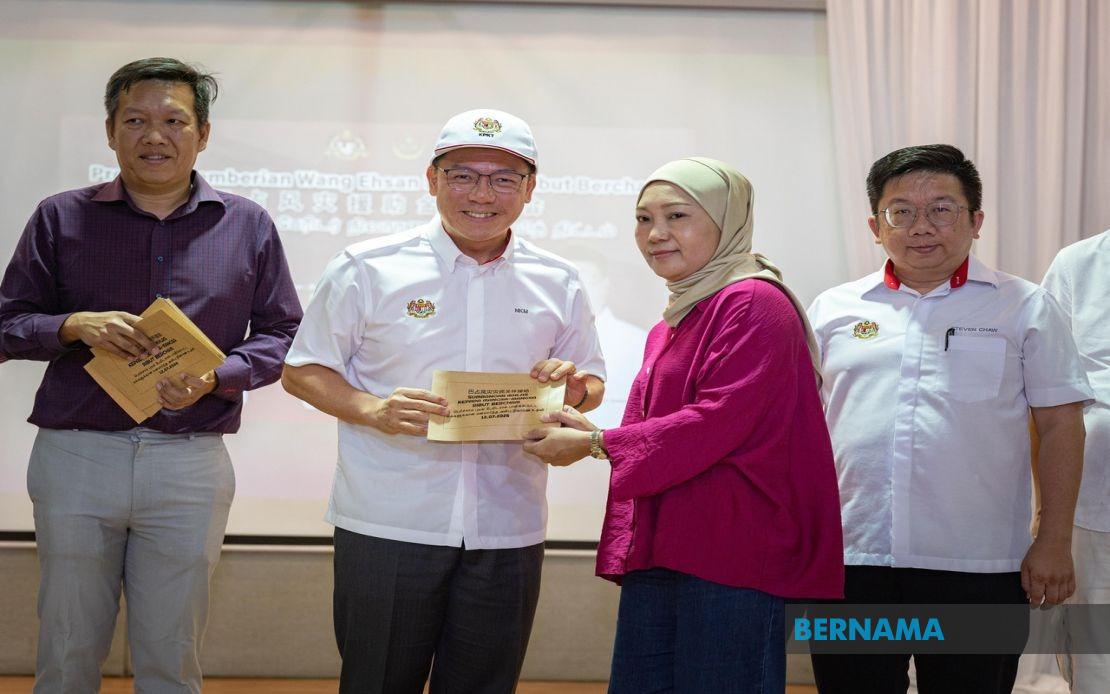
Residents of Bercham in Perak's Kinta district have begun receiving financial relief following the destructive storm that struck the community last month, with 554 affected households each obtaining RM1,800 in aid during a distribution ceremony presided over by Housing and Local Government Minister Nga Kor Ming. The payout, coordinated across multiple assistance channels, represents a consolidated response to one of the region's more significant weather-related incidents this year, drawing contributions from both government resources and private sector partners seeking to stabilize household finances in the aftermath of substantial property damage.
The Genting Malaysia group, through its corporate social responsibility initiatives channeled via Genting Bersama Malaysia, emerged as a significant source of the RM1 million relief package, demonstrating the role that major corporations continue to play in disaster recovery efforts within their operational communities. This collaborative funding approach underscores a broader pattern across Malaysia where private enterprises supplement government assistance programs to ensure more comprehensive household recovery, particularly when infrastructure damage and personal property loss create immediate cash-flow pressures for working families.
Bercham assemblyman Ong Boon Piow attended the distribution event, signifying political acknowledgment of the incident's severity and the administration's commitment to constituent support. Such representation at relief ceremonies serves dual purposes: it provides visible government presence to affected communities whilst documenting relief efforts for legislative records and future disaster management planning. In Perak's political landscape, where state-level and federal coordination remains critical for resource allocation, such joint appearances reinforce lines of accountability across different governance tiers.
Nga's remarks at the ceremony articulated the practical constraints facing disaster relief administration, candidly acknowledging that the cumulative assistance, whilst meaningful, cannot fully restore homes or absorb all financial losses incurred. The minister noted that families have already accessed RM1,000 in government support and RM300 from the district chief's office, making the RM1,800 Genting contribution the third layer of immediate assistance. This tiered approach, common in Malaysian disaster response, attempts to distribute limited public funds across broader beneficiary populations rather than concentrating resources on partial recovery for fewer households.
The June 19 meteorological event that triggered this relief response inflicted widespread damage across five distinct residential zones within Bercham, with more than 500 dwellings suffering structural or material harm from an extended period of intense rainfall combined with damaging wind speeds. The concentration of damage across multiple neighborhoods simultaneously indicated the storm's considerable geographic scope and intensity, affecting diverse socioeconomic strata within the community and creating complex reconstruction challenges for municipal authorities managing infrastructure repair priorities.
Nga's statement that his personal commitment extends to Bercham despite his operational base in Putrajaya reflects the political expectations placed on federal ministers regarding constituency engagement and disaster responsiveness. Such personal assurances, whilst sometimes dismissed as rhetorical flourishes, carry weight in Malaysian political culture where ministerial accessibility to affected communities influences electoral perceptions and party support. The framing of relief provision as an outcome of determined advocacy rather than automatic bureaucratic process carries implicit messaging about political efficacy and ministerial influence.
The infrastructure and housing dimensions of the Bercham incident extend beyond immediate family hardship, affecting local property values, insurance claims processing, and municipal service delivery as authorities prioritize repair of roads, electrical systems, and water infrastructure damaged alongside residential structures. Insurance industry outcomes remain unclear from available reports, though severe storm events typically generate contested claims and delayed settlements that compound financial pressure on uninsured or underinsured households, particularly affecting lower-income families concentrated in areas prone to storm damage.
For Malaysian readers in similar climatic zones, particularly across Perak, Selangor, and other regions experiencing increased extreme weather volatility, the Bercham response illustrates both the availability of multi-channel disaster assistance and its practical limitations. The RM1,800 individual family payout, whilst substantial compared to typical government relief amounts, falls considerably short of reconstruction costs for damaged homes, suggesting that recovery trajectories for affected households will extend well beyond the immediate relief period into sustained rebuilding efforts.
The involvement of Genting Malaysia also signals how gaming and entertainment sector corporations maintain community presence through disaster response, potentially enhancing corporate reputation within host communities whilst demonstrating corporate citizenship expectations increasingly prevalent among major Malaysian enterprises. Such contributions, though voluntary, increasingly function as anticipated corporate responsibilities rather than extraordinary gestures, reflecting evolving standards for business engagement with social welfare obligations.
Looking forward, the Bercham incident provides policymakers with renewed data regarding storm vulnerability patterns in Perak's urban-fringe communities, potentially informing future urban planning decisions, building code enforcement, and disaster preparedness investments. Whether the provincial and federal authorities utilize this event to reassess infrastructure resilience or community warning systems remains a critical question for residents facing recurrent severe weather threats in subsequent seasons.

