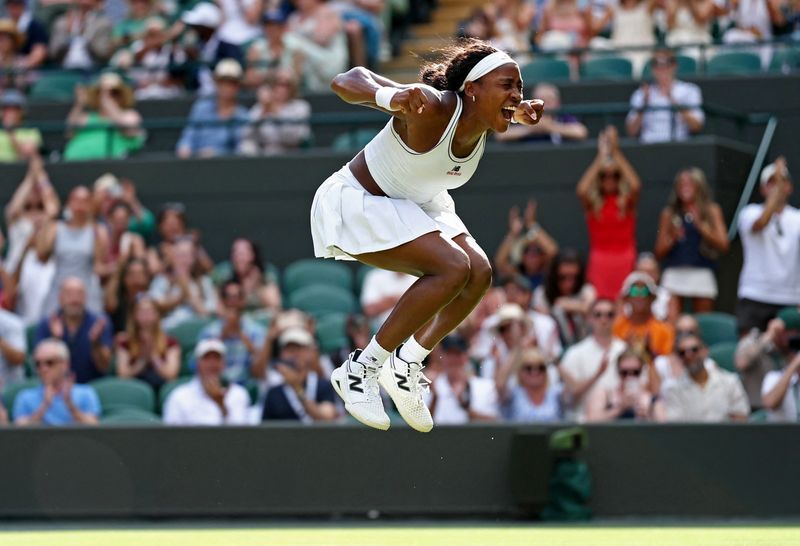
American tennis star Coco Gauff came perilously close to suffering another disappointing early elimination from Wimbledon on Wednesday, ultimately prevailing against Argentina's Solana Sierra 6-3 3-6 7-6(10-7) in a gripping second-round encounter that stretched to a nerve-wracking tiebreak decider. The world number seven's narrow escape keeps alive her hopes of finally breaking through at the All England Club, a venue that has stubbornly resisted her best efforts despite her credentials as a two-time Grand Slam champion.
Gauff's persistent struggles at Wimbledon stand in stark contrast to her success elsewhere on the professional circuit. The American has never managed to advance beyond the fourth round at the only major championship she has failed to win convincingly, a psychological barrier that loomed large during Wednesday's encounter on Court One. Such limitations at the grass-court fortress are both puzzling and concerning for a player of her pedigree, raising questions about whether her game translates effectively to the unique demands of this surface.
Sierra arrived as a formidable challenger despite her ranking of 56th in the world. The Argentine's credentials include a memorable run the previous year when she became the first player to enter the tournament as a lucky loser and reach the women's round of 16 during the Open era, demonstrating her ability to perform under pressure on the biggest stages. This previous success gave her confidence and tactical knowledge that would prove challenging for Gauff to navigate.
The opening set suggested a straightforward afternoon as Gauff dominated, claiming the first six games and establishing commanding control. However, her concentration wavered noticeably in the second set, partly triggered by an unusual moment when her serve went sideways into the umpire's chair, a bizarre occurrence that seemed to unsettle her momentum. Such distractions can be costly at elite level, and Sierra capitalised immediately by breaking Gauff to love and establishing a 2-0 lead before pushing further ahead to 4-1.
The third set became a dramatic pendulum swing of momentum and opportunity. Sierra created a break point at 1-1, but Gauff fought back, responding with a thunderous 124 mph serve that helped her regain control and move ahead 2-1. The Argentine then mounted another sustained challenge, saving three consecutive break points while consolidating positions at 2-2 and 3-3, before actually breaking Gauff's serve herself to take a 4-3 advantage. This reversal meant Gauff faced serious danger, particularly when serving at 5-3 with her back against the wall.
Gauff's resolve proved decisive in these pressure moments. Rather than capitulating after falling behind, she held her serve to stay alive and then broke Sierra immediately thereafter to seize back the initiative at 5-4. The momentum shift proved decisive as Sierra crumbled under renewed pressure, unable to recover from this loss of advantage.
The tiebreak itself became a miniature battle, with Sierra initially seizing control by racing to a 7-4 lead, putting her within touching distance of victory. Gauff then produced the decisive moment of the match, reeling off six consecutive points that swung the momentum decisively in her favour. She clinched victory with characteristic aggression, finishing with a 117 mph ace on her first match point that Sierra could not touch.
Gauff's analysis of her performance revealed telling insights into the psychological warfare of professional tennis. She acknowledged that Sierra's power-hitting forced her into a largely defensive posture throughout the encounter, requiring her to absorb pace before finding opportunities to unleash her own attacking shots. The two-time Grand Slam champion attributed her eventual triumph significantly to her serving consistency, which provided both an offensive weapon and an insurance policy during critical moments.
Her serve ultimately proved decisive not just in the tiebreak but across the entire three-set marathon. The reliability of her first and second deliveries enabled her to recover from precarious positions and maintain confidence when the match hung in the balance. At elite professional level, such small technical consistencies often determine outcomes in tight contests.
The victory keeps Gauff's tournament alive and maintains hope that she might finally conquer her Wimbledon curse this year. For Malaysian and Southeast Asian readers following professional tennis, Gauff's struggle here serves as a reminder that even the most decorated players face specific venues where they underperform relative to their overall abilities. Her eventual advancement past Sierra through sheer determination and composure in crucial moments demonstrates the mental fortitude required at the highest levels of international sport.

