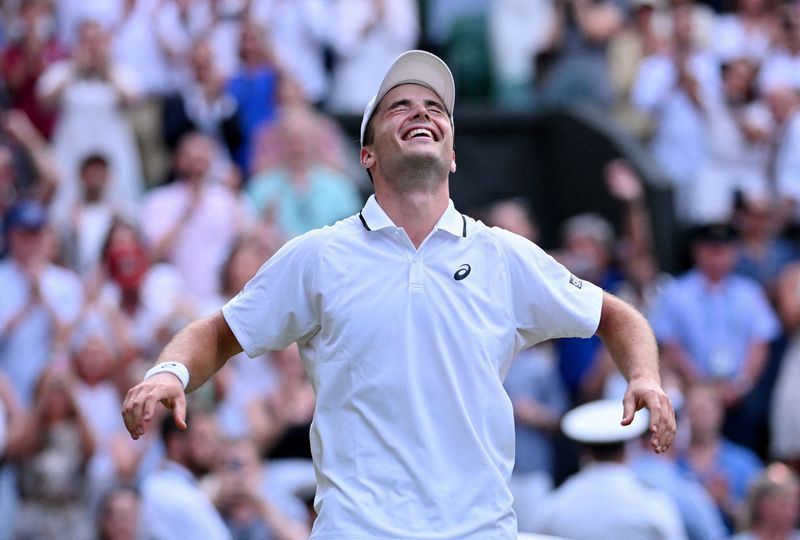
Arthur Fery's journey to the Wimbledon semi-finals reads like a screenplay that would likely be rejected by studios for stretching credibility too far. The 23-year-old, who spent his childhood within a short walk of Centre Court, entered the tournament as a wildcard despite holding only two previous Grand Slam match victories and a world ranking of 114th. Yet here he stands, one victory away from the final on what would be his 24th birthday, chasing a distinction that has eluded all but one player in professional tennis history. If Fery can overcome the considerable challenge of second seed Alexander Zverev in Friday's semi-final, he would have the opportunity to emulate Goran Ivanisevic, who in 2001 became the sole wildcard entrant to capture the Wimbledon singles crown.
The path that brought Fery to this extraordinary juncture showcases both privilege and determination. Born in Sevres, a suburb of Paris near Roland Garros, Fery comes from a family deeply embedded in both tennis and business. His father, Loic Fery, is a multimillionaire hedge fund manager who owns the French football club Lorient, while his mother, Olivia, competed professionally in tennis. Despite these French roots and the family's proximity to one of tennis's greatest tournaments, young Arthur's formative years unfolded in London. He attended King's College in Wimbledon and immersed himself in the British tennis system, creating credentials that transcend his birthplace and parentage.
Fery's recent Centre Court performance against ninth seed Flavio Cobolli demonstrated the calibre of play now evident in his game. Dispatching the Italian 6-4, 7-6(4), 6-0 on Wednesday's humid afternoon, Fery appeared to play several inches taller than his actual 5ft 9in frame, retrieving balls that seemed geographically impossible to reach and establishing defensive walls that neutralised his opponent's attacking options. The crowd's energy visibly fuelled his intensity, transforming the court into his domain rather than neutral territory. This victory elevated him to historic status within British tennis, making him only the fifth British man in the professional era to reach a Wimbledon semi-final.
The spectral presence of royalty has shadowed Fery's run through the tournament. Britain's Queen Camilla watched from the Royal Box during his quarterfinal demolition of Cobolli, greeting him with congratulations following the match. Princess Kate offered vocal support during his earlier encounter with Otto Virtanen. These royal endorsements carry symbolic weight in the context of Wimbledon's establishment traditions, yet Fery has processed these moments with remarkable equanimity. When describing his interaction with the Queen, he articulated his gratitude without grandiosity, allowing his demeanour to reflect the measured temperament he displays navigating competitive points.
The broader tennis world has registered approval of Fery's emergence. Eight-time Wimbledon champion Roger Federer nodded acknowledgment during Fery's thrilling five-set encounter against Grigor Dimitrov in the fourth round, a match that could have concluded in either direction. This recognition from one of the sport's greatest practitioners underscores that Fery's success represents genuine competitive achievement rather than fortunate circumstance. His progression through increasingly difficult opposition has been methodical and convincing, establishing that the wildcard designation reflects opportunity rather than talent deficit.
Fery's approach to his unexpected prominence reveals maturity that extends beyond his years. Rather than attempting to craft sensational sound bites for assembled journalists, he speaks in measured tones about managing the intensity ahead. When discussing his upcoming semi-final, he expressed relief that consecutive matches would not allow time for the psychological weight of his situation to accumulate. This psychological discipline mirrors the tactical intelligence evident in his on-court decision-making, suggesting that his mental framework can support sustained pressure at the highest competitive level.
The road to this moment involved deliberate choices that shaped his development as a complete athlete and individual. Rather than committing immediately to professional tennis following secondary school, Fery selected the university pathway, attending Stanford University where he majored in science, technology and society. At Stanford, he achieved ranking as the top collegiate player nationally before transitioning to professional competition. This educational detour provided maturity, intellectual grounding, and a foundation extending beyond the narrow confines of professional sport, factors that perhaps explain his composed demeanour in the face of unprecedented circumstances.
Fery's emergence as Britain's unexpected standard bearer arrives at a moment of historical rarity for the home nation at Wimbledon. Following a calamitous opening round that eliminated 15 of 19 British singles players, the nation's hopes had appeared bleak. The tournament's traditional association with British dominance—historical rather than recent—made the early exodus particularly dispiriting. Fery's subsequent progression has reversed that narrative, transforming him from relative anonymity into the focal point of British tennis aspirations during these two weeks in July.
The continental dimensions of Fery's identity underscore questions about belonging and allegiance in contemporary professional sport. Born to French parents near Paris and initially representing France as a junior competitor, Fery nonetheless articulated certainty about his British identity. His father confirmed this conviction to French sports media, drawing a parallel to hypothetical scenarios of players from established Parisian neighbourhoods representing France at Roland Garros. The circumstances of Fery's childhood—schooling within minutes of Wimbledon, immersion in British culture and systems—created authentic connection to his adopted nation, transcending the accident of birthplace.
Facing Alexander Zverev represents a qualitative escalation from recent opposition. The German, seeded second and a French Open champion, brings consistent Grand Slam success and a complete technical arsenal that differs substantially from previous Fery opponents. Zverev's baseline power and court coverage present tactical challenges requiring precision and adaptability from the Briton. However, Fery's trajectory through the tournament suggests capability to elevate his performance in response to increased demand. The semi-final will test whether his recent performances reflect sustainable excellence or the inevitable exhaustion following unexpected exertion.
Beyond Friday's individual contest lies the broader implications of Fery's run for tennis in Britain and the sport's appeal across demographics. His accessibility—a London-raised player accessible to British audiences—combined with his underdog narrative, has generated investment extending beyond traditional tennis enthusiasts. The fairytale dimension attracts casual observers while his genuine technical accomplishment commands respect from informed followers. Should he progress to Sunday's final, the narrative would intensify exponentially, transforming him into a figure whose story transcends sport.
The historical context enriches appreciation of Fery's achievement. Ivanisevic's 2001 wildcard triumph represented sport's capacity to produce genuinely improbable outcomes. Two decades have passed since that moment without repetition, during an era of unprecedented player specialisation and predictability. Fery's parallel journey reignites the possibility that tennis retains capacity for surprise, that preparation and opportunity occasionally align to produce trajectories that defy probability. Whether he can complete the narrative arc depends on Friday's performance against Zverev, but the mere achievement of reaching this juncture has already secured Fery's place within Wimbledon's compelling history.

