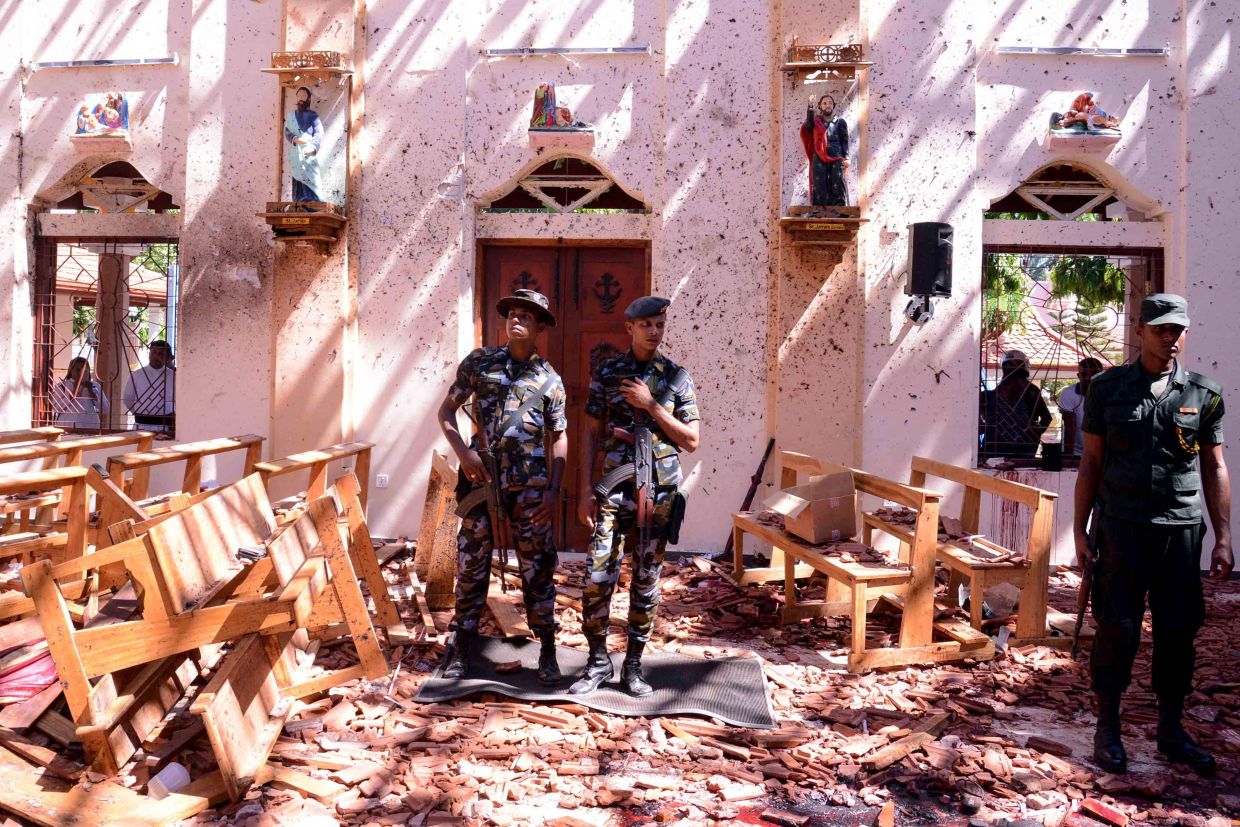
The arrest of Suresh Sallay represents one of South Asia's most startling reversals of official narrative. The retired major general and counterterrorism specialist, who has lectured at the Pentagon and United Nations on preventing extremist radicalisation, now stands accused by his own government of engineering the deadliest civilian attack in Sri Lankan history. Detained in February under anti-terrorism provisions, Sallay faces charges of having "strategically directed" the coordinated bombings of April 21, 2019—attacks that claimed 279 lives and wounded over 500 in simultaneous strikes across three luxury hotels and three churches.
The Easter bombings shook not only Sri Lanka but the global community. Among the dead were tourists and business travellers from Australia, Britain, China, Denmark, the Netherlands, Japan and the United States, transforming what appeared to be a regional security failure into an international incident. The initial investigation traced responsibility to seven Sunni Muslim suicide bombers allegedly inspired by the Islamic State group. International media scrutinised how intelligence warnings, particularly from Indian agencies, went unheeded and how such an organised operation evaded security detection across multiple targets. For nearly four years, this narrative—of a militant jihadist cell exploiting gaps in Sri Lanka's security apparatus—remained the official explanation.
Yet investigators and government prosecutors now pursue an altogether different theory: that the attacks were orchestrated by elements within the state apparatus itself, wielded as a political weapon to influence the 2019 presidential election. Public Security Minister Ananda Wijepala declared in parliament that Sallay served as the "mastermind" who "conspired with and strategically directed Islamic extremists until they carried out the attacks." According to Wijepala's account, Sallay met with Muslim men mere weeks before the bombings to gather intelligence on potential targets. This extraordinary reversal suggests not merely a security lapse, but deliberate cultivation of a terror cell by state actors seeking to engineer a crisis.
The alternative narrative rests on allegations that hardline Buddhist nationalist elements, aligned with the powerful Rajapaksa political dynasty, constructed a false flag operation to create the conditions for a security-focused political victory. Gotabaya Rajapaksa, a retired military officer, had campaigned on a platform of crushing Islamist extremism—a message that would resonate powerfully following nationwide attacks by Muslim suicide bombers. A 2023 Channel 4 investigation cited a whistleblower claiming the attack was permitted to unfold to facilitate Rajapaksa's election-winning narrative. Investigators have told the court that the alleged conspiracy aimed to generate sufficient chaos and fear that voters would rally behind Rajapaksa as the strongman capable of protecting the nation, much as he had led the military campaign against Tamil separatists a decade earlier.
Rajapaksa governments have acknowledged a historical precedent for such manipulation: during Sri Lanka's 1983-2009 civil war, the state deliberately funded jihadist groups to gather intelligence on Tamil rebel movements. According to official accounts, these militants were meant to serve as proxy intelligence collectors, yet they allegedly double-crossed their handlers and launched the Easter bombings independently. Critics, however, argue that this convenient narrative obscures deliberate deployment. They contend that state security agencies deliberately cultivated and radicalised a network of Islamist extremists, not merely to monitor Tamil separatists, but to manufacture a contemporary Muslim terror threat that could justify both the election of Rajapaksa and subsequent suppression of minority communities and democratic freedoms.
Sallay's own trajectory illuminates the intersection of institutional power and sudden political vulnerability. After Gotabaya Rajapaksa's 2019 election victory, Sallay received appointment as head of the State Intelligence Service—a remarkable honour that made him the first military officer ever entrusted with Sri Lanka's espionage apparatus. His credentials seemed impeccable: a career officer who had served in Sri Lankan diplomatic missions in France and Malaysia, educated at India's prestigious National Defence College and universities in New Delhi and Bradford. He had addressed American defence strategists on suicide terrorism and warned the United Nations about social media's role in radicalising vulnerable populations. His very expertise on extremism and terrorism recommended him for leading the nation's intelligence response.
Yet shortly after assuming office, Sallay wielded his new authority to arrest Hejaaz Hizbullah, a Muslim human rights lawyer, in 2020. Hizbullah was accused of masterminding the Easter bombings despite no credible evidence being produced. The lawyer spent twenty-two months in detention before authorities reluctantly released him, their case in ruins. That Sallay would deploy his intelligence position to intern a prominent Muslim rights advocate without sufficient evidence suggests either incompetence or political calculation—or both. Hizbullah's detention might be read as part of a broader strategy to silence Muslim voices and consolidate power during Rajapaksa's administration.
Sallay's own arrest now mirrors that earlier pattern of state power wielded without constraint. He has not been formally charged despite months in custody, and he maintains his innocence categorically. His next court appearance is scheduled for mid-July, yet the legal process shows few signs of imminent resolution. The absence of formal charges while maintaining detention reflects the arbitrary character that has come to define Sri Lankan law enforcement under successive administrations. His case demonstrates how anti-terrorism legislation, ostensibly designed to protect public security, becomes an instrument through which powerful actors eliminate rivals or silence inconvenient witnesses.
The diversity of Sallay's personal identity—a Muslim married to a Buddhist woman, with a Catholic mother who has petitioned Pope Francis for his release—mirrors the religious pluralism that characterises Sri Lanka itself. The nation of 22 million comprises approximately 70 percent Buddhists, 12 percent Hindus, ten percent Sunni Muslims and seven percent Christians. Yet this demographic reality contrasts sharply with political narratives that increasingly position Muslims as foreign threats and Islam as incompatible with Sri Lankan national identity. Sallay's detention resonates beyond his individual fate; it signals vulnerability for Muslim citizens and religious minorities more broadly.
The investigation into the Easter bombings has exposed documented links between the bombers and at least two separate state intelligence agencies, confirming that security institutions possessed far deeper knowledge of the planned attacks than publicly acknowledged. Rather than treating these institutional connections as evidence of coordinated conspiracy requiring transparent judicial examination, government authorities instead appear to be scapegoating individuals—first Hizbullah, now Sallay—while protecting the broader institutional structures that facilitated the attacks. The focus on Sallay as a singular "mastermind" may serve to deflect attention from systematic failures or deliberate actions by multiple agencies and political actors.
For Malaysia and other Southeast Asian nations, the Sri Lankan case illustrates how counterterrorism frameworks and intelligence agencies, when operating without genuine oversight and within systems of weak institutional checks, become instruments of political control rather than public security. The transformation of Sallay from celebrated counterterrorism expert to accused terrorist architect happened not through any dramatic revelation of hidden evidence, but through administrative decision and political accusation. Malaysian observers should note that the same security apparatus and legal mechanisms invoked to protect citizens can, without robust parliamentary oversight and judicial independence, become weapons against citizens themselves.
The ultimate trajectory of Sallay's case will shape how Sri Lanka's political leadership confronts or obscures the truth about one of South Asia's most significant terror attacks. Should courts eventually prove the conspiracy allegations with transparent evidence, they will have documented an extraordinary security scandal. Should authorities ultimately release him without charges, as they did with Hizbullah, the episode will have revealed the arbitrary nature of security detention in Sri Lanka. Either way, the reversal from blaming external militants to accusing a state intelligence chief reflects the turbulent politics of post-conflict South Asian societies struggling to reconcile security imperatives with democratic accountability and minority protection.

