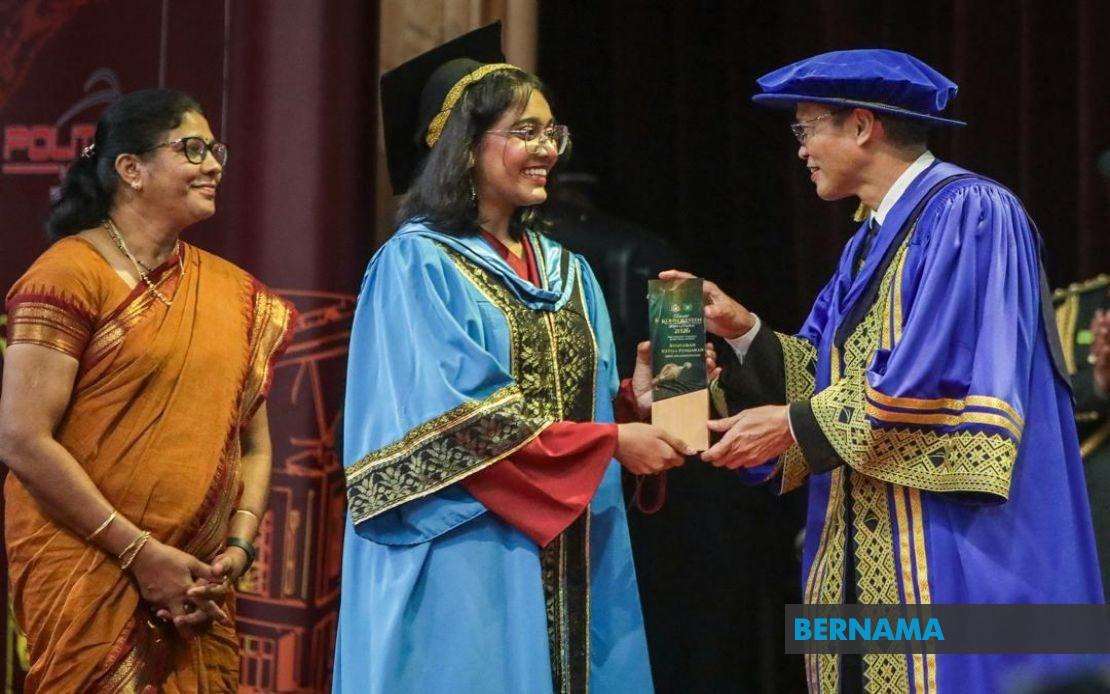
Teerti Ganapathi Rao's journey through Politeknik Tuanku Syed Sirajuddin stands as a testament to resilience in the face of personal tragedy. The 22-year-old Diploma in Digital Technology graduate from the Department of Information and Communication Technology secured two prestigious honours during the 2026 Northern Zone Polytechnic and Community College Convocation Ceremony, held at PTSS in Arau today. What makes her achievement particularly remarkable is that she earned these accolades—the Director-General's Award and the Academic and Co-Curricular Excellence Award—whilst grappling with the profound loss of her father, who died whilst she was sitting her Semester Two examinations in 2023.
With a cumulative grade point average of 3.61, Teerti has set a high benchmark for academic performance within the polytechnic system. Her accomplishment resonates beyond mere statistics, reflecting the complex emotional landscape that many Malaysian students navigate whilst pursuing their qualifications. The convocation ceremony, graced by the Raja of Perlis Tuanku Syed Sirajuddin Jamalullail, celebrated 6,104 graduates from polytechnics and community colleges across Perlis, Kedah and Penang. Among this cohort, Teerti's recognition underscores the polytechnic sector's commitment to acknowledging not only academic prowess but also the personal circumstances that define each student's educational trajectory.
In her remarks to journalists at Dewan Harumanis, Teerti expressed genuine surprise at receiving the award, an emotion that speaks to her humility and the unexpected nature of her success given the circumstances she faced. Her father's counsel during his lifetime became the foundational pillar upon which she built her resolve. As the youngest of four siblings, she had initially contemplated pursuing a foundation programme, but her late father's persistent encouragement to complete her diploma proved transformative. That paternal guidance, which she internalized during his lifetime, became her emotional anchor during the darkest period of her academic journey.
The institutional support Teerti received from Politeknik Tuanku Syed Sirajuddin also deserves recognition. Over her three-year tenure, she earned the Head of Department's Award for Semesters One, Three and Four, demonstrating sustained academic performance rather than isolated achievement. Beyond the classroom, her engagement with the Student Representative Council provided practical training in leadership, communication and collaborative problem-solving—competencies increasingly demanded by Malaysian employers across digital sectors. These co-curricular experiences equipped her with soft skills that complement her technical qualifications, positioning her competitively within the technology workforce landscape.
Teerti's intellectual curiosity extended beyond the immediate curriculum. She represented PTSS in a collaborative programme and delivered a seminar paper at Universiti Putra Indonesia, facilitating academic exchange within Southeast Asia's polytechnic and university networks. Her final-year project, the Koop Printing System, demonstrates applied learning at work—she designed software to enhance operational efficiency within cooperative printing services, illustrating how polytechnic education translates into tangible solutions for small and medium enterprises. This project-based approach aligns with the polytechnic sector's mission to produce graduates capable of immediate workplace contribution.
Language proficiency often distinguishes competitive graduates in Malaysia's increasingly globalized economy. Teerti's multilingual abilities span Mandarin, Tamil and Telugu alongside Bahasa Melayu and English, with foundational knowledge of French, Japanese and Korean. This linguistic versatility reflects both her intellectual agility and her awareness that technology careers frequently operate within international contexts. For Malaysian employers seeking digitally skilled workers capable of navigating cross-cultural professional environments, such capabilities represent genuine asset.
Looking forward, Teerti has applied for undergraduate programmes in Bachelor's degree Information Technology, with Universiti Malaya as her preferred institution. Her aspiration to ultimately pursue a Doctor of Philosophy degree signals ambition that transcends the polytechnic-to-employment pathway many of her peers follow. This academic trajectory, if realized, could position her among Malaysia's emerging technology researchers, potentially contributing to the nation's efforts to build indigenous innovation capacity within the IT sector. Such pathways, where polytechnic graduates transition into university-level and postgraduate study, remain underdeveloped within Malaysia's education ecosystem, making her trajectory noteworthy.
Teerti attributes her interest in information technology to an introduction at age 16 through gaming communities, where she encountered coding and computational thinking. This organic pathway into STEM—mediated through leisure activities rather than formal guidance—highlights how digital natives naturally gravitate toward technology fields. Her observation that IT is challenging but becomes manageable through systematic learning and conceptual clarity reflects maturity often lacking in younger students. She has internalized that technical mastery requires patience, sustained effort and genuine understanding rather than rote memorization.
The convocation ceremony itself, running through August 9, represents a significant moment for Malaysia's polytechnic sector. Celebrating over six thousand graduates simultaneously acknowledges the substantial contribution these institutions make to workforce development across northern Peninsular Malaysia. For a nation navigating digital transformation and seeking to reduce dependency on imported technical talent, polytechnic graduates like Teerti represent the foundation upon which this transition depends. Their willingness to persist through personal adversity whilst maintaining academic excellence suggests a workforce generation equipped not merely with technical knowledge but psychological resilience.
Teerti's story carries implications beyond individual success. It demonstrates that personal tragedy need not derail educational ambitions, particularly where institutional support structures and family encouragement align. For Malaysian policymakers, her journey exemplifies why investment in polytechnic infrastructure, counselling services and academic support mechanisms yields returns measured not only in employment statistics but in human capability and resilience. Her awards validate not merely her examination performance but her capacity to function productively amid grief, a capacity every institution should cultivate.
Moving forward, institutions like PTSS might consider how Teerti's experience can inform student support frameworks. Grief during examination periods, whilst individually managed by Teerti, likely affects other students less visibly or less successfully. Strengthening psychosocial support, flexibility in assessment and peer mentorship would acknowledge that academic excellence emerges from the intersection of intellectual ability, institutional responsiveness and personal determination. Teerti's Director-General's Award recognizes not merely what she achieved but the circumstances within which she achieved it—a distinction worth highlighting as other Malaysian students navigate their own complex personal circumstances.

