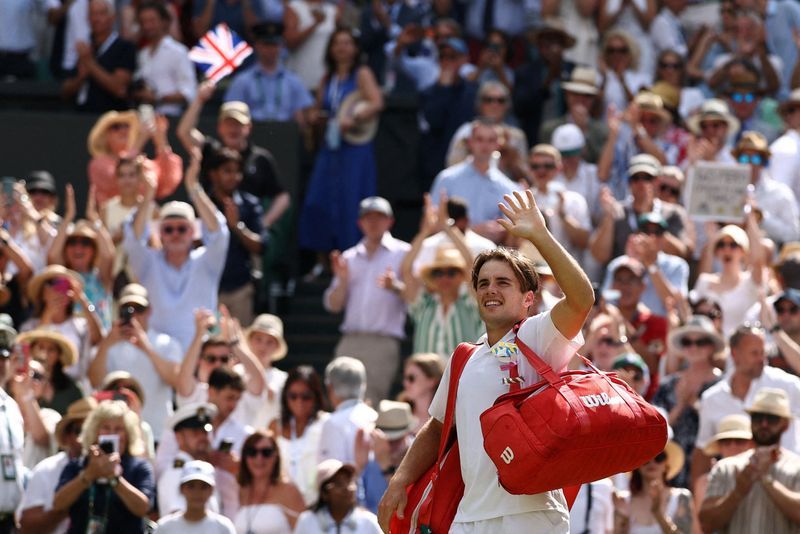
Arthur Fery's unexpected journey through Wimbledon this July has rewritten the script of his 2024 summer. The 23-year-old Briton arrived at the All England Club as Britain's 114th-ranked player, initially viewing the tournament as merely a professional obligation. What set him apart was his wildcard entry—a gift that would soon prove transformative. Rather than steeling himself for a likely early exit, Fery had already mentally checked out, envisioning himself relaxing on Greek shores with friends while the tournament progressed without him. Instead, he would spend the next fortnight grinding through matches on London's sweltering Centre Court, his tan plans abandoned for the gruelling demands of grasscourt tennis at sport's most prestigious venue.
The scale of Fery's achievement cannot be overstated in the context of modern tennis. He became the first wildcard entry to reach the men's semi-finals at Wimbledon in a quarter century, a statistic that underscores how rare such penetration truly is in an era dominated by established touring professionals. His path through five consecutive matches represented an accumulation of unlikely victories, each one seemingly improbable for a player whose major championship experience beforehand amounted to just two previous wins across all Grand Slam tournaments. The journey tested not only his physical endurance during London's heat wave but also his mental fortitude as expectations mounted with each passing round.
The narrative around Fery captured public imagination in a way few tennis stories do. His Greek holiday plan became a running joke that humanised the competition, transforming what might have been a straightforward athlete-overcomes-odds narrative into something more relatable and amusing. When one of his friends had departed for Greece ahead of schedule, confident that Fery would exit early and join him, only to return two days later to support his unexpected ascent, it provided the kind of storyline that resonates beyond the tennis community. This personal touch, combined with his youth and home advantage, galvanised supporters and created an atmosphere of genuine national investment in his progress.
The support Fery received transcended typical sports fandom. The England men's football team, fresh from their own tournament experiences, sent him a video message of encouragement. More significantly, Queen Camilla and Princess Kate attended matches to watch him compete, lending a sense of ceremonial importance to his run. Such endorsements, whether from international football stars or the British royal family, carry weight that extends Fery's influence beyond the tennis-watching public. For a player ranked outside the top 100, this level of institutional and cultural backing was extraordinary and clearly energised his performances during the crucial latter stages.
Fery's run ultimately concluded when Alexander Zverev halted his progress in straight sets on Friday, bringing an end to the fairytale but not diminishing its significance. The German's victory represented the collision between Fery's surging momentum and the established elite of professional tennis. While defeat stung, the semi-final appearance alone guaranteed a transformation in Fery's career trajectory and financial security. He collected £900,000 in prize money from reaching the last four, a sum that would have seemed fantastical just weeks earlier and which immediately elevated his prospects for the remainder of the season.
The financial windfall represents more than mere compensation; it reflects the tangible investment professional tennis places in deep tournament runs. With this substantial sum secured, Fery can indeed afford the upgraded holiday he joked about, but more importantly, he can focus entirely on his professional development without the financial anxiety that often constrains rising players. The prize money provides a safety net that allows for longer training blocks, better coaching support, and entry fees for higher-tier events that might otherwise strain his budget.
Fery's ranking trajectory undergoes dramatic revision following his semi-final appearance. His position is anticipated to improve into the mid-30s, a leap of nearly 80 places that fundamentally alters the landscape of opportunities available to him. This elevation automatically qualifies him for tour events across a full year and potentially beyond, eliminating the need for wildcards and qualifying rounds that characterised his path to Wimbledon. Such access to the professional circuit's main draws represents the difference between gradual development and accelerated progression towards genuine contention status.
The implications for British tennis are significant, particularly given Fery's position as the nation's new number one in the men's rankings following his surge. This elevation places pressure and expectation squarely on his shoulders, a burden he acknowledges with refreshing honesty. His willingness to embrace the challenge rather than shy from it suggests maturity beyond his years, though the real test will emerge in how he performs when the novelty of his Wimbledon achievement fades and opponents begin studying his patterns.
Fery's own assessment of what lies ahead demonstrates both realistic ambition and measured perspective. He recognised the necessity of a proper rest period to process the extraordinary events of the past fortnight before embarking on the North American hardcourt swing. This circuit culminates with the US Open at Flushing Meadows, where Fery will make his Grand Slam debut in the main draw—a far cry from his wildcard entry at Wimbledon. The hardcourt surface, particularly in American conditions, will present a stern examination of whether his grasscourt breakthrough translates across different playing environments.
For Malaysian and Southeast Asian tennis followers, Fery's story offers an intriguing reminder that professional sport remains capable of producing genuine surprises, even at its highest levels. While Fery's achievement occurred within the European tennis ecosystem, it validates the principle that dedication and opportunity, when converging, can produce outsized results. The tournament's conclusion marks not an ending but a beginning for a player whose ranking and resources will finally permit him to compete as an equal rather than an aspiring hopeful.

