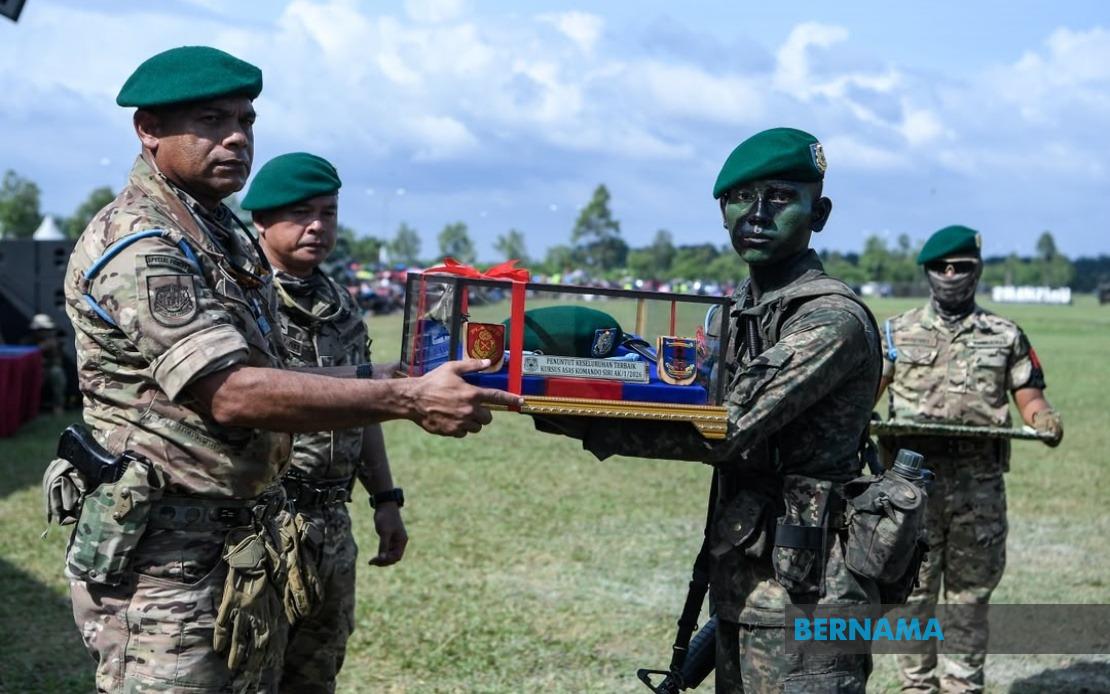
Second Lieutenant Muhammad Fadli Jamalluddin's ascent through Malaysia's demanding commando training programme offers an instructive lesson in military perseverance and the institutional value placed on determination in the armed forces. The 24-year-old officer from Ampang completed the Basic Commando Course Series AK/1/26 at Universiti Sultan Abdul Halim Mu'adzam Shah in Kuala Ketil on July 11, earning recognition as Best Overall Trainee—an achievement rendered all the more significant by his prior failures and the near-catastrophic setback he narrowly averted during the course itself.
Muhammad Fadli's path to the green beret was far from straightforward. He initially faltered during the Basic Commando Course Series 3/2024, a disappointment that could have derailed lesser aspirants. Rather than accepting defeat, he channelled his frustration into renewed commitment, returning for a second attempt with sharpened focus and deeper understanding of what the course demanded. This trajectory—failure, reflection, and purposeful return—reflects a temperament increasingly sought in special operations personnel, where both physical capability and psychological resilience determine success in high-stakes environments.
The trajectory toward a military career took root during his secondary education, where Muhammad Fadli first envisioned himself serving in uniform. He pursued this calling through studies at the National Defence University of Malaysia (UPNM), ultimately joining the Royal Malay Regiment in 2024 with a Bachelor's degree in Global Policing and Intelligence with Honours. His academic background distinguished him among commando candidates, providing theoretical frameworks for understanding special operations planning and decision-making beyond raw physical endurance. This educational foundation would prove crucial when he faced the most critical juncture of his commando training.
During the eighth week of the current course, Muhammad Fadli encountered a training failure that threatened to disqualify him entirely. At that advanced stage—having already completed over 100 kilometres of demanding endurance marches and survived weeks of combined land and sea training—another complete course repetition loomed as a real possibility. The psychological impact proved immense; by his own account, he wept at the prospect of beginning anew. Colleagues and mentors counselled him to withdraw rather than submit to further punishment, yet he refused the path of convenience. His determination to transform failure into opportunity rather than accepting it as a terminal verdict demonstrates the mental fortitude that distinguishes elite military personnel.
The three-month curriculum that Muhammad Fadli navigated combines rigorous land and sea operations designed to test both physiological limits and psychological endurance. As he observed, becoming a commando demands far more than physical strength; it requires the cognitive sharpness and sound judgment essential for planning complex special operations and making split-second decisions under extreme pressure. This holistic approach to soldier development—treating physical capability as merely one component of multifaceted military competence—reflects global best practices in special forces training and increasingly shapes how Malaysia's military identifies and develops elite personnel.
Beyond the institutional context, Muhammad Fadli's achievement carries profound personal significance. As the third of five siblings, he carries family aspirations alongside personal ambition. His motivation crystallised around a deeply emotional imperative: making his father proud. This personal anchor became particularly poignant given that his father suffered a stroke more than a year prior, preventing attendance at the closing ceremony. Muhammad Fadli has dedicated his accomplishment to his father's strength and recovery, transforming military achievement into an act of familial devotion and hope. Such personal narratives humanise the broader institutional story of military excellence and highlight how individual service connects to family narratives and intergenerational aspiration.
The commando training course that Muhammad Fadli completed represents one of Malaysia's most selective military pipelines. Of the cohort, only five officers and 33 other ranks successfully navigated the full curriculum—numbers reflecting the attrition inherent in genuinely demanding selection processes. These graduation rates ensure that the green beret genuinely signifies exceptional capability rather than mere completion of a bureaucratic process. For a young officer to emerge not simply as a graduate but as the standout performer speaks to exceptional dedication and talent.
Colonél Nordin Abu, Commandant of the Special Warfare Training Centre (PULPAK), presented Muhammad Fadli with the Best Overall Trainee award. This institutional recognition validates both his individual effort and the training system's capacity to identify and reward excellence. Within the military hierarchy, such awards carry symbolic weight, signalling to peers, superiors, and the broader defence establishment that an officer possesses exceptional promise for future special operations roles and potential advancement into senior leadership positions.
Muhammad Fadli's membership in the 21st Special Service Group (21 GGK) marks his formal entry into Malaysia's elite commando units. These formations serve critical roles in national security, ranging from counterterrorism operations to disaster relief, and place extraordinary demands on personnel. Having demonstrated resilience through repeated setbacks and sustained performance under duress, Muhammad Fadli arrives in this role with a proven track record of perseverance. His journey from initial failure to excellence illustrates that military capability emerges not from unblemished trajectories but from the capacity to absorb failure, extract lessons, and return stronger—a quality particularly valuable in the unpredictable operational environments where special forces operate.
The broader significance of his achievement extends to how Malaysia's military cultivates excellence within its officer corps. By insisting on rigorous selection standards while simultaneously providing pathways for candidates to remediate initial failures, the institution balances meritocratic selection with developmental opportunity. Muhammad Fadli's example demonstrates that first attempts need not determine ultimate capacity, provided candidates possess the psychological resilience and institutional support to attempt recovery. This approach contrasts with systems that make single-attempt selections, potentially losing valuable personnel whose initial performance may not reflect ultimate capability.
Looking forward, Muhammad Fadli enters his specialised military career with credentials that position him advantageously for advancement. His combination of university-level education, commando qualification, demonstrated resilience, and award-winning performance creates a profile attractive for accelerated career development, potential involvement in advanced training programmes, and eventual positions of greater responsibility within special operations commands. The Malaysian military benefits from retaining and developing officers of this calibre, particularly as regional security challenges increasingly demand sophisticated special operations capabilities.

