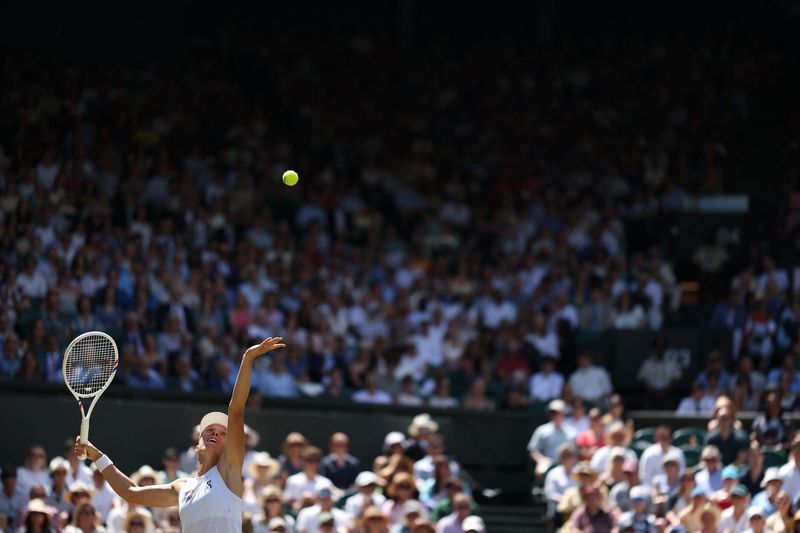
Alexandra Eala's remarkable journey reached a career-defining moment on Saturday when the rising Filipino tennis star eliminated Poland's Iga Swiatek, the third seed and defending Wimbledon champion, in a thrilling third-round encounter at the All England Club. The 7-6(9) 6-2 victory represented a seismic upset in women's tennis, signalling that Eala has arrived as a genuine threat at sport's grandest stages. The emotional Eala, visibly overwhelmed by the magnitude of her achievement, reflected on her path from humble beginnings to the hallowed grass courts of London, describing the triumph as validation of years of sacrifice and dedication.
Swiatek's title defence unravelled against an opponent who refused to be intimidated by her opponent's pedigree and ranking. The Polish player arrived at Wimbledon carrying the weight of expectation after capturing last year's crown, a breakthrough that finally answered persistent questions about her competence on grass. However, the early exit in the Bad Homburg preparation tournament had raised fresh doubts about her consistency, and Saturday's loss suggested those concerns were justified. Despite navigating past Taylor Townsend and dispatching Karolina Pliskova in successive rounds, Swiatek found herself outplayed by an inspired Eala under bright afternoon skies that favoured the challenger's aggressive baseline tactics.
The opening set crystallised the intensity of their confrontation, with neither player yielding ground easily. Both competitors displayed exceptional shot-making and mental fortitude, engaging in a tiebreak that reflected the championship-level tennis on display. Swiatek's frustration manifested in visible signs of irritation—a smile masking underlying discomfort, followed by animated exchanges with her support team and a racket slam on her chair. Yet Eala thrived on the drama, commanding Centre Court with a powerful left-handed baseline game that consistently troubled Swiatek's returning and disrupted the Pole's typical rhythm. The crowd's roaring approval for the underdog Filipino athlete created an atmosphere that clearly elevated Eala's performance while potentially adding pressure on the defending champion.
Eala's previously recorded loss to Swiatek in Miami, followed by the Polish player's revenge victory in Madrid, had established a competitive narrative between the pair. Saturday's encounter, however, proved decisive in establishing a new chapter in their rivalry. The second set saw Eala elevate her intensity considerably, breaking Swiatek's serve twice in succession to establish commanding 3-0 advantage. Her powerful stroke-making and clinical execution overwhelmed the Polish player's attempts to find her range. Swiatek showed glimpses of recovery when she retrieved one break and demonstrated renewed determination, yet Eala maintained her composure when it mattered most, ultimately sealing the victory with a precise forehand winner that punctuated her dominance.
The implications of this victory extend far beyond the immediate tournament result. Eala becomes only the second Filipino player in recent memory to advance to the second week of a Grand Slam, representing a landmark achievement for tennis development in the Philippines. Her emotional remarks after the match, recounting her childhood training sessions with her brother and grandfather while wearing mismatched attire and shoes with light-up features, resonated with the broader narrative of Southeast Asian athletes breaking through on the global stage. The specificity of those memories—the ruffled socks, the light-up shoes, the youthful exuberance—underscored how this moment validates sacrifices made by entire families pursuing excellence in a sport historically dominated by wealthier, more developed nations.
Eala's progression creates intriguing scenarios for the tournament's second week. Her fourth-round opponent will be Jasmine Paolini, the 2024 final runner-up, a formidable challenge that will test whether Eala's victory over Swiatek represented a genuine elevation in her capabilities or a one-match flowering. Nonetheless, her composure throughout the contest and her ability to maintain focus during crucial moments suggest a player maturing rapidly on the professional stage. The 19-year-old left-hander's tactical intelligence—particularly her willingness to attack early in rallies and her willingness to take risks—indicates coaching of high quality and personal dedication to continuous improvement.
For Malaysian and Southeast Asian tennis enthusiasts, Eala's breakthrough carries particular significance. The region has produced talented players, yet few have sustained excellence at Grand Slam level. Eala's demonstration that a Southeast Asian player can compete with and defeat top-seeded Grand Slam champions opens psychological pathways for emerging stars throughout the region. The victory also illustrates how modern professional tennis increasingly rewards aggressive, innovative play over defensive consistency—a tactical evolution that favours players willing to take calculated risks rather than relying solely on court positioning and stability.
Swiatek's defeat raises questions about the consistency that has eluded her throughout her career despite multiple Grand Slam titles. The Polish star's difficulty in maintaining form across different surfaces and tournament cycles remains a defining characteristic of her career arc. Her struggles on grass, despite last year's championship, suggest that previous victory represented a temporary breakthrough rather than a transformed player. The back-to-back rounds against Townsend and Pliskova provided false confidence about her tournament trajectory, masking underlying vulnerabilities that Eala's aggressive approach mercilessly exposed.
The Centre Court atmosphere played a meaningful role in the outcome. Eala's recognition of the crowd's support and her explicit gratitude for their encouragement demonstrated emotional intelligence and connection to the occasion. She understood that Grand Slam tennis involves not merely technical excellence but psychological resilience and ability to harness crowd energy. Her comment that this represented her dream court and that she had to seize such rare opportunities reflected a mindset of gratitude coupled with ambition—a balance that separates tournament-winning athletes from those who merely participate.
Looking forward, Eala's victory positions her as a player whose trajectory deserves serious monitoring. The combination of technical skill, tactical sophistication, mental resilience, and youthful hunger creates a profile consistent with players who sustain excellence over multiple seasons. While she faces genuine tests in upcoming rounds, the psychological barrier of defeating a top-three seeded defending champion has been permanently breached. Such victories, particularly against opponents of Swiatek's stature, fundamentally alter player confidence and ranking trajectories.

