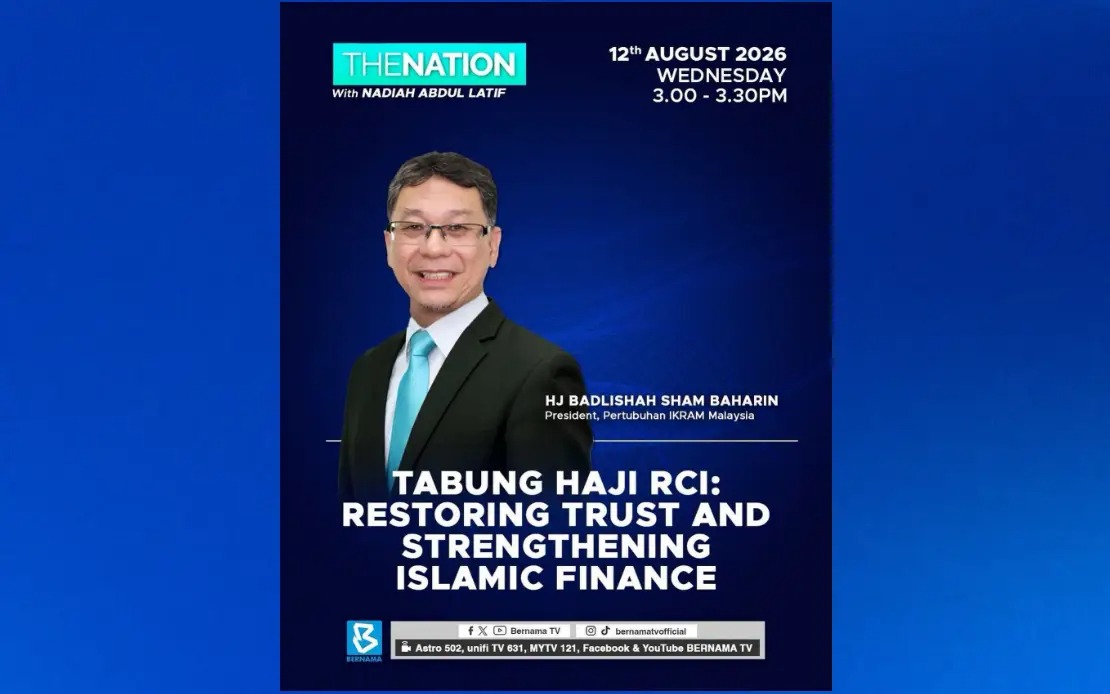
Pertubuhan IKRAM Malaysia's president Badlishah Sham Baharin has pushed back against mounting pressure for a fresh Royal Commission of Inquiry into Tabung Haji, contending that the current investigation by authorities provides sufficient oversight of the troubled pilgrim fund manager. Speaking after an appearance on Bernama TV's current affairs programme discussing trust and stability in Islamic finance, Badlishah Sham articulated concern about the escalating use of RCIs as a policymaking tool, warning that deploying such bodies for routine matters dilutes their institutional gravitas and reserved status for genuinely critical matters of national scope.
Both government and opposition lawmakers have recently demanded an expanded RCI to examine Tabung Haji's stewardship during the 2021-2025 period, citing evidence that the previous commission's mandate terminated at 2020. The calls reflect persistent unease over the fund's financial trajectory and the accumulation of losses that have shaken confidence among nearly 10 million depositors and the broader Muslim community. Finance Minister II Datuk Seri Amir Hamzah Azizan disclosed in parliamentary proceedings that the institution sustained nearly RM13 billion in losses across 14 problematic investments, with seven initiatives resulting in complete financial collapse and recovery considered unattainable.
The scale of financial deterioration reflects a systemic failure spanning years. Approximately RM10.2 billion of this catastrophic loss was absorbed by taxpayers through a government rescue engineered by Urusharta Jamaah Sdn Bhd in 2018, while an additional RM2.6 billion in write-downs materialised between 2018 and 2025 as investments remaining under Tabung Haji's active management continued deteriorating. These figures underscore the severity of mismanagement and the extent to which ordinary Malaysians, particularly the Islamic-observant middle class and lower-income groups who constitute Tabung Haji's base, have borne the consequences of institutional governance failures.
Among the most egregious losses was the Al-Rawda arrangement, which consumed RM1.5 billion of Tabung Haji's resources. The scheme involved leasing accommodations in Makkah and Madinah to house pilgrims during the hajj season, with Tabung Haji disbursing 1.4 billion Saudi riyals to intermediaries between 2015 and 2017. When Al-Rawda ceased rental remittances in early 2019, Tabung Haji was forced to acknowledge the investment's irretrievable nature, provisioning a full RM1 billion impairment charge in 2024. This particular catastrophe exemplifies how investment decisions lacked elementary due diligence, risk assessment mechanisms, and safeguards to protect pilgrims' savings.
Badlishah Sham's position reflects a pragmatic approach to institutional accountability. Rather than endorsing another extended judicial inquiry consuming years and vast public resources, he advocates for establishing a coordinated multi-agency task force capable of examining investment portfolios displaying elevated risk profiles whilst simultaneously preventing recurrence of comparable lapses. This mechanism would function more expeditiously than traditional RCI procedures whilst maintaining investigative rigour and accountability oversight. Critically, he emphasised that foundational investment diligence must precede any capital deployment, demanding comprehensive examination of whether proposed ventures align with ethical standards and procedural compliance frameworks before institutional resources are committed.
Yet Badlishah Sham's argument for restraint does not diminish accountability imperatives. He remains adamant that breaches of fiduciary duty and legal violations must culminate in criminal prosecution and consequence, delegating investigative responsibility to established institutions including the Malaysian Anti-Corruption Commission. This framework preserves both the institutional credibility of accountability mechanisms and the operational agility necessary to prevent capital squandering whilst investigations proceed through parallel channels. For Malaysian depositors and policymakers monitoring Tabung Haji's recovery trajectory, such an approach offers efficiency without sacrificing justice.
The debate simultaneously exposed parliamentary dysfunction when opposition lawmakers abandoned the Dewan Rakyat chamber during special proceedings focused on the RCI report, a development Badlishah Sham characterised as fundamentally irresponsible. He articulated a pointed criticism of legislators treating parliamentary obligations lightly, particularly given that these lawmakers represent constituencies whose residents depend upon Tabung Haji's integrity. Abandoning chambers during critical debate about institutional failure whilst subsequently mobilising social media platforms to critique government decisions represents, in his assessment, a dereliction of representative responsibility and a failure to execute the checks-and-balances function that underpins parliamentary democracy.
This commentary carries particular resonance across Malaysia's Muslim-majority electorate, where Tabung Haji maintains symbolic and practical significance extending far beyond conventional financial institutions. For millions of Malaysians, the fund represents their pathway to fulfilling one of Islam's five foundational pillars, making breaches of stewardship cuts especially deep. The RM13 billion in losses represents not merely accounting abstractions but compromised retirement provisions, delayed pilgrimage schedules, and eroded trust in governance structures purporting to serve Islam-specific requirements. When opposition politicians effectively withdrew from accountability proceedings, they signalled indifference to depositors' material interests and the institutional failures undermining community confidence.
The RCI report itself, released in late July, documented extensive governance deficiencies throughout the 2014-2020 period and produced 25 reform recommendations, with Tabung Haji implementing roughly 75 percent by month's end. However, these improvements address legacy problems whilst exposing questions about the 2020-2025 interval that operated beyond the commission's investigative scope. Whether an expanded RCI proves necessary or whether coordinated agency collaboration under Badlishah Sham's preferred framework suffices remains contested, yet both positions acknowledge that preventing comparable future disasters requires institutional transformation transcending merely prosecuting individuals responsible for historical losses.
For Malaysian policymakers navigating this governance crisis, the stakes extend beyond Tabung Haji itself. Islamic financial institutions across Southeast Asia—including pilgrim funds, Shariah-compliant investment vehicles, and Islamic banking products—face scrutiny regarding their governance standards and protective mechanisms. Malaysia's response to Tabung Haji's travails establishes precedent for how religious institutions entrusted with community capital should be monitored, investigated when failures emerge, and reformed to restore stakeholder confidence. Whether that accountability proceeds through fresh RCI procedures or alternative investigative mechanisms matters considerably less than demonstrating that institutional capture, investment recklessness, and fiduciary breaches carry genuine consequences whilst preventing future repetition through structural reforms and renewed oversight rigour.

