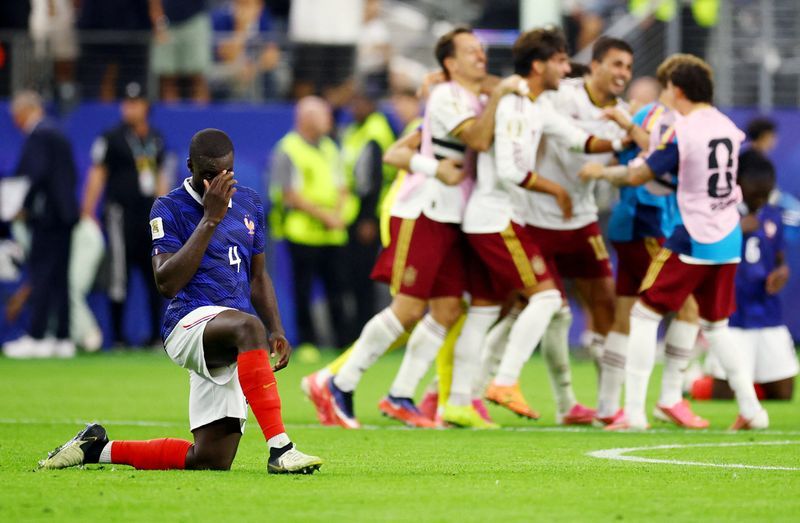
France's World Cup journey has ended in dramatic fashion, with the defending champions suffering a crushing 2-0 semi-final defeat to Spain in Arlington, Texas on Tuesday. The result represents a spectacular and humiliating exit for a team that had been widely regarded as tournament favourites heading into the knockout stages. Unlike their narrow penalty defeat to Argentina in the 2022 final—a match that saw them fight back from an unfavourable position to leave with honour intact—there was no redemptive narrative available this time. Instead, France were systematically dismantled by a Spanish outfit that played with superior tactical awareness and technical composure.
The gap between perception and reality proved cavernous for the French. Bookmakers and analysts had installed Didier Deschamps' squad as the tournament's most dangerous team, yet when faced with their first genuinely challenging opponent, they proved thoroughly inadequate. Coach Deschamps himself acknowledged the bitter truth in his post-match assessment, admitting that his players had failed to execute their game plan and were technically outclassed. The manager's candid admission underscored the extent of France's failure: this was not a case of narrow margins or bad luck, but a fundamental breakdown in their ability to compete at the level required.
Spain's approach to the match revealed a sharp tactical superiority that left France struggling from the opening minutes. The Spanish team, buoyed by the confident predictions of teenager Lamine Yamal—who had boldly declared that France should fear them—demonstrated a complete understanding of how to neutralise their opponents. Yamal's confidence proved entirely justified as his team controlled the pace and rhythm of the encounter, deliberately slowing the game when necessary to disrupt France's rhythm and force their opponents into frustration.
The symbolic embodiment of France's collapse was midfielder Michael Olise, the player Deschamps had positioned as the creative lynchpin to unlock Spain's defensive structure. Olise, who had enjoyed a season of such promise that his name had been mentioned in Ballon d'Or discussions, appeared utterly overwhelmed by the magnitude of the occasion. On the Dallas Stadium pitch, he was reduced to a peripheral figure, starved of possession and bereft of ideas. His statistics told a damning story: the 24-year-old surrendered possession twenty times and failed to complete a single dribble, an abysmal return that crystallised France's attacking sterility. In contrast, Spain's Rodri controlled the midfield with clinical authority, gliding through the French defensive lines with the ease of someone playing against an inferior opponent.
Olise's anonymity was merely symptomatic of a broader collapse across France's entire attacking apparatus. Ousmane Dembélé, who might have been expected to provide creative spark down the flank, posed virtually no threat whatsoever. The centre-forward position saw Bradley Barcola and his replacement Désiré Doué equally blunt and ineffective, rendering France's supposedly potent attacking lineup utterly impotent. Even Kylian Mbappé, despite his status as one of world football's finest talents, failed to produce the moment of individual brilliance that might have altered the trajectory of the match. The arena's loudest reaction of the afternoon came not from any French attacking move, but from the appearance of David and Victoria Beckham on the stadium's giant screen—a telling commentary on where the match's dramatic momentum lay.
France's vulnerability became increasingly apparent as the match progressed, particularly in their midfield where Deschamps' defensive pairing struggled against a superior Spanish side. Adrien Rabiot received an early caution that forced him into a constrained, defensive approach, robbing him of the aggressive presence he might normally have provided. Aurélien Tchouaméni, hampered by a lack of match fitness following a two-game absence through hamstring injury, found himself unable to maintain the pace of play and was repeatedly exposed by Spain's incisive passing sequences. These weaknesses in the heart of the pitch left France's defensive line fatally exposed.
Spain's efficiency in attack punished France's disorganisation with ruthless precision. Mikel Oyarzabal converted a penalty kick in the twenty-second minute after France had committed a defensive indiscretion, and Pedro Porro added a second goal just before the hour mark. These two moments of Spanish clinical finishing came against a backdrop of relentless Spanish pressure and French confusion. France never recovered from either setback, and the absence of any meaningful response illustrated the depth of their tactical paralysis.
The final whistle brought scenes of anguish that contrasted sharply with the pre-match rhetoric of unity and cohesion that had dominated French media coverage. Mbappé stood alone on the pitch in apparent stunned silence, while teammates either dropped to their knees or buried their faces in their hands. The body language of defeat was unmistakable and profound, suggesting that the squad's morale had been fundamentally shattered by the experience. All the carefully constructed narratives about team spirit and collective strength suddenly seemed hollow and distant.
For Southeast Asian observers, this result carries broader implications for how tournament favouritism and perceived strength can prove misleading in knockout football. Spain's calculated, methodical approach and willingness to engage in a sustained tactical battle demonstrated that the tournament's most expensively assembled squad is not necessarily the most dangerous. France's elimination removes one of Europe's strongest voices from the latter stages of the competition, potentially reshaping the tournament's trajectory in ways that could favour other contenders who have demonstrated greater tactical flexibility and resilience. The match serves as a stark reminder that football's unpredictability remains one of its defining characteristics, and that even the most formidable-seeming teams can be systematically dismantled when they encounter opponents of superior quality and preparation.

