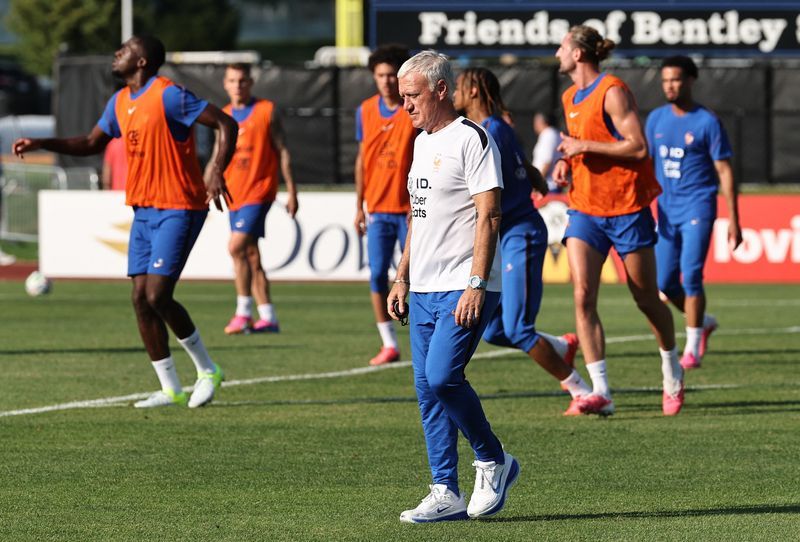
Les Bleus completed the group stage with a flawless record, demonstrating the kind of offensive dominance that suggests they remain among the tournament's most formidable sides. The French squad accumulated ten goals across victories against Senegal, Iraq and Norway, establishing themselves as Group I champions and setting the tone for their advancement to the knockout rounds. This run has confirmed what many observers suspected entering the competition: France possesses one of the most electrifying forward lines in modern World Cup football, anchored by the blistering pace of Kylian Mbappe, the technical brilliance of Ousmane Dembele and the creative versatility of Michael Olise.
Yet beneath the glittering attacking statistics lies a structural concern that coach Didier Deschamps cannot ignore as his team prepares for Tuesday's Round of 32 encounter with Sweden. The left flank of France's formation has appeared inconsistent and vulnerable throughout the group phase, prompting the manager to consider tactical adjustments that could strengthen this area without dismantling the attacking architecture that has proven so effective. Theo Hernandez, operating as left back, has failed to deliver the commanding performances expected of him, raising questions about France's ability to maintain clean sheets in a knockout competition where defensive composure becomes increasingly critical.
In response to these concerns, Lucas Digne is widely expected to replace Hernandez against Sweden, bringing proven defensive discipline and more reliable delivery from wide areas. The switch represents a pragmatic decision by Deschamps, prioritising stability over attacking ambition on the left side. Simultaneously, Bradley Barcola appears set to replace Desire Doue in the attacking line-up, with the manager seeking a player who offers directness, pace in transition and the kind of explosive running that can create genuine width on the flank opposite the dominant right-side combination of Olise, Mbappe and Dembele. These adjustments would preserve France's essential balance while creating greater cohesion across the entire defensive unit.
The return of William Saliba to central defence provides additional reassurance, delivering the kind of organisational presence that has sometimes been absent during the group phase. Nevertheless, Sweden represents the sort of pragmatic, physically imposing opponent that could exploit any lingering defensive vulnerabilities if France become careless. The Swedish side finished second in their group behind the Netherlands after a roller-coaster sequence of results: an emphatic 5-1 victory over Tunisia followed by a 5-1 defeat at Dutch hands, then a 1-1 draw with Japan. These results suggest a team capable of both clinical finishing and alarming lapses in concentration.
From a broader tournament perspective, Sweden will likely employ a compact defensive shape, attempting to restrict France's space and manufacturing opportunities from set pieces or rapid counter-attacks. This tactical approach could prove problematic for Deschamps if his defenders are not sufficiently alert, as the French back line has occasionally been caught off-guard during open play. The tournament structure itself presents a different examination compared to the group phase, where France could occasionally overwhelm inferior opponents despite defensive irregularities. Sweden, though not in France's category, possess sufficient organisation and physical intensity to make proceedings uncomfortable should the French side lose patience or underestimate their opposition.
From a competitive standpoint, France's attacking depth remains genuinely unmatched by any other team in the tournament. Beyond the settled front line, Deschamps can deploy Barcola, Doue, Rayan Cherki, Jean-Philippe Mateta or Marcus Thuram from the bench—a collection of attacking talent that no rival squad can reasonably match in terms of quality and quantity. This abundance of options means France can maintain sustained offensive pressure regardless of which personnel take the field at any given moment.
Mbappe has positioned himself as the tournament's defining figure, combining explosive pace with clinical finishing that has generated consistent scoring opportunities. Dembele's hat-trick performance against Norway highlighted the creative brilliance available in midfield, while Olise's intelligent positional play has orchestrated attacks from the right flank. This trinity of attacking options has operated with sufficient understanding that their on-pitch chemistry appears organic rather than imposed by coaching instruction.
Sweden's attacking resources, while respectable, occupy an entirely different category. Alexander Isak, Viktor Gyokeres and Anthony Elanga provide the Swedes with experienced forwards capable of troubling most defences, yet their combined firepower pales against France's multifaceted attacking system. As former England captain Gary Lineker observed to French sports daily L'Equipe, while Sweden cannot be dismissed as a weak side, they lack the devastating attacking amplitude that characterises the French operation. Lineker's assessment acknowledged that France's forward depth could theoretically render them vulnerable on counter-attacks—a tendency occasionally evident during their group-stage encounters—yet compensated for this vulnerability through sheer offensive superiority.
Historically, France have demonstrated exceptional pedigree in knockout competition. Since their loss to Germany in 2014, France have never exited the World Cup at this stage, with their only subsequent knockout defeat coming in the 2022 final against Argentina. This record suggests institutional understanding of how to manage the different demands and pressures that accompany sudden-death football. Sweden, conversely, arrive as opponents who depend heavily on structural discipline and occasional moments of clinical opportunism rather than sustained dominance.
Victory would position France for a potential Round of 16 clash against either Germany or Paraguay, both presenting different tactical challenges. The Germans represent a heavyweight opponent steeped in knockout tradition, while Paraguay offers an opportunity for France to impose their superior firepower against more modest opposition. Regardless of potential progression pathways, the immediate priority for Deschamps centres on resolving the left-side questions while maintaining the attacking momentum that has defined this tournament run. Should he successfully achieve this equilibrium, France will enter the knockout phase as genuine contenders for the title, possessing both the offensive sophistication and emerging defensive stability required for deep tournament progression.

