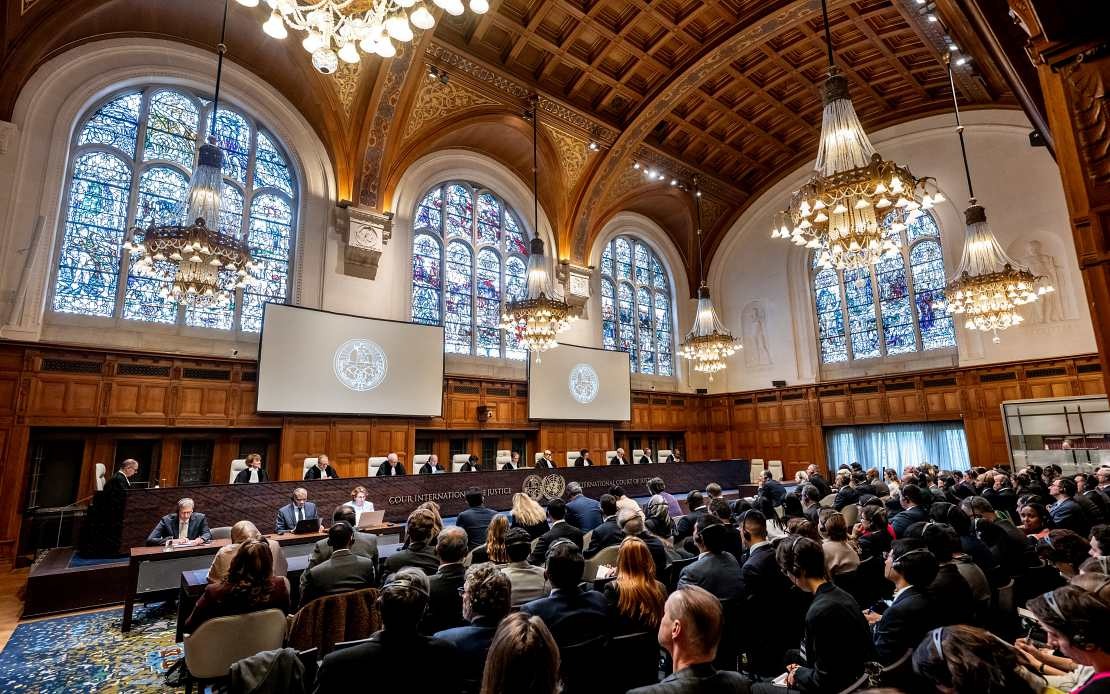
A diplomatic rift is widening between the United States and the International Criminal Court, with France this week positioning itself squarely behind the multilateral justice institution even as American leadership moves to undermine its authority. The French Foreign Ministry used an official statement on Thursday to reinforce Paris's backing for the ICC, directly contradicting claims from the US that the court represents a threat to sovereign nations and their judicial independence.
Pascal Confavreux, speaking for France's Ministry of Foreign Affairs, made clear that his government sees no contradiction between supporting the ICC and protecting national interests. Rather than viewing the court as an overreach of international authority, the French position holds that the ICC's mandate to prosecute individuals—rather than entire states—makes it fundamentally different from mechanisms that might genuinely compromise state sovereignty. This distinction is crucial to understanding how different nations frame their relationship with international justice architecture, particularly as geopolitical tensions complicate multilateral cooperation.
The immediate catalyst for France's statement was a series of escalating moves by the Trump administration, specifically by Secretary of State Marco Rubio, who has characterised the ICC as incompatible with American interests. Rubio's rhetoric signals not merely rhetorical opposition but an active campaign: Washington has launched a coordinated initiative explicitly designed to constrain what it perceives as the court's ability to challenge American interests, and Rubio has publicly announced that the US will actively recruit other nations to follow its lead in abandoning the institution.
France's response reflects a deeper philosophical disagreement about the role of international institutions in the modern world. While the US has historically maintained distance from the ICC—never ratifying the Rome Statute that established the court—many Western allies including France view the institution as essential to preventing mass atrocities and holding individuals accountable for crimes that transcend borders. The French statement explicitly affirmed the court's role in combating impunity and prosecuting crimes of the gravest magnitude: genocide, war crimes, crimes against humanity, and the crime of aggression.
Established in 2002 and headquartered in The Hague, the ICC emerged from international consensus that certain crimes were so severe they warranted prosecution by a forum beyond individual national systems. The court's jurisdiction remains narrow and complementary—it only intervenes when national courts are unwilling or unable to prosecute. This design was intended to address precisely the concerns that American policymakers now raise about sovereignty, yet the philosophical gap between Washington's position and that of ICC supporters appears to be widening rather than narrowing.
The symbolic weight of France's statement extends beyond bilateral relations between Paris and Washington. As a permanent member of the UN Security Council and a leading European power, France's reaffirmation of support carries implications throughout the Global South, where many nations view the ICC with considerable ambiguity. Some African and Middle Eastern countries have questioned whether the court's enforcement has been geographically balanced or has occasionally reflected the interests of more powerful nations, lending credence to arguments that international institutions can themselves be instruments of power imbalance.
French officials also emphasized what they characterised as unacceptable threats and attacks against ICC personnel and officials. This language suggests concern not only about the court's legal status but about its operational security and the safety of those who work within its system. Such attacks have been reported in various contexts, and the French position frames protection of the institution's staff as a matter of principle rather than mere administrative concern.
The confrontation between Washington and the ICC highlights a fundamental question about how international governance should function in an era of rising nationalism and declining faith in multilateral institutions. The US withdrawal impulse reflects a broader American skepticism toward mechanisms that might constrain executive discretion or submit American actions to external scrutiny. For smaller nations and those concerned about potential violations of international humanitarian law, conversely, the ICC represents a crucial counterbalance to the traditional dominance of powerful states in determining international norms and consequences.
Southeast Asian nations, many of which have complex relationships with international courts and dispute resolution mechanisms, are watching this dynamic with particular attention. Countries throughout the region have observed how major powers treat international institutions when those institutions' decisions conflict with their preferred outcomes. The French-American divergence over the ICC thus sends signals about whether rules-based international order remains meaningful or whether geopolitical power will ultimately determine institutional credibility and compliance.
France's support is neither costless nor symbolic alone. European nations collectively provide significant financial contributions to the ICC, and European backing provides the court with diplomatic cover and operational resources that would be difficult to replace should American pressure succeed in fragmenting the institution's support base. By explicitly reaffirming its commitment, France is signalling that it will not join any American-led campaign to hollow out or abandon the court, even as such campaigns intensify.
The timing and intensity of American opposition to the ICC suggests that the institution may face its most serious institutional crisis since its establishment. Whether other major powers follow France's path of reaffirmation or prove susceptible to American pressure will likely determine whether the ICC emerges strengthened through international solidarity or weakened through gradual institutional isolation and resource constraint. The next months will reveal whether the consensus that once created the ICC can withstand the pressures of contemporary great-power competition.

