When France and Morocco clash in a World Cup quarter-final in Boston on Thursday, the fixture carries far more than sporting significance. The two nations meet as historical partners whose complex relationship spans more than a century, with their football squads embodying the intricate webs of migration, education, and cultural exchange that have defined Franco-Moroccan ties since Morocco's independence in 1956. The players taking the field represent something deeper than national allegiance—they are products of a relationship that has fundamentally shaped both societies.
Morocco's status as a French protectorate from 1912 to 1956 left enduring marks across education systems, business networks, and population movements that continue to structure everyday life on both sides of the Mediterranean. Football has emerged as perhaps the most visible expression of these ties, with the sport serving as a mirror to the broader demographic and cultural currents flowing between the countries. The upcoming encounter in Massachusetts, rather than in the heightened security environment of France itself, may create space for these connections to be acknowledged more openly and celebrated more freely by supporters who share family histories and friendships across national borders.
The composition of Morocco's World Cup squad illustrates this entanglement with striking clarity. Six players were born on French soil, while numerous others developed their talents in Ligue 1 or progressed through France's youth academy system before choosing to represent Morocco internationally. These career trajectories are not anomalies but rather reflect a deliberate federation strategy that has transformed Morocco's diaspora into a competitive asset rather than viewing it as a loss of national talent. This approach represents a sophisticated recognition that football ability and national identity need not be mutually exclusive, and that a player's birthplace or formative years do not determine their ultimate footballing allegiance.
Ayyoub Bouaddi exemplifies this phenomenon with particular clarity. The teenager was born in France, developed his technical skills at Lille, and represented France at youth international level before ultimately committing to Morocco's senior programme. His career path encapsulates the dual footballing identities that lend this fixture its particular emotional resonance and distinguish it from conventional international encounters. Players like Bouaddi navigate multiple cultural and sporting worlds, their choices reflecting personal connections to heritage, family aspirations, and professional opportunities that transcend simple national categorisation.
Beyond individual player journeys, the fixture itself carries the weight of recent tournament history and shifting power dynamics in world football. France arrive as defending world champions from 2018, with the established credentials and attacking firepower expected of a team mounting a serious campaign for another global title. They have demonstrated their capacity to reach quarter-finals and beyond, their squad enriched by the multicultural composition that has long characterised French football at the elite level. Yet Morocco have fundamentally altered perceptions of what African football can achieve on the world stage. Four years ago, they became the first African nation to reach a World Cup semi-final, an accomplishment that captivated supporters far beyond their own borders and demonstrated that traditional football hierarchies were not immutable.
The previous encounter between these nations in Qatar in 2022, concluded with France emerging 2-0 victors, carried significant emotional charge while simultaneously demonstrating something unexpected—a mutual recognition between teams whose players and supporters understood each other's stories. That charge reflected not antagonism but rather the poignancy of meeting at such an elevated level, with so much at stake and so much shared history in the background. The rematch takes place in a notably different geographical and cultural context that may alter the tenor of how their rivalry is perceived and experienced.
Boston provides an unexpectedly intimate setting for this encounter compared to the European theatre where such fixtures typically unfold. The Moroccan community in Massachusetts, while smaller and less visible than counterparts in French metropolitan areas, maintains deep roots throughout the wider region. Moroccan-born residents have established networks spanning families, students, professionals, and business enterprises that create genuine infrastructure for supporting the national team. These communities do not necessarily view a France-Morocco match as requiring them to choose sides or abandon friendships forged across national lines. Mohammed Saadi, a 57-year-old taxi driver embedded in Boston's Moroccan community, articulated this perspective with evident conviction: some residents watch matches together in shared buildings, shake hands at the conclusion regardless of outcome, and view football fundamentally as a family affair where national rivalry need not extinguish personal bonds.
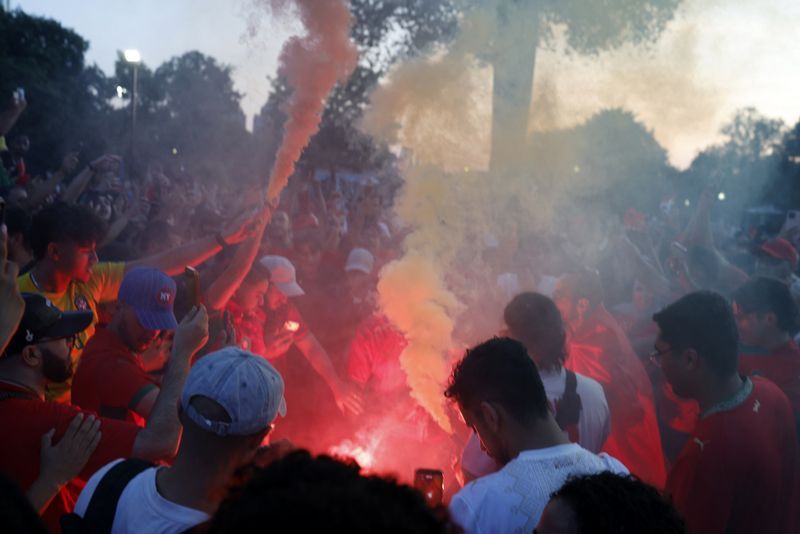
In the lead-up to Thursday's match, Boston Common became an unlikely gathering place for transnational football culture. Over one thousand supporters assembled to sing Dima l-Maghrib (Always Morocco) and wave national flags in a demonstration that remained conspicuously peaceful and celebratory rather than fractious. Youssef Bennani, a 36-year-old software engineer who travelled from Finland to attend every Morocco match in the tournament, encapsulated the inclusive spirit characterising Boston's approach to the fixture. He described encountering Moroccan supporters, French supporters, and other fans alongside one another, describing the occasion as destined to become a grand party rather than a tense confrontation between hostile camps.
Morocco's continued advancement through the tournament has fundamentally altered how teams approach fixtures against them. They have graduated from the compelling underdogs of 2022 to a rigorously organised side possessing genuine player development infrastructure and the self-belief necessary to challenge football's traditional powerhouses. Their federation has deliberately connected domestic development pathways with talent cultivated throughout Europe, creating a sustainable competitive model rather than relying on sporadic individual brilliance. A convincing 3-0 victory over Canada demonstrated the pace, tactical discipline, and ambition that have propelled them back to the quarter-final stage and warranted respect from even the most established football nations.
France cannot afford complacency despite their superior tournament pedigree. Their attacking capabilities have ranked among the tournament's most dangerous, yet Morocco's defensive organisation and counter-attacking speed present genuine tactical challenges. The quarter-final will unfold between two teams whose relationship extends far beyond ninety minutes of football, whose supporters frequently share linguistic heritage, educational pathways, and family connections, and whose matches carry resonance that transcends sport. Boston's role as host to this encounter may ultimately prove more significant than the usual framing of quarter-finals suggests, as the city's relative distance from European tensions creates space for the genuine complexity of Franco-Moroccan relations to be acknowledged and celebrated rather than reduced to simple national antagonism.

