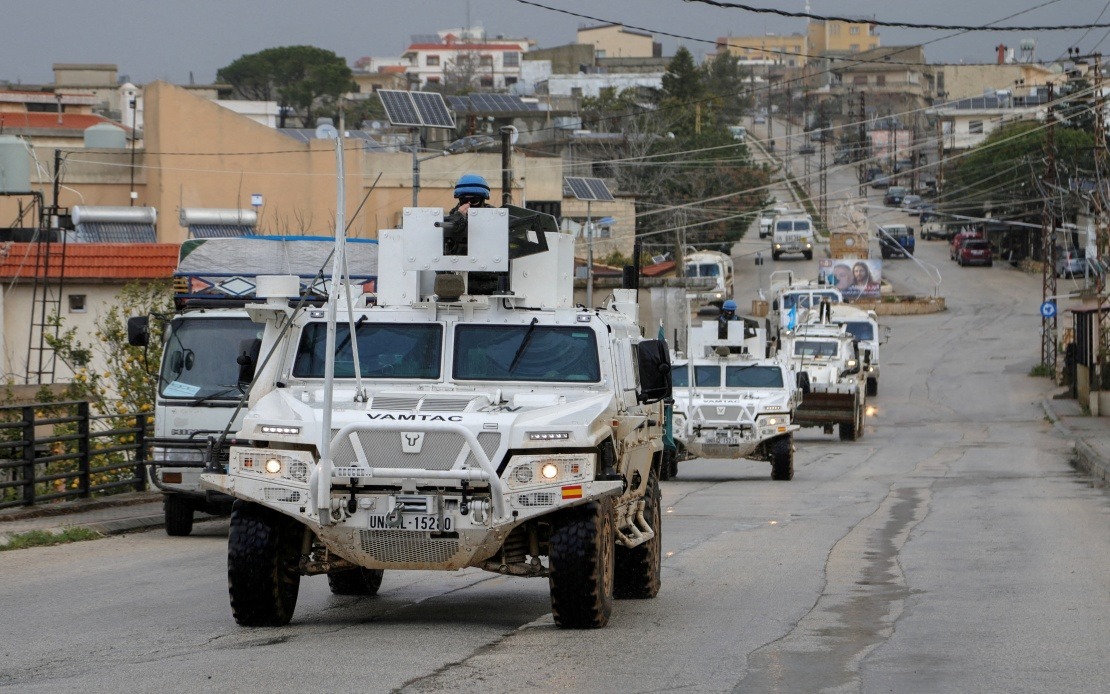
France and Italy have committed to assembling an international coalition that will maintain support for Lebanon following the scheduled withdrawal of the United Nations Interim Force in Lebanon (UNIFIL) at year's end, French President Emmanuel Macron announced during talks with Italian Prime Minister Giorgia Meloni in Antibes this week. The initiative represents a significant diplomatic effort to ensure continuity of international engagement in a strategically important but chronically unstable country, signalling European determination to prevent a security vacuum that could invite further regional conflict.
Macron outlined the coalition's core mission: to reinforce Lebanese state institutions, particularly its military apparatus, while safeguarding the nation's sovereignty from external interference. The French leader stressed that the arrangement would operate within established international frameworks, coordinating closely with both the European Union and the United Nations to ensure legitimacy and effectiveness. This multilayered approach seeks to avoid the appearance of unilateral intervention whilst maintaining the collective security umbrella that Lebanon has relied upon during UNIFIL's three-decade presence.
Meloni's endorsement of the proposal emphasised Europe's shared concern about the consequences of abrupt international disengagement. The Italian Prime Minister characterised an unmanaged transition as "extremely dangerous," highlighting the risk that Lebanese territory could become a flashpoint for broader Middle Eastern tensions. Italy's participation underscores European consensus that Lebanon's stability matters beyond regional borders, with implications for Mediterranean security and European strategic interests in the eastern basin.
The backdrop to this announcement is Security Council Resolution 2790, which mandates UNIFIL's operational cessation on December 31st. The resolution provides for a measured withdrawal of personnel over a twelve-month period commencing from that date, allowing roughly a year for the transition to alternative arrangements. This timeline creates both an opportunity and a constraint: sufficient breathing room to establish successor mechanisms, but also a finite window before the international military presence that has underpinned Lebanese security for three decades vanishes entirely.
For Malaysian observers, the Franco-Italian initiative merits attention as a case study in burden-sharing among developed nations on regional stabilisation. Unlike the more militarily assertive approaches pursued by other powers in the Middle East, the European framework emphasises institutional strengthening and sovereignty preservation—principles that resonate with Malaysia's own foreign policy preferences and ASEAN's emphasis on non-interference and respect for state capacity. The model suggests how external actors can maintain influence whilst respecting local legitimacy, a balance that developing nations in Southeast Asia continuously navigate.
Lebanon's institutional fragility makes the coalition's work particularly consequential. The Lebanese Armed Forces remain severely underfunded and under-equipped, hampered by sectarian divisions that reflect the country's complex confessional system. UNIFIL's departure removes a significant stabilising factor without automatically upgrading Lebanese military capability. The Franco-Italian coalition thus faces the challenge of materially enhancing Lebanese defence capacity whilst respecting the country's political autonomy and not becoming entangled in domestic factional disputes that have paralysed reform efforts for decades.
The timing also reflects Europe's broader strategic recalibration in the Middle East. With the United States reassessing its regional commitments and Russia maintaining its Syria presence, European nations recognise that maintaining influence requires sustained engagement rather than episodic intervention. For France particularly, which has historical ties to Lebanon and active interests in Mediterranean geopolitics, the coalition represents an attempt to maintain continental relevance in a region where Great Power competition continues to intensify. Italy's participation broadens the coalition's footprint and suggests a more coordinated European approach than has characterised recent Middle Eastern diplomacy.
The coordination with the UN signals awareness that legitimacy matters. UNIFIL, though frequently criticised for limitations, operates under Security Council mandate and commands respect for its impartiality. A successor arrangement carrying UN endorsement gains traction that purely European or ad-hoc coalitions might lack. However, this reliance on consensus also exposes potential vulnerabilities: Russian or Chinese obstruction at the Security Council could constrain the coalition's mandate or resources, forcing it to operate in narrower parameters than its architects might prefer.
Regional dynamics complicate implementation significantly. Hezbollah's entrenchment in Lebanese society, Iranian influence through its proxy network, and Palestinian factions' presence all pose challenges to any external stabilisation effort. The coalition must navigate these realities without either capitulating to destabilising forces or appearing to target specific Lebanese communities. This delicate equilibrium explains why Macron and Meloni emphasised coordination and Lebanese-owned solutions rather than external imposition—rhetoric that acknowledges the limits of international power even as it mobilises that power constructively.
For Southeast Asia's strategic calculations, the Franco-Italian coalition exemplifies how middle powers and developed nations can collaborate on regional stability without formal alliance structures. ASEAN nations, which often balance between greater powers whilst maintaining strategic autonomy, may find instructive lessons in how France and Italy propose to support Lebanese self-determination whilst advancing their own interests. The coalition's emphasis on institutional capacity-building rather than military occupation also aligns with approaches that developing nations find more palatable than traditional interventionism.
The financial dimension remains largely unspecified in public statements, but meaningful institutional strengthening requires sustained resource commitment. Military equipment, training programmes, and institutional reforms all carry substantial costs. Whether European governments will match their diplomatic ambitions with commensurate budgetary support will determine the coalition's practical effectiveness. This funding question also intersects with European domestic political pressures, where Middle Eastern engagements face increasing parliamentary scrutiny and public scepticism.
Looking ahead, the coalition's success will be measured not merely by preventing immediate security collapse but by whether it contributes to genuine Lebanese institutional reform. UNIFIL's decades-long presence, whatever its limitations, provided a stable framework within which Lebanese state capacity theoretically could develop. The Franco-Italian coalition inherits responsibility for maintaining that framework during a critical transition period. How effectively they perform this role will influence not only Lebanon's trajectory but also European credibility in future regional stabilisation efforts across the broader Middle East.

