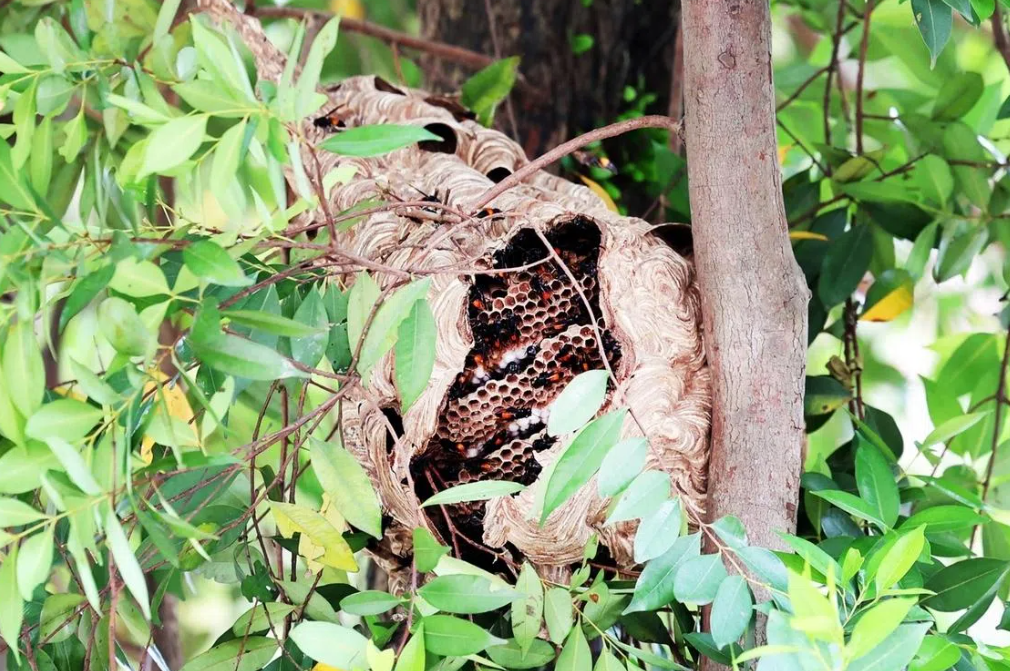
Four residents required hospital treatment at Singapore General Hospital following a sudden hornet attack in the vicinity of Redhill Market on the afternoon of July 10. The incident, which unfolded without warning in a busy public space, underscores the dangers posed by aggressive insects in urban environments and has reignited discussions about wildlife management in densely populated areas. Authorities responded swiftly, with the Singapore Civil Defence Force and Tanjong Pagar Town Council arriving at the scene around 1pm after receiving emergency alerts.
The source of the attack was traced to a substantial hornet nest lodged in a tree along the footpath positioned between Block 78 Redhill Lane and a Shell petrol station. This location—sandwiched between residential housing and commercial infrastructure—placed the nest in direct proximity to high pedestrian traffic. The Tanjong Pagar Town Council moved quickly to establish a safety perimeter around the affected zone and engaged contracted pest control professionals to undertake the delicate operation of nest removal. According to council officials, the nest was extracted without further incident and the footpath has since been verified as safe for public access.
Eyewitness accounts paint a harrowing picture of the assault. Chen, a coffee drinker at the market when the attack commenced, heard cries warning others of the hornets' presence and witnessed an elderly man being pursued and stung repeatedly by the swarm. Another observer, identified as Mei Zhen, encountered a female victim in her 70s seeking refuge in a nearby toilet facility. The woman displayed visible injuries, with her ears severely inflamed, reddened, and bleeding from multiple puncture wounds. She reported experiencing headaches and dizziness—symptoms consistent with significant venom exposure. Zhen's account suggests the swarm was exceptionally aggressive, with more than ten insects circling the victim's head, some nesting in her hair while others descended upon the surrounding toilet facility.
The ferocity of hornet attacks relates directly to the composition and potency of their venom. According to data from the National University Hospital, hornets differ markedly from bees and smaller wasps in their capacity to inflict damage through repeated stinging, with each puncture delivering substantially larger quantities of toxic compounds. The venom itself represents a complex cocktail of destructive agents. Histamine, a naturally occurring chemical within the venom, triggers allergic responses in human tissues. Melittin, another primary component, generates acute pain at sting sites. Additional proteins including phospholipase and hyaluronidase add layers of cellular damage, with the latter capable of breaching protective barriers between tissue layers and accelerating venom penetration into deeper biological structures.
In cases where multiple stings occur simultaneously or where victims experience hypersensitivity, the consequences can escalate rapidly into life-threatening territory. Severe hornet envenomation may precipitate acute drops in blood pressure, restrict blood flow to vital organs including the heart and brain, or trigger swelling of the airways that can obstruct breathing entirely. This cascade of physiological failures explains why four individuals required hospital assessment and treatment following the Redhill Market incident. The victims' ages and health profiles likely influenced the severity of their reactions, with older adults typically exhibiting heightened vulnerability to systemic venom effects.
The Tanjong Pagar Town Council has issued guidance emphasizing the importance of public awareness regarding hornet encounters. Residents encountering an active nest or aggressive hornets should remain as calm as circumstances permit and create immediate distance between themselves and the insects. The council specifically advises seeking shelter inside nearby buildings rather than remaining in open areas where insects can pursue. Critically, the advisory stresses that members of the public should never attempt to disturb nests or undertake removal operations independently, as such actions almost invariably provoke defensive responses from protective colony members. For individuals who have sustained stings, immediate evacuation from the danger zone takes priority, followed by evaluation of symptom severity.
Emergency medical assistance through the 995 hotline should be summoned without delay if a sting victim develops severe reactions or experiences systemic symptoms. Early medical intervention can prevent progression toward organ dysfunction and airway compromise. The city-state's healthcare system maintains specialized protocols for managing envenomation cases, though prevention through prompt professional nest removal represents the optimal approach. Tanjong Pagar's swift activation of its pest control contractor demonstrates the value of municipal readiness in response to such incidents.
This July 10 incident is not an isolated occurrence within Singapore's recent history. In 2024, a separate hornet attack at Sungei Buloh resulted in five individuals being transported to hospital facilities. More tragically, that same year witnessed the death of a cyclist after a hornet swarm attacked him while he traversed the Sembawang Park Connector. These recurrent incidents suggest that hornet populations within the island city-state may be increasing in density or aggressiveness, or alternatively that expanding human activity in green spaces is generating more frequent interactions between residents and insect colonies. The pattern raises questions about ecological management, urban planning considerations regarding green space maintenance, and public education regarding insect avoidance and safety protocols.
For Malaysian readers and officials in neighbouring jurisdictions, the Singapore incidents carry particular relevance. Hornet species native to tropical Southeast Asia share similar venom composition and aggressive characteristics, meaning comparable risks exist throughout the region. Urban expansion and human encroachment into green spaces—trends accelerating across Malaysia and the broader region—increase the probability of human-hornet encounters. The Singapore authorities' emphasis on professional pest management rather than amateur intervention offers an instructive model. Additionally, the incident highlights the importance of robust municipal response systems capable of mobilizing expertise rapidly when public safety threats emerge suddenly in civilian areas. Both the preventive and responsive elements of Singapore's approach merit consideration by other Southeast Asian cities developing or refining their own wildlife management and public health protocols.

