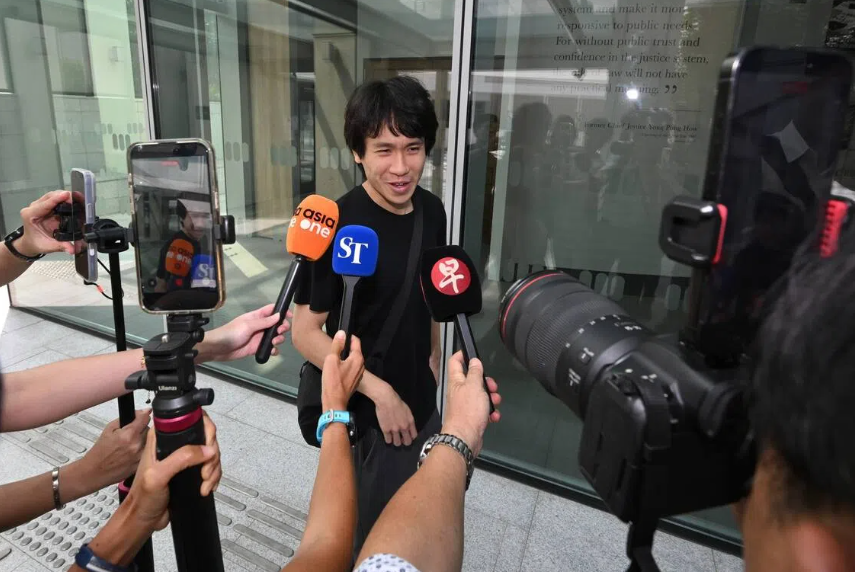
Former child actor Amos Yee appeared in Singapore's District Court on August 26 to face four additional charges, bringing the total tally against the 27-year-old to seven distinct offences spanning racial harmony legislation, harassment laws, and national service violations. The charges mark an escalation in authorities' prosecution of Yee, whose controversial online statements have triggered investigation by the Singapore Police Force since April. The case underscores the tension between free speech advocates and Singapore's strict regulatory framework protecting both racial cohesion and child welfare.
Three of Yee's seven charges relate to Singapore's Enlistment Act, concerning his failure to comply with national service obligations. Authorities allege he departed Singapore without proper exit permits on two separate occasions, first from December 13, 2015, through April 19, 2016, and again from December 15, 2016, through March 19, 2026. Additionally, he is accused of failing to present himself for the mandatory pre-enlistment medical screening examination between April 26, 2016, and March 19, 2026. Violations of enlistment requirements carry maximum penalties of ten thousand Singapore dollars in fines, up to three years imprisonment, or both.
The four newly levelled charges pivot on content Yee published across multiple platforms during a concentrated period from April through June. One charge under the Penal Code targets blog posts dated April 7 and April 11, in which Yee allegedly asserted that Malaysia's Malay and Indian populations experienced systemic discrimination by the Chinese majority in Singapore. According to court documents, he purportedly encouraged these communities to mobilise against the government. A second charge concerns a video uploaded May 27 containing similar allegations specifically targeting the Malay-Muslim community. These charges carry maximum sentences of three years imprisonment and fines if convicted.
Two further charges under the Protection from Harassment Act relate to content created in 2021 that authorities characterise as particularly alarming. Yee allegedly produced three videos in which he advocated for decriminalising child sexual abuse, claiming that infants and children possessed the capacity to consent to sexual activity. According to investigators, he called for repealing laws prohibiting the production and possession of child abuse material. A separate blog post published June 30 reiterated these positions. Each POHA violation carries potential fines up to five thousand Singapore dollars.
The convergence of charges spanning racial incitement, child protection, and national service evasion demonstrates the breadth of Singapore's investigative response to Yee's online activities. The Singapore Police Force initiated formal inquiries after receiving multiple complaints between April and July 2026 regarding his blog posts. Platform moderation followed official action when X, formerly Twitter, disabled Yee's video after police issued a disabling direction under the Online Criminal Harms Act on August 18. Authorities simultaneously issued stop communication directives requiring removal of disputed content from his blog.
Court-imposed bail of fifteen thousand Singapore dollars includes conditions that curtail Yee's online expression pending trial. He is prohibited from posting any content concerning his views on paedophilia, as well as material that could foment discord between racial or religious groups. The restrictions effectively constrain his ability to develop or publish arguments that formed the basis of the charges. A pre-trial conference is scheduled for September 18, allowing the prosecution and defence to narrow contested issues before full proceedings commence.
For Malaysian and Southeast Asian observers, the prosecution illuminates Singapore's uncompromising approach to speech that intersects with child protection and interracial harmony. Unlike jurisdictions debating the boundaries of expression, Singapore's legal architecture prioritises maintaining social cohesion and safeguarding vulnerable populations, with relatively limited exceptions for artistic, political, or journalistic content. The severity of penalties—particularly those under the Enlistment Act, which compound with substantive offences—reflects the state's view that cumulative violations warrant robust consequences.
Yee's case also reflects broader regional patterns in which younger voices utilise digital platforms to challenge establishment orthodoxies, often encountering state intervention. The timing and nature of his posts, clustering around April and May before authorities escalated enforcement in August, suggest a window during which his posts circulated before official restriction. This lag between publication and prosecution, increasingly common across Southeast Asia, raises questions about platform accountability and the pace at which governments can respond to viral content.
The charges carry particular resonance given Yee's background as a former child actor whose early notoriety derived from performing in films and television. His transition to online commentary and advocacy reflects a broader phenomenon wherein public figures leverage prior prominence to amplify alternative viewpoints. However, the lack of protective latitude ordinarily afforded to public discourse suggests Singapore's courts will assess his statements against the community standards embodied in the Penal Code and harassment legislation, rather than applying heightened scrutiny for political speech.
The case remains fluid pending September's pre-trial conference. Should Yee proceed to trial and face conviction on the more serious charges, sentences could extend across multiple counts, potentially resulting in substantial cumulative imprisonment. The intersection of national service violations with substantive offences also complicates sentencing dynamics, as courts may view systemic flouting of conscription requirements as an aggravating factor. Whether Yee's legal team will mount defences challenging the factual basis or constitutional scope of the provisions remains unclear at this stage.

