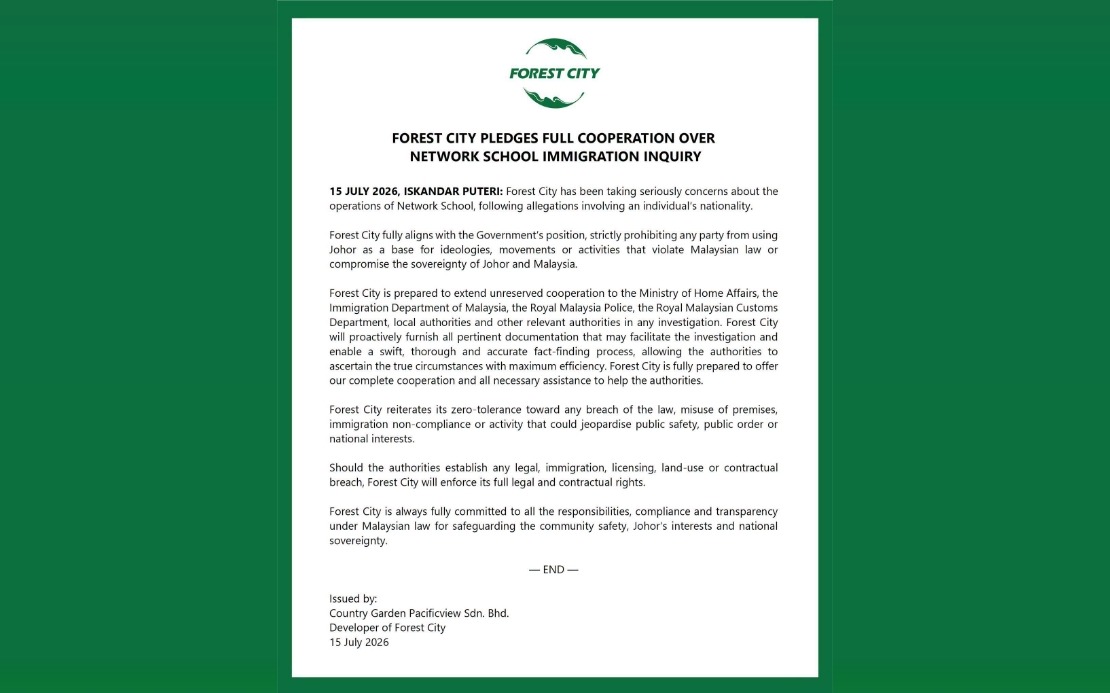
Forest City's developer, Country Garden Pacificview Sdn Bhd, has signalled its readiness to extend comprehensive support to government agencies investigating claims that a network school operating within the residential development involved Israeli citizens. The company released a formal statement in Johor Bahru on July 15, indicating it recognises the gravity of the matter and aligns itself with the federal government's position that Johor should not serve as a staging ground for activities that breach Malaysian law or compromise national sovereignty.
The commitment extends across multiple government bodies responsible for security and immigration oversight. Country Garden Pacificview has pledged to work with the Home Ministry, the Immigration Department, the Royal Malaysia Police, the Royal Malaysian Customs Department, and municipal authorities in piecing together the facts of the case. This multi-agency collaboration reflects the seriousness with which authorities are treating the investigation, as the involvement of foreign nationals—particularly those from nations Malaysia does not maintain full diplomatic engagement with—triggers heightened scrutiny under national security protocols.
The developer has undertaken to furnish all documentation and records pertinent to the investigation without delay. By removing administrative obstacles that might otherwise slow the fact-finding process, Country Garden Pacificview aims to demonstrate genuine institutional cooperation rather than mere rhetorical commitment. This approach typically accelerates investigations when developers and property managers genuinely comply, as they possess direct knowledge of tenant activities, lease agreements, and visitor logs that immigration and law enforcement agencies would otherwise need to obtain through compulsory legal mechanisms.
Additionally, the company has articulated an explicit zero-tolerance policy regarding breaches of Malaysian law, misuse of leased premises, violations of immigration statutes, and conduct that endangers public order or safety. Such categorical statements are significant in the Malaysian corporate landscape, where developers and property owners can face regulatory consequences and reputational damage if their facilities become inadvertently or deliberately implicated in unauthorised operations. By publicly distancing itself from any potential wrongdoing, the developer seeks to protect its commercial interests while signalling institutional responsibility.
The investigation was triggered when Johor Menteri Besar Datuk Onn Hafiz Ghazi raised concerns about the Network School's operations, alleging that participants included Israeli nationals who allegedly entered Malaysia using secondary passports rather than their primary documents. This allegation strikes at the heart of Malaysian immigration enforcement, as such practices circumvent normal vetting procedures and complicate security screening. The menteri besar's intervention underscores how state-level officials monitor activities within their jurisdictions, particularly when foreign nationals and sensitive geopolitical considerations intersect.
Following the menteri besar's directive, immigration officials executed an inspection of 266 foreign nationals representing 40 countries at Forest City. The preliminary assessment confirmed that all individuals examined possessed valid immigration documentation, suggesting either that the network school operated above board or that any irregularities existed at the organisational rather than individual level. However, authorities have signalled that investigations remain ongoing, indicating that immigration status alone does not resolve questions about the legitimacy or declared purpose of the educational programme.
The incident highlights vulnerabilities in how private developments, particularly large integrated communities like Forest City, can inadvertently become venues for activities that skirt legal or political boundaries. Foreign nationals and international programmes increasingly operate within Malaysia's residential and commercial complexes, and while most operate legitimately, the sheer scale of foreign population transience in such developments creates supervisory challenges for both proprietors and regulators. Developers operating high-volume international communities must balance welcoming foreign investment and residents with maintaining vigilance over usage patterns that deviate from declared purposes.
For Malaysian readers and regional observers, the situation underscores how geopolitical sensitivities interact with domestic security frameworks. Malaysia's longstanding support for Palestinian causes and its policy of not maintaining formal relations with Israel create a distinct legal and political environment compared to many regional neighbours. Any programme involving Israeli nationals or entities—whether educational, commercial, or otherwise—operates within this sensitive context. What might be a routine international exchange programme in Singapore or Thailand becomes a matter requiring governmental investigation in Malaysia.
The investigation also raises broader questions about oversight mechanisms for international educational ventures operating in semi-private settings. Network schools, coding bootcamps, and other short-term educational programmes increasingly operate globally, often with transient student populations and informal institutional structures. When such programmes involve nationals from countries with which Malaysia has strained diplomatic relations, regulatory authorities face the challenge of distinguishing between legitimate educational exchange and activities that contravene national interests. The Forest City case suggests that Malaysian authorities will pursue investigation when diplomatic concerns surface, regardless of whether individual participants possess proper documentation.
Country Garden Pacificview's proactive stance reflects broader industry practices in Malaysia's property development sector, where maintaining government favour and avoiding regulatory entanglement are critical business considerations. Large integrated developments like Forest City, which attract substantial foreign investment and international residents, operate under heightened scrutiny. Developers understand that apparent negligence or complicity in problematic tenant activities can trigger sanctions, permit reviews, or public image damage that affects long-term profitability and expansion plans.
The resolution of this investigation will likely establish precedent for how authorities approach similar situations involving foreign nationals and programmes within private developments. If irregularities are confirmed, authorities may impose new reporting requirements or oversight protocols on developers hosting international programmes. Conversely, if the investigation concludes that Network School operated legitimately despite geopolitical sensitivities, it may signal that Malaysian regulatory frameworks distinguish between nationality, formal compliance, and actual misconduct. This distinction will prove important as Malaysia continues attracting international investment and foreign talent while maintaining its foreign policy positions.
Government agencies will face the task of determining whether the primary issue involved immigration violations, undeclared programme objectives, security risks, or merely the politically sensitive fact of Israeli involvement. Each determination carries different implications for regulatory responses and future policy guidance. The developer's cooperation, while commendable from a corporate governance perspective, cannot ultimately control the investigation's trajectory or conclusions once authorities complete their fact-finding.

