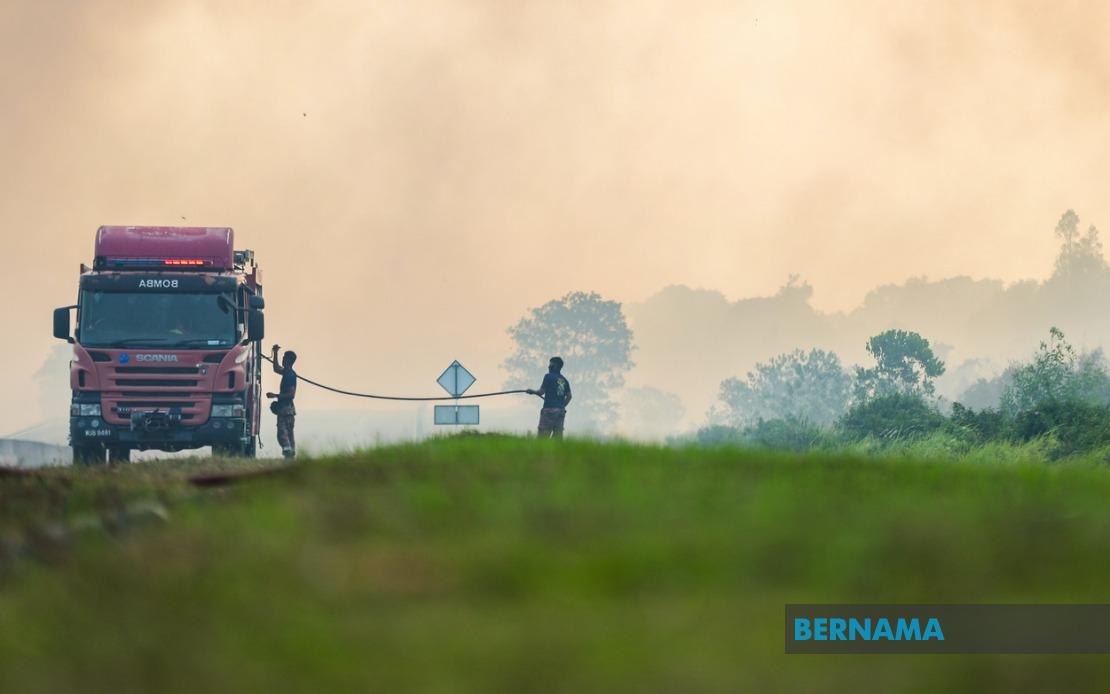
A significant peatland fire ravaging an area near Kota Tinggi in Johor has seen marked progress, with firefighting teams successfully containing more than 57 per cent of the affected zone as of Monday afternoon. The blaze, which ignited at Jalan Bypass Punggai-Sebana Cove in Pengerang, has charred 51.4 hectares of vulnerable peatland, one of Southeast Asia's most ecologically sensitive environments. By 4 pm on August 26, crews had extinguished over 29 hectares, leaving roughly 22 hectares still requiring active suppression and firebreak construction across two operational sectors.
The firefighting campaign commenced immediately after the initial outbreak on Monday and has continued without pause to prevent further escalation and protect surrounding communities. Fire Superintendent II Baharuddin Idris, commanding operations at Sungai Rengit Fire and Rescue Station, emphasised the round-the-clock nature of the response, highlighting that monitoring and suppression activities are sustained continuously to stop flames from spreading into untouched areas. This relentless approach reflects the serious risk posed by peatland fires, which can smoulder for days and reignite unexpectedly if not carefully managed.
The operation has been bifurcated into two distinct sectors to maximise efficiency and resource deployment. Sector A remains the most challenging zone, with more than 21 hectares still requiring intensive firefighting efforts and the establishment of protective firebreaks to halt lateral spread. In contrast, Sector B has been brought to near-total extinguishment, representing a significant tactical victory that allows personnel and equipment to concentrate remaining capacity on the more stubborn northern section. This segmented approach enables commanders to deploy specialist teams and machinery where they are most needed.
Aircraft support arrived at the scene in the early afternoon, having received clearance from the Air Operations Control Centre to participate in the suppression effort. The aircraft took to the air at 2:30 pm, adding aerial capability to a ground-based campaign that has already mobilised substantial resources. Peatland fires present unique challenges that often exceed conventional firefighting techniques, making air-based water and fire-retardant drops a critical tactical tool for rapidly covering large, difficult-to-access terrain.
The personnel mobilised for this emergency response underscore the complexity of managing major peatland incidents in Malaysia. A core team of 36 firefighters formed the backbone of the operation, supported by nine personnel from the Malaysian Civil Defence Force, who bring additional training in mass casualty management and emergency coordination. The involvement of 14 specialists from Ranhill SAJ—a water utility and engineering firm—suggests that water supply logistics and infrastructure assessment factored into operational planning. Additionally, two environmental specialists from the Department of Environment monitored ecological impact and advised on containment strategies, whilst three representatives from the Pengerang Municipal Council ensured alignment with local governance and community protection priorities.
The choice to deploy such a heterogeneous team reflects evolving approaches to disaster management in Malaysia, where major incidents increasingly require coordination across multiple agencies with distinct technical expertise. Rather than relying solely on traditional fire brigades, authorities now regularly integrate civil defence personnel, engineering specialists, environmental experts, and municipal officers. This integrated model has proven more effective at containing complex incidents, particularly those involving hazardous materials, ecologically sensitive areas, or threats to dense populations.
Peatland fires carry implications extending far beyond immediate suppression challenges. These fires release substantial carbon emissions, as peat combustion releases stored organic carbon accumulated over centuries. The smoke and haze generated can affect air quality across the region, impacting respiratory health in Malaysia, Singapore, and southern Thailand. The Pengerang area, already subject to industrial development pressures, represents a zone where balancing economic activity with environmental preservation remains contested.
The incident at Punggai-Sebana Cove illustrates the persistent vulnerability of Malaysia's peatlands to ignition, whether through accidental causes, agricultural practices, or deliberate land clearance. Johor, one of the nation's largest states and home to significant peat reserves, remains particularly susceptible to such events, especially during drier months when moisture levels in peat soil decline and combustibility rises. The frequency of peatland fires across Peninsular Malaysia and Malaysian Borneo has prompted government agencies and conservation organisations to advocate for stricter land-use planning, enhanced fire prevention measures, and better restoration of degraded peatlands.
The Kota Tinggi region, situated inland from the Strait of Johor, sits within a landscape increasingly fragmented by urban expansion, industrial infrastructure, and agricultural zones. Peatland conservation in such settings requires balancing immediate economic pressures against long-term environmental stability and community health. The rapid mobilisation of resources to the Pengerang fire indicates that authorities prioritise containing such incidents swiftly, yet the underlying drivers—habitat degradation, incomplete peatland protection frameworks, and land-use conflicts—persist as systemic challenges demanding policy-level solutions.
As firefighting teams continue their intensive efforts, attention will turn to post-incident analysis and lessons learned. The performance of inter-agency coordination, the effectiveness of aircraft deployment in tropical peatland conditions, and the adequacy of personnel and equipment levels will all inform future emergency response protocols. For Malaysian policymakers and regional observers, incidents like the Punggai-Sebana Cove fire serve as periodic reminders that peatland management remains unfinished business across Southeast Asia, where economic pressures frequently override conservation imperatives.

