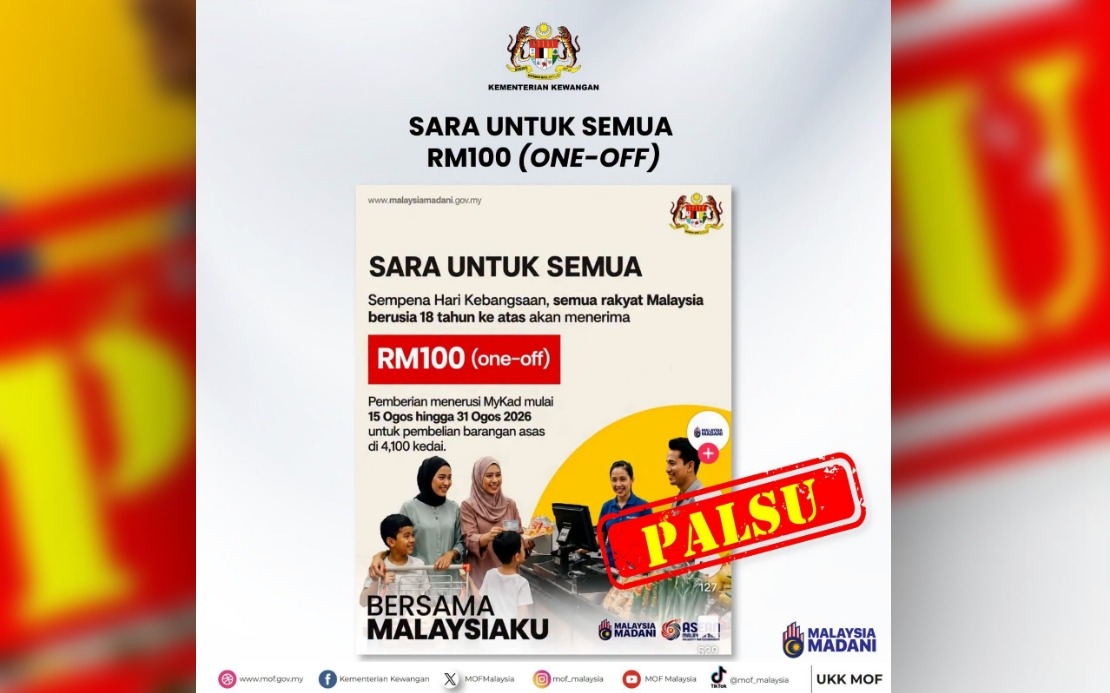
The Ministry of Finance has moved to stamp out misinformation spreading across social media platforms, categorically denying allegations that the government intends to distribute a one-off RM100 Sumbangan Asas Rahmah payment to all Malaysian citizens aged 18 and above as part of National Day commemorations. The false claim, which had gained significant traction online, prompted an official statement from the ministry clarifying that no such announcement has been authorised or contemplated.
The viral poster, which was designed to mimic official government communications, represents another instance of elaborate hoaxes targeting Malaysian voters ahead of significant national occasions. Such fabrications typically exploit citizens' expectations regarding welfare assistance or cash distributions, leveraging the credibility of government institutions to lend weight to entirely fictitious promises. The rapid spread of the RM100 SARA claim underscores persistent challenges in combating disinformation in Malaysia's digital information ecosystem, where false announcements can reach millions before fact-checkers can intervene.
SARA, which translates to Basic Assistance, has been a cornerstone of the federal government's targeted welfare programme aimed at providing relief to lower-income households and vulnerable populations. The actual SARA scheme, implemented in recent years, delivers genuine financial support through proper channels and rigorous eligibility assessments. By conflating genuine government initiatives with fabricated claims, bad-faith actors attempt to erode public trust in legitimate assistance programmes while creating confusion about which announcements represent authentic policy.
The Finance Ministry's statement emphasised that citizens should verify information exclusively through official government communication channels before accepting or disseminating claims about new policy announcements or financial distributions. This guidance reflects growing concern among Malaysian authorities about the speed with which false narratives can propagate through messaging applications, social media platforms, and informal networks, potentially undermining confidence in genuine government communications.
The timing of this false claim, coinciding with National Day celebrations, suggests deliberate efforts to exploit periods of heightened national sentiment and media attention. Hoaxes timed to major national occasions often succeed because citizens' critical faculties may be temporarily lowered by festive atmospheres, while media outlets are focused on covering official celebrations rather than fact-checking every circulating claim. The sophistication of modern disinformation means that fabricated announcements increasingly incorporate authentic design elements, official-sounding language, and plausible policy frameworks that make detection more difficult for average citizens.
For Malaysian readers, this episode provides important lessons about information hygiene in an era of increasingly convincing digital manipulation. Government agencies worldwide have noted that effective disinformation campaigns succeed not by making outlandish claims, but by embedding false information within frameworks that closely resemble legitimate policy announcements. The RM100 SARA claim succeeded initially because the actual SARA programme is well-known, making an expansion or special distribution temporarily credible in citizens' minds.
The Finance Ministry's response demonstrates that Malaysian authorities are attempting to be more proactive in correcting false narratives rather than allowing misinformation to circulate unchecked. However, the reactive nature of such denials means that damage to public understanding has typically already occurred by the time official corrections are issued. Many citizens who saw the viral poster may never see the subsequent denial, leaving them under a false impression about government policy.
Regionally, Malaysia's experience with this particular hoax reflects broader Southeast Asian challenges regarding disinformation and online manipulation. Countries across the region have grappled with similar false claims about cash distributions, with hoaxes targeting citizens during election periods, religious holidays, and national commemorations. The sophistication and frequency of such attempts suggests that organised networks are deliberately manufacturing these fabrications rather than isolated individuals engaging in sporadic pranks.
The proliferation of such misinformation also reflects underlying public expectations about government support, particularly during periods of economic uncertainty or rising cost of living. When citizens are genuinely struggling financially, false claims about direct cash assistance gain traction precisely because such support aligns with what many voters wish the government would provide. Understanding this psychological dimension helps explain why debunking alone may be insufficient—authorities may need to complement fact-checking efforts with clearer communication about actual welfare programmes and eligibility criteria.
Moving forward, the Finance Ministry and other government bodies will likely need to establish more systematic approaches to combating coordinated disinformation campaigns. This might include pre-emptive announcements ahead of major national occasions clarifying what genuine policy initiatives are under consideration, making it harder for false claims to masquerade as credible. Additionally, public education campaigns emphasising the importance of verification through official channels could gradually shift citizen behaviour toward more critical consumption of extraordinary claims circulating online.
The incident serves as a reminder that in Malaysia's increasingly digital information environment, institutional credibility depends partly on the government's ability to communicate swiftly and transparently about its actual policies while systematically addressing false claims. Citizens are advised to bookmark official government websites and follow verified social media accounts rather than relying on information shared through informal networks, where fabrications can flourish unchecked.

