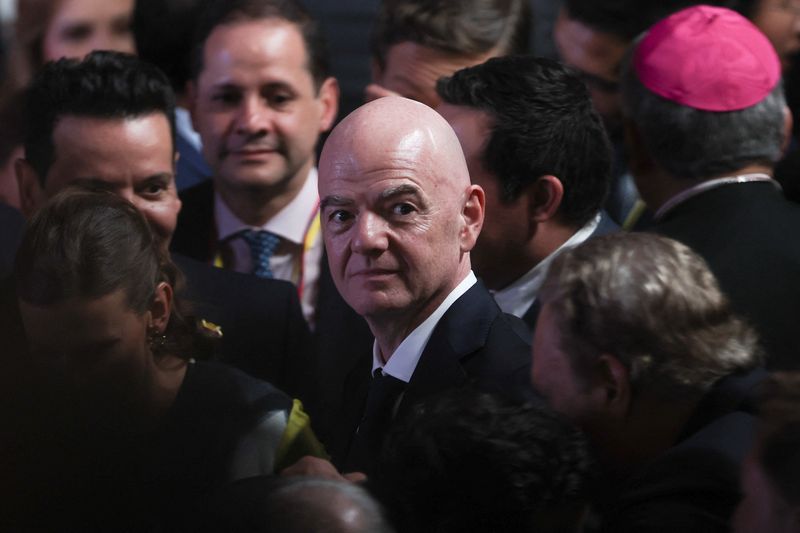
The future of FIFA president Gianni Infantino has become a lightning rod for institutional debate, with the Confederation of African Football's Patrice Motsepe stepping into the controversy to advocate for a democratic resolution. Rather than succumbing to mounting pressure from multiple continental confederations calling for his resignation, Motsepe has insisted that the appropriate forum for determining Infantino's tenure lies within the established electoral machinery that will convene in Rabat, Morocco on March 18 during FIFA's 77th Congress.
Infantino's leadership has come under unprecedented scrutiny following his failed attempt to secure private investment in FIFA competitions, most notably the World Cup. This initiative sparked an extraordinary alliance of opposition among three major continental bodies—UEFA representing Europe, the AFC representing Asia, and CONCACAF representing North and Central America. Their coordinated public critique represents a rare moment of consensus among confederations that often find themselves at loggerheads over governance and commercial matters, signalling the depth of institutional concern about the direction under Infantino's stewardship.
The CAF president's intervention reflects a broader geopolitical reality within world football. Africa, through CAF, has maintained demonstrable loyalty to Infantino, and this support carries substantial weight given that African nations represent a significant voting bloc within FIFA's membership. Motsepe's public endorsement, coupled with his assertion that the FIFA president "has been loyal to African football," underscores how continental football politics shape the outcome of global governance disputes. For Southeast Asian readers, this dynamic matters considerably, as ASEAN nations are predominantly members of the AFC, making them aligned with the confederation's position calling for Infantino's removal.
Motsepe's stance emphasises procedural legitimacy over precipitous action. He argued forcefully that the electoral process scheduled for 2027—technically March 2024 based on FIFA's actual Congress calendar—represents the constitutionally mandated mechanism through which FIFA member associations, all 211 of them, can express confidence or withdrawal of confidence in their leader. This position reflects a conservative interpretation of institutional governance that prioritises established processes over extra-institutional pressure campaigns, regardless of their moral force or institutional prestige of those mounting them.
The philosophical underpinning of Motsepe's argument centres on democratic principles and due process. He contended that any leader behaving in ways contrary to proper governance standards should indeed face scrutiny and interrogation, but that this accountability mechanism must flow through established channels rather than public campaigns orchestrated by rival power centres. This framework suggests that while no leader is beyond question, the legitimacy of challenging that leadership depends upon adherence to institutional procedures—a somewhat circular logic that benefits incumbents with institutional support.
Motsepe's comments also reflected a pragmatic calculation about FIFA's stability and institutional cohesion. By framing the election as the appropriate venue for settling the dispute, he positioned himself above the fray while implicitly arguing that premature removal or forced resignation would undermine FIFA's institutional integrity. This appeal to institutional continuity resonates particularly with federations that benefit from existing power structures and prefer evolutionary to revolutionary change in global football governance.
However, the emergence of such a serious challenge to Infantino's leadership from Europe, North America, and Asia suggests that the electoral outcome in 2027 remains genuinely uncertain. While African support provides a substantial voting foundation, UEFA's numerous member nations, combined with AFC and CONCACAF representation, constitute a formidable opposing bloc. Infantino will need to either substantially repair relationships with these confederations or build additional coalitions beyond Africa to secure re-election. The upcoming campaign period will likely witness intensive diplomatic efforts to secure commitments from individual member associations.
For Malaysia and other Southeast Asian nations, the FIFA leadership question carries direct implications. As AFC members, these countries have aligned with a confederation opposing Infantino's continued leadership. Yet ASEAN nations also depend on FIFA infrastructure, international competition frameworks, and developmental support that FIFA provides through its technical and capacity-building programmes. A prolonged institutional conflict between continental confederations could complicate access to these resources or create divisions within ASEAN itself on how to vote.
Motsepe's invocation of unity and football development as overarching priorities, though rhetorically appealing, somewhat obscures the substantive governance concerns that prompted the rebellion against Infantino. The attempt to introduce private investment into World Cup structures represented a fundamental challenge to football's traditional institutional architecture, with implications for how competitions are organised, revenue is distributed, and decisions are made. These are not merely procedural matters that goodwill and unity can easily resolve.
The CAF president's insistence on following FIFA processes also reflects Africa's relative institutional strength within global football governance. With 54 member associations potentially voting as a bloc, African confederations exercise considerable influence over FIFA elections. This structural advantage motivates CAF to defend the existing institutional framework, which it can leverage through unified voting patterns, rather than support structural reforms that might diminish its collective weight.
Looking ahead, the March 2027 Congress will undoubtedly become the focal point for an intensifying power struggle within FIFA. Motsepe's defence of the electoral process does not resolve the underlying tensions about football's commercial future, the proper balance between continental confederations and FIFA's central authority, or the appropriate mechanisms for member accountability. What it does accomplish is purchasing time for negotiations and potentially securing African support for Infantino's continued leadership, at least until the membership directly votes on his future.

