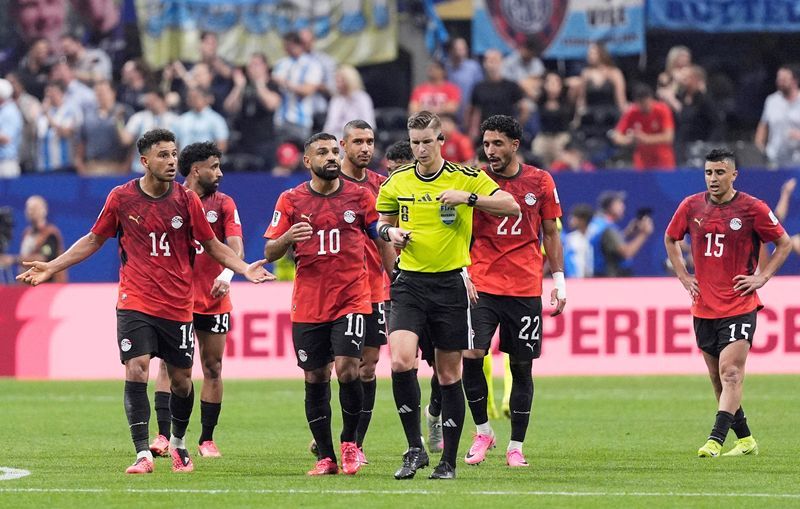
FIFA's top refereeing official has moved to shut down controversy surrounding Argentina's narrow World Cup escape against Egypt, asserting that match officials cannot be influenced by external pressure and operate with absolute independence. Pierluigi Collina, who oversees refereeing standards for world football's governing body, issued a forceful statement defending the conduct of officials in the round-of-16 encounter, which saw Argentina overturn a 2-0 deficit to secure victory through Enzo Fernandez's stoppage-time goal. The intervention signals FIFA's determination to protect the credibility of its officials against growing accusations of unfairness following Egypt's elimination from the tournament.
Egypt's exit has sparked considerable backlash from Cairo, with the Egyptian Football Association formally challenging the integrity of several key decisions that they claim fundamentally altered the match's outcome. Coach Hossam Hassan suggested following the defeat that the referee may have faced external pressure to ensure Argentina's progression, a particularly pointed allegation given Argentina's global prominence and the narrative value of their participation in advancing stages. The Egyptian federation released a statement highlighting multiple incidents that they characterized as raising serious concerns about consistency, particularly regarding the application of rules in situations directly affecting possession and scoring opportunities.
The most contentious flashpoint involved Mostafa Zico's second-half goal, which officials ruled out after VAR intervention identified a foul during the build-up phase. Egypt disputed the decision vehemently, characterizing the infraction cited by VAR—a foul by Marwan Attia on Argentina's Lisandro Martinez—as non-existent and questioning why such a technical violation merited goal-line intervention. The decision proved pivotal, denying Egypt what would have been a three-goal advantage and effectively removing any margin for error in the remaining minutes. This reversal became a focal point for broader complaints about how VAR was being applied throughout the tournament, with the Egyptian federation questioning whether standards were being applied uniformly across all matches.
A second incident that drew Egyptian ire occurred moments before Argentina's winning goal, when Mohamed Salah appeared to be fouled by Julian Alvarez in the penalty area without attracting the referee's attention or triggering VAR review. The timing heightened sensitivity around the decision, as the very next sequence of play produced Argentina's match-winning goal. Egypt argued that had the penalty been awarded, the entire flow and conclusion of the match would have differed fundamentally. The proximity of this non-call to Argentina's victory created an impression among observers that the match's critical junctures were being adjudicated with inconsistency.
Collina's response emphasized that criticism of refereeing decisions represents a normal feature of professional football, but he drew a sharp distinction between constructive debate and allegations attacking officials' integrity. Speaking through FIFA's official media channels, he stated that questioning whether referees can be influenced by external actors—whether political figures, confederations, or even FIFA leadership itself—crosses an unacceptable line. Collina argued that such allegations carry serious consequences beyond the immediate sporting context, potentially exposing match officials and their families to harassment and threats. This framing positioned FIFA's defense less as a technical explanation and more as protection of institutional credibility and referee safety.
Regarding the disallowed Zico goal, Collina reiterated FIFA's position that VAR correctly identified a foul deserving intervention, regardless of whether the infraction appeared obvious during normal play. He emphasized that the VAR protocol does not require fouls to be blatant or easily visible to the naked eye; any contact that technically violates the laws of the game can trigger review and reversal if the referee initially missed it. This interpretation reflects FIFA's increasingly strict approach to technical compliance, prioritizing rule adherence over considerations of match flow or the severity of offenses. The approach suggests that FIFA views such interventions as essential to maintaining consistent application of laws across matches, though critics argue it prioritizes literal rule interpretation over the spirit of the game.
Collina provided detailed justification for the non-award of a penalty following Salah's contact with Alvarez, arguing that VAR and the on-field referee both evaluated the challenge as routine physical contact rather than a punishable offense. His explanation introduced a distinction between defensive contact that occurs after a player plays the ball versus contact constituting a foul, suggesting that Alvarez's positioning and the sequence of contact fell within acceptable parameters. This explanation appeared designed to demonstrate reasoned judgment rather than arbitrary decision-making, though it inevitably remains open to interpretation and disagreement about where subjective thresholds lie in real-time match situations.
The broader context of FIFA's defense reflects the organization's ongoing efforts to maintain faith in VAR technology, which has faced considerable criticism from various quarters since its introduction at international level. Collina acknowledged that certain decisions inherently involve subjective elements, a candid admission that undercuts claims of perfect objectivity while attempting to frame such subjectivity as inevitable rather than problematic. FIFA's satisfaction with overall VAR application throughout the tournament, according to Collina, suggests institutional confidence that the system is functioning as intended, though this assessment carries obvious bias given FIFA's investment in the technology's success.
For regional football stakeholders and Southeast Asian observers, the Argentina-Egypt controversy carries lessons about how refereeing standards and VAR implementation can dramatically influence tournament outcomes. The incident demonstrates that even at the highest levels of competition, disagreement persists about whether officials have applied rules consistently and fairly. The Egypt situation also illustrates how disappointed teams with significant global platforms can challenge decisions through institutional channels, though such challenges rarely result in overturned results. Malaysian and regional football administrators watching these international controversies gain perspective on how Asian Football Confederation competitions might navigate similar disputes, particularly as VAR becomes more widely adopted across regional tournaments.
The fundamental tension exposed by this controversy reflects broader questions about whether football's rulebook can ever be applied with complete objectivity or whether the sport inevitably involves judgment calls favoring certain interpretations. Collina's insistence on institutional integrity and the independence of match officials represents FIFA's official position, yet the detailed explanations required to defend specific decisions suggest that reasonable observers can and will disagree about their correctness. Egypt's elimination based on these contested decisions raises difficult questions about whether VAR has improved or merely shifted the location of controversy, from obvious on-field mistakes to technical interpretations of contact and fouls that reasonable people assess differently. As football governance continues evolving, particularly with technology's expanding role, these fundamental questions about consistency, fairness, and institutional credibility will remain central to the sport's credibility.

