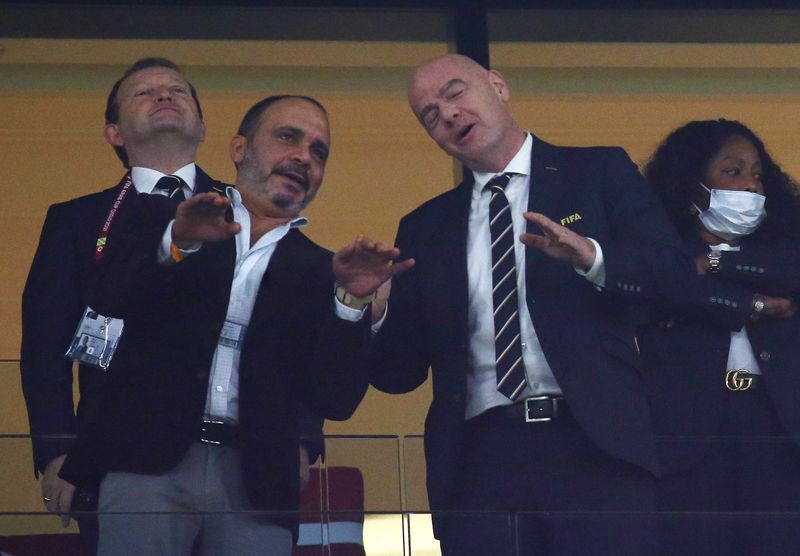
Jordan's national football team and coaching staff have finally received outstanding payments for reaching the Arab Cup final, ending an eight-month dispute that exposed deeper tensions within international football governance. Prince Ali bin Hussein, president of the Jordan Football Association, confirmed the payment's arrival on Thursday morning, just two days after levelling serious accusations against FIFA leadership regarding the distribution of tournament rewards.
The dispute centres on prize money that should have been transferred immediately following Jordan's participation in the 2025 Arab Cup held in Qatar last December. Instead, the association remained unpaid through the intervening months, creating financial strain for players and staff who had represented their country at a major regional competition. The delay proved particularly frustrating given that FIFA typically disburses tournament winnings within established timelines, and the extended wait suggested administrative dysfunction or deliberate withholding.
Prince Ali's frustration boiled over this week when he directly challenged FIFA President Gianni Infantino following the latter's controversial decision to withdraw a proposal that would have permitted FIFA to sell a portion of World Cup commercial rights. The Jordanian official alleged that FIFA had employed the delayed prize money as a form of leverage, suggesting during World Cup discussions that supporting Infantino's presidency "would go a long way to helping our FA out." This characterisation of conditional aid—linking financial obligations to political support—constitutes a serious allegation within the context of FIFA's governance structure and raises questions about how the organisation prioritises institutional interests over member associations' legitimate entitlements.
The timing of FIFA's sudden delivery of the overdue funds carries unmistakable symbolism. The payment arrived immediately after Prince Ali's public accusations became known, suggesting that the delay was either administratively negligent or deliberately strategic. Either interpretation reflects poorly on FIFA's institutional credibility and its relationship with national associations that depend on tournament revenue to sustain operations and player welfare. For Jordan specifically, an eight-month delay in receiving earned compensation represents a significant cash flow disruption for an organisation operating within the relatively constrained financial environment typical of Middle Eastern football federations.
Prince Ali has made clear, however, that receiving the long-overdue payment does not constitute a resolution to underlying governance concerns. He explicitly stated that the money's arrival would not modify his position regarding FIFA's leadership or his intention to withhold endorsement of Infantino. This stance reflects a calculation that the payment, while welcome, represents merely a symptom of broader systemic issues that plague FIFA's relationships with member associations. The Jordanian federation chief positioned the delayed payment within a recurring pattern he linked directly to FIFA presidential election cycles, suggesting that financial pressure and conditional support typify how FIFA manages its internal politics.
The allegations carry particular weight given that they emerge from a senior figure within regional football governance. Prince Ali commands respect as both a royal family member and an experienced football administrator, lending credibility to claims that might otherwise be dismissed as complaints from smaller football nations. His public condemnation signals that frustration with FIFA's governance extends beyond peripheral associations to include respected voices within established football structures.
FIFA's institutional response has remained notably restrained. The organisation did not directly address Prince Ali's blackmail allegations or explain the eight-month payment delay. Instead, FIFA leadership has focused on damage control regarding the failed World Cup commercial rights proposal, issuing apologies to member associations for the mismanagement while simultaneously reaffirming support for Infantino following a crisis meeting in Morocco. This approach—acknowledging administrative failures while defending presidential leadership—sidesteps the more serious allegations concerning conditional aid and creates an impression of institutional compartmentalisation rather than comprehensive accountability.
The incident illuminates persistent structural vulnerabilities within FIFA's governance framework, particularly the tension between centralised presidential authority and the federated structure that theoretically grants voting power to member associations. When financial leverage becomes a tool for securing political support within such systems, the integrity of democratic processes becomes compromised. National associations dependent on FIFA revenue distributions face implicit pressure regarding their voting positions, creating conflicts between institutional loyalty and organisational interests.
For Southeast Asian football administrators observing from the region, the Jordan situation offers instructive lessons regarding engagement with FIFA's byzantine political ecosystem. The delayed prize money dispute demonstrates that even established football nations cannot assume timely treatment of financial obligations, and that FIFA's internal politics can directly impact member associations' access to earned revenue. Malaysian and other regional football federations operate within similar power dynamics, where dependence on FIFA distributions creates inherent vulnerability to institutional pressure.
The broader significance extends to FIFA's ongoing credibility crisis. The failed World Cup commercialisation proposal, combined with allegations of conditional financial support and payment delays, reinforces perceptions that FIFA functions more as a political apparatus serving leadership interests than as a democratic institution serving member associations. Prince Ali's refusal to allow the payment to modify his position signals that FIFA cannot purchase political support through belated financial compliance; legitimacy requires consistent, equitable treatment rather than selective compensation following public pressure.
Looking forward, the incident raises questions about FIFA's accountability mechanisms and whether member associations possess sufficient collective leverage to enforce governance standards. Prince Ali's public stance suggests growing willingness among federation leaders to challenge FIFA's institutional orthodoxy, potentially creating space for broader reform movements. However, individual federation pressure remains limited without coordinated action from multiple major football nations willing to risk FIFA's institutional retaliation.
The resolution of the Jordan payment dispute through immediate delivery following public accusations, rather than through established administrative channels, exposes FIFA's reactive rather than proactive governance culture. This pattern—where problems require public scandals to trigger action—indicates systemic dysfunction extending well beyond a single delayed payment. For international football's credibility and for member associations seeking predictable, equitable treatment, FIFA's governance architecture requires fundamental reform beyond the current institutional cosmetics.

