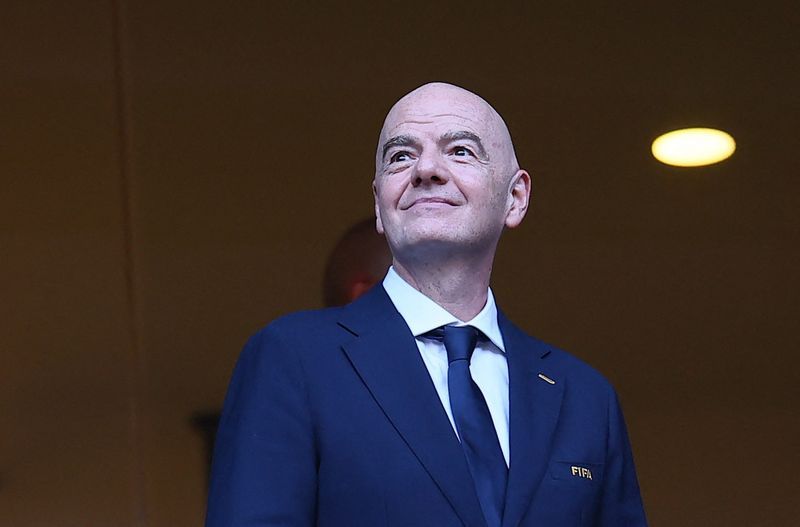
The fallout from FIFA President Gianni Infantino's ill-fated attempt to monetise the World Cup through private investment continues to reshape the political landscape within global football's governing body. After withdrawing the controversial proposal late Friday night—which would have injected $4.2 billion into a newly created commercial entity—Infantino finds himself isolated from some of his most powerful allies, a dramatic reversal of fortune for a leader who has held unchallenged control since assuming office in 2016.
The 56-year-old Swiss-Italian executive's decision to abort the plan came after three days of unprecedented institutional discord that exposed deep fractures within FIFA's confederate structure. His public apology acknowledged the divisive nature of the proposal, yet the damage to his political standing appears irreversible. The scheme would have represented the first time private capital entered World Cup governance directly, fundamentally altering the tournament's ownership structure and raising serious questions about FIFA's decision-making processes that Infantino failed to adequately address with stakeholders beforehand.
The political arithmetic now heavily favours Infantino's opponents as the 211 member federations prepare to vote at the FIFA Congress scheduled for Morocco in March. Five major European national associations, prominently including England's Football Association, have formally rescinded their endorsements of his reelection, while Denmark has indicated it never intended to support him regardless. Meanwhile, a modest coalition of supporters has publicly declared continued backing—Morocco, Qatar, Kuwait, Lebanon, and Sri Lanka have lined up behind the incumbent—but these numbers fall considerably short of the broad coalition he previously commanded.
The withdrawal of confidence from regional confederations strikes at the heart of Infantino's political coalition. UEFA, European football's governing confederation, and CONCACAF, which oversees the sport across North America, Central America, and the Caribbean, issued scathing statements questioning his leadership credibility on Saturday. The AFC, Asia's confederation, adopted a more measured tone but nevertheless condemned the complete absence of consultation regarding the proposal as wholly unacceptable, signalling that even traditionally more compliant regional bodies have reached the limits of their tolerance for unilateral decision-making.
According to reporting from the Times of London, the three major regional confederations—UEFA, CONCACAF, and the AFC—are considering an aggressive strategy to force Infantino's removal, potentially involving the disruption of FIFA's normal operations and even the establishment of rival competitions. The fact that such dramatic countermeasures are being seriously entertained underscores the severity of the breach of trust his proposal created. For organisations that have long operated within FIFA's established hierarchies, this represents a dramatic escalation that suggests Infantino's previous ability to manage dissent through financial incentives and backroom negotiations may no longer function effectively.
Infantino's immediate tactical challenge centres on preventing the convening of an Extraordinary Congress, which could be triggered if 43 or more FIFA member associations submit formal written requests. Such a gathering would allow opponents to present alternative candidates and potentially move to remove him before the scheduled March election. This threshold—representing roughly one-fifth of FIFA's membership—is deceptively modest given the current level of discontent among major confederations and their constituent members.
The proposal itself had been carefully calibrated to generate support from precisely those national associations least able to withstand financial pressure. Infantino had pitched the scheme to less wealthy federations in non-European regions with promises of substantial annual dividends ranging from $20 million to $40 million commencing in early 2024. This carrot-and-stick approach has traditionally formed the foundation of FIFA power structures, mirroring the strategies employed by his immediate predecessors João Havelange and Sepp Blatter, who likewise built their authority principally outside Europe where financial dependency on FIFA distributions remains acute.
The timing of Infantino's predicament creates particular vulnerability. He possesses approximately seven months before the March Congress to rehabilitate relationships with damaged allies and reinforce his position against potential challengers. The November 18 deadline for nomination of alternative candidates will prove critical; should opponents identify a credible contender capable of appealing to both the traditionally prosperous European associations and the developing federations dependent on FIFA resources, Infantino's path to reelection becomes substantially narrower. Any challenger must convincingly demonstrate commitment to both institutional governance reform that European confederations now demand and continued financial support that poorer associations require.
UEFA has already taken preliminary legal steps, dispatching a document preservation letter to FIFA regarding all materials connected to the failed proposal, though senior officials have indicated they remain undecided regarding formal legal proceedings. This measured approach suggests the confederation may be calibrating its response carefully, potentially reserving escalation for future provocation. The very existence of such legal preparations, however, signals that the World Cup stake sale proposal has crossed a threshold from political disagreement into potential legal territory—a dramatic development in what has traditionally been an internal governance matter.
Infantino's struggle to retain power reflects broader institutional tensions within global football that extend beyond his individual leadership. The proposal exposed fundamental questions about FIFA's decision-making transparency, the balance between centralised executive authority and confederate consultation, and the appropriate relationship between sporting governance and commercial interests. Whether Infantino survives the coming months will likely depend less on his ability to defend the specific proposal and more on his capacity to convince wavering federations that he understands and accepts the need for structural reforms addressing these deeper governance failures.

