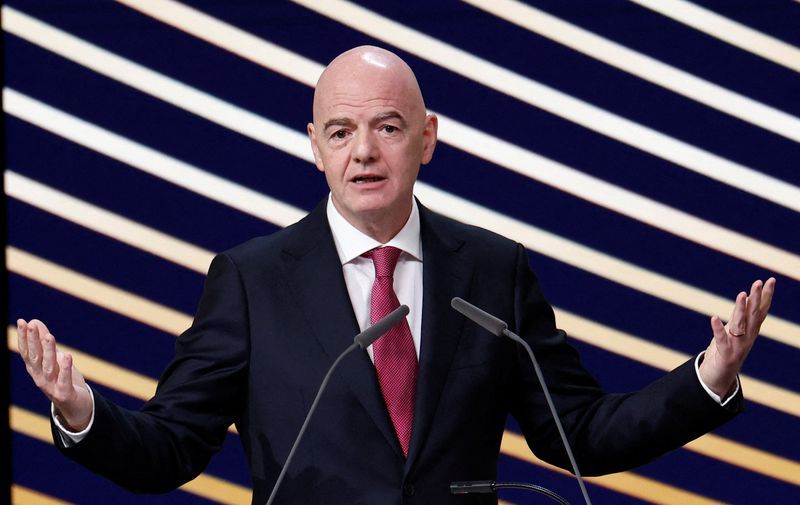
FIFA President Gianni Infantino's path to re-election has grown considerably steeper after his controversial proposal to sell a stake in the World Cup to private investors triggered widespread backlash from major football confederations worldwide. The scheme prompted Serbia, Sweden, and Wales to withdraw their backing, undermining what should have been a routine second-term approval process. As regional governing bodies and prominent football figures openly challenge his leadership, at least five high-profile candidates have begun positioning themselves as potential replacements for the 2027-2031 term, with the decisive vote scheduled for Morocco on March 18.
The deterioration of support around Infantino represents a significant rupture within FIFA's leadership structure. What started as an internal governance dispute has evolved into a broader crisis of confidence, exposing fractures between continental federations that rarely operate in such overt coordination. The scale and speed of the backlash caught many observers off guard, suggesting that frustrations with Infantino's tenure had been building beneath the surface for considerably longer than publicly acknowledged. The private equity proposal itself appears to have served as a catalyst that united disparate interests across Europe, Africa, and the Americas, each with distinct concerns about FIFA's direction.
Victor Montagliani, who leads CONCACAF and represents North American football interests, has emerged as a serious contender according to recent reports. As a Canadian businessman with established credentials in continental governance, Montagliani brings geographic diversity to a field that might otherwise lack North American representation. Notably, while CONCACAF rejected Infantino's private equity scheme, the confederation stopped short of the outright boycott that UEFA implemented, suggesting Montagliani may occupy a middle ground that appeals to pragmatists within football's global structure. His positioning as a regional leader during 2026 World Cup preparations on CONCACAF soil gives him substantial leverage and visibility.
European football's establishment has begun crystallizing around alternative candidates. Aleksander Ceferin, UEFA's Slovenian president, represents the continent's sporting establishment and has become one of Infantino's most vocal critics following a series of disputes that culminated in Ceferin's boycott of the recent World Cup final. His decision to sit out such a prominent global football event sent a powerful symbolic message about the depth of UEFA's alienation from FIFA's current leadership. However, Ceferin's role as Europe's senior football administrator may complicate his candidacy by making him appear too regionally focused for a truly global federation.
The AFC's senior figures also present themselves as alternative leaders. Sheikh Salman bin Ibrahim Al Khalifa from Bahrain, who holds a senior vice presidency on FIFA's Council, has long opposed Infantino's agenda on major tournaments, notably including resistance to World Cup expansion to 64 teams. The AFC's formal criticism of Infantino's approach to consultation and decision-making processes indicates broader dissatisfaction with governance standards, not merely policy disagreements. This structural critique of FIFA's institutional framework could resonate with federations concerned about democratic participation in global football governance.
Qatari sports executive Nasser Al-Khelaifi presents an intriguing alternative, particularly given his prominence as Paris Saint-Germain's president and his extensive experience navigating international football's highest circles. According to recent reporting, European football officials have begun rallying around Al-Khelaifi as a serious challenger, suggesting he commands respect across multiple confederations despite his Middle Eastern base. His business acumen and experience managing one of world football's most prominent clubs could appeal to members seeking someone with demonstrated organizational prowess beyond pure federation experience.
Norwegian Football Federation President Lise Klaveness represents a distinct candidacy rooted in principled opposition to Infantino's governance approach. As one of global football's most prominent women leaders, Klaveness commanded the opposition to the World Cup privatization scheme with particular vocal strength. Her previous willingness to contemplate ethics complaints against FIFA, notably regarding the handling of Folain Balogun's suspension following U.S. President Donald Trump's intervention, demonstrates commitment to FIFA's institutional integrity independent of political pressure. Her candidacy would signal a shift toward governance reform and ethical standards enforcement.
The Balogun incident itself deserves closer examination for Malaysian readers, as it illuminates how FIFA operates under Infantino's direction. The suspension of a U.S. national team player was reversed following Trump's personal intervention, an extraordinary sequence suggesting FIFA's decision-making processes had become dangerously porous to external political pressure. This episode crystallized concerns about FIFA's independence and institutional integrity that extended well beyond the World Cup privatization controversy. Klaveness's willingness to pursue accountability for such apparent compromises positioned her as a reform-oriented alternative to the incumbent.
The timing of this leadership transition coincides with FIFA's navigation of multiple complex challenges that will shape global football's future. The 2026 World Cup expansion to 48 teams, the ongoing financial sustainability of football's governing structures, and relationships with continental confederations all demand leadership capable of building broad consensus. Infantino's top-down approach and willingness to pursue dramatic institutional changes without apparent consultation with regional partners clearly alienated significant portions of FIFA's membership. Each potential successor must address how they would restore collaborative governance structures while pursuing necessary modernization.
For Southeast Asian football administrators and fans, this leadership transition carries practical implications. Malaysia's football federation operates within the AFC, making Sheikh Salman's potential presidency directly relevant to regional governance. Alternatively, a Ceferin or Klaveness presidency would maintain stronger UEFA influence on global football policy. The choice between these candidates will influence everything from tournament scheduling to dispute resolution mechanisms that affect Southeast Asian clubs and national teams. The region's relatively quiet presence in FIFA politics means Malaysian interests often require alignment with larger AFC coalition partners, a dynamic that would shift depending on which candidate ultimately prevails.
The March 18 vote in Morocco will reveal whether Infantino can maintain sufficient support among his coalition partners or whether coalition fragmentation proves irreversible. His apparent miscalculation regarding the private equity proposal's popularity suggests he may have overestimated his political capital. Each potential successor offers distinct visions for FIFA's future and different relationships with regional confederations. As Malaysian football observers monitor developments, they should recognize that FIFA presidential elections ultimately determine not merely who occupies a ceremonial position, but rather who shapes the structural rules within which their own football administrators operate and compete globally.

