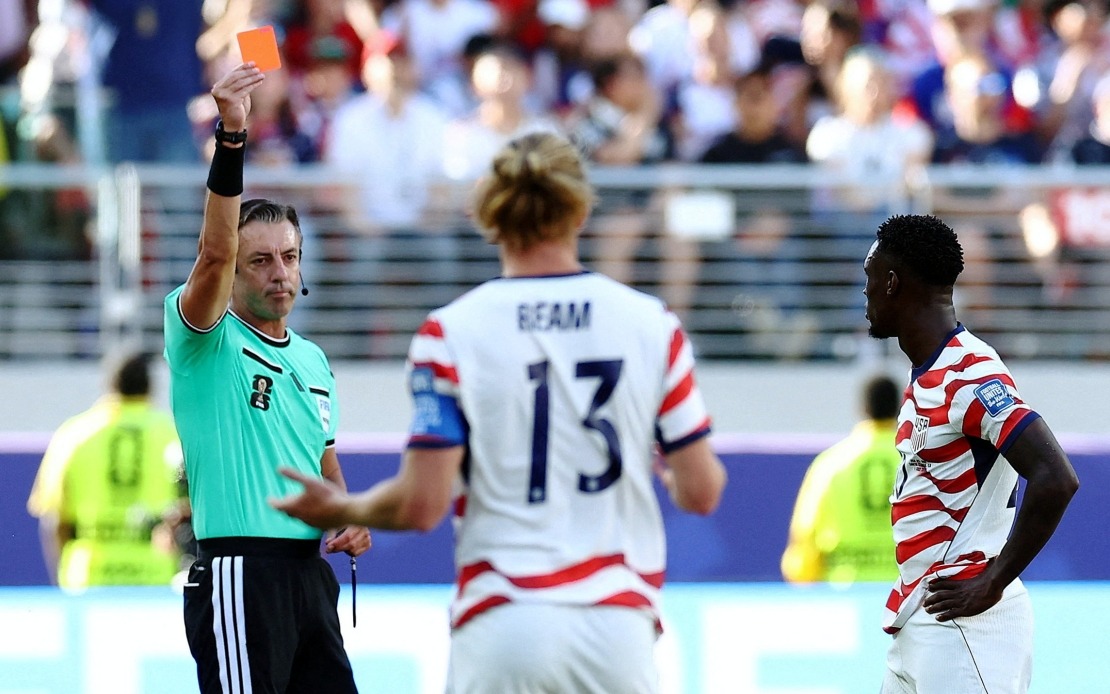
FIFA has firmly defended Brazilian referee Raphael Claus against criticism from United States President Donald Trump, with the global football body's referees chief Pierluigi Collina offering a full-throated endorsement of the match official's credentials and professionalism. The dispute emerged after Trump publicly questioned Claus's decision-making following a controversial incident during the tournament, drawing international attention to refereeing standards at the highest level of competitive football.
The controversy centred on a red card that Claus issued to American striker Folarin Balogun during the last-32 encounter between the United States and Bosnia and Herzegovina. Trump characterised the dismissal as suspect, contending that the referee's judgment had undermined the American team's tournament prospects. The incident highlighted ongoing tensions between political figures and match officials over officiating decisions, a phenomenon that has become increasingly visible in recent years as social media amplifies immediate reactions to controversial sporting moments.
Interestingly, the disciplinary outcome did not ultimately derail Balogun's participation in subsequent matches. The red card was controversially suspended on Sunday, permitting him to feature in the last-16 tie against Belgium the following day. However, that fixture proved disappointing for the American contingent, who suffered a heavy 4-1 defeat in Seattle, suggesting that Balogun's availability may have provided limited practical advantage to the team's campaign.
FIFA responded to Trump's criticism by issuing an official statement that positioned Claus among the elite practitioners of his profession globally. The organisation described him as one of the world's most accomplished professional referees and emphasised his status as a valued contributor to Team One, the designated referees' collective for the World Cup competition. This formulation served to elevate Claus's standing and implicitly rebut suggestions that his judgment or integrity were open to question, placing FIFA's institutional authority behind the official.
Collina, who holds responsibility for referee standards and appointments across FIFA competitions, went further in his personal defence of Claus. He noted that this represented the Brazilian's second World Cup assignment, having previously officiated during the Qatar tournament in 2022, thereby establishing a track record of selection by football's governing body. Collina characterised Claus as experienced and highly respected within refereeing circles, deploying language that simultaneously reasserted FIFA's confidence in him and implicitly questioned the grounds for Trump's scepticism.
The political dimension of this exchange carries implications for how sports organisations manage pressure from powerful national figures. Trump's intervention represented an unusually direct form of executive criticism directed at a sporting decision, one typically reserved for behind-the-scenes diplomatic channels rather than public statements. By responding through formal channels while maintaining Claus's professional standing, FIFA signalled a commitment to referee autonomy even when faced with high-profile political challenge, though observers might note the earlier reports that FIFA president Gianni Infantino had personally received a call from Trump requesting a review of the incident.
Claus's stock within FIFA may actually be elevated rather than diminished by this episode. Officials who maintain their professional integrity despite external pressure are typically regarded more favourably by administrators responsible for future tournament selections. The possibility that Claus could be selected to officiate the tournament final remains open, particularly given that Brazil has already exited the competition at the last-16 stage, eliminating potential conflict-of-interest considerations that might otherwise preclude a Brazilian referee from the sport's most prestigious match.
Infantino himself addressed the broader question of refereeing standards without directly naming Claus, choosing instead to comment on the quality and selection methodology for match officials more generally. Writing on Instagram, the FIFA president characterised the World Cup as an overwhelming success and attributed significant credit to the calibre of officiating throughout the tournament. He emphasised the rigorous selection process that identified referees based on demonstrated skill, consistency, and sustained performance quality, effectively constructing a defence of the appointment philosophy that had selected Claus.
The FIFA president's intervention carried a broader message about institutional values. Infantino reiterated the necessity of respecting both referees and the rulebook that governs football competition, framing this respect as foundational to the sport itself. His formulation—that football cannot exist without referees—articulated a position that officials occupy an indispensable role and warrant protection from inappropriate external scrutiny. This philosophical stance undergirds FIFA's response to Trump's criticism, positioning the defence of Claus within a larger framework concerning the integrity of competitive structures.
For Malaysian and Southeast Asian football audiences, this episode illustrates the complex relationship between political authority and sporting governance in an increasingly interconnected world. Decisions made by referees during international tournaments carry implications far beyond the immediate match context, particularly when involving prominent nations like the United States. The willingness of FIFA to defend its officials against political pressure, even from a major world leader, suggests an attempt to maintain institutional independence from political influence, though questions remain about the genuine extent of that autonomy given earlier reports of Trump's direct communication with football's governing body.
The incident also underscores ongoing debates within football about refereeing consistency and the role of technology in decision-making. VAR review featured prominently in Claus's original red card decision, raising questions about whether controversy stemmed from the referee's judgment or from ambiguities in how the video review technology was interpreted and applied. These technical dimensions matter for grassroots and professional football alike across the region, where refereeing standards directly impact competitive integrity and player development.
Moving forward, Claus's career trajectory will likely demonstrate whether FIFA's public backing translates into continued high-profile assignments. If he receives significant tournament responsibilities following this episode, it would signal that FIFA regards his conduct as beyond reproach and that political pressure does not influence official selection. Conversely, any reduction in his appointment frequency could suggest that such political interventions carry indirect consequences despite public denials, shaping how future referees approach decisions involving major footballing nations.

