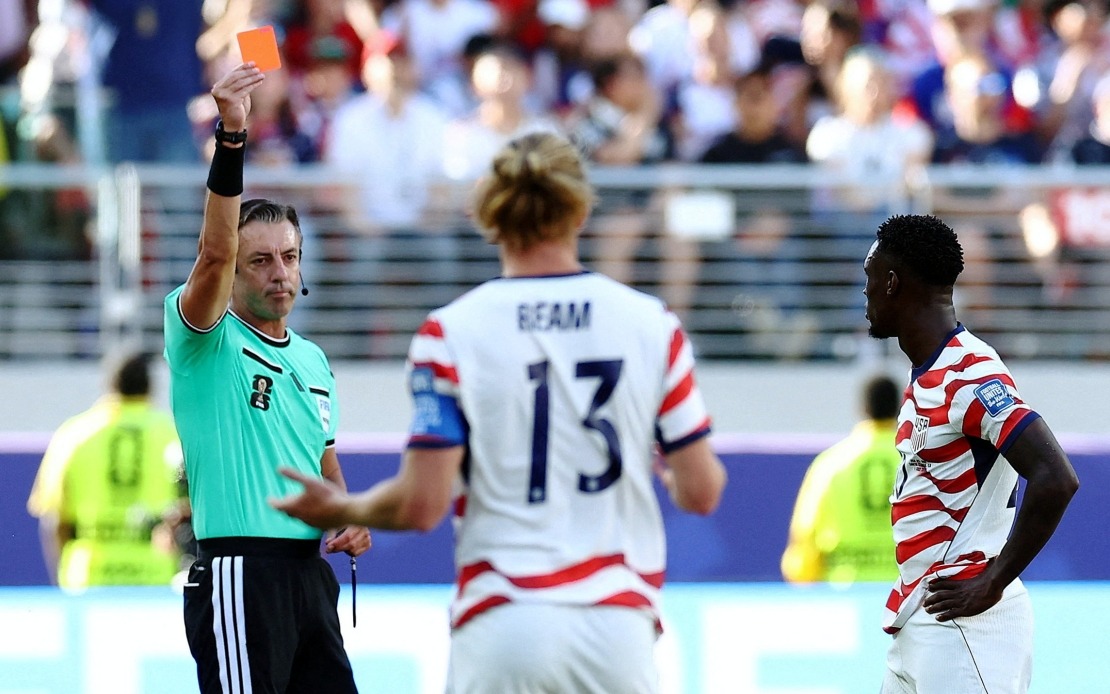
FIFA's decision to suspend enforcement of a one-match ban imposed on United States striker Folarin Balogun has cleared the way for the American to face Belgium in a high-stakes World Cup round-of-16 encounter scheduled for Monday in Seattle, though the ruling has triggered an immediate and formal protest from the Belgian Football Association.
Balogun received his red card during the United States' 2-0 group-stage victory over Bosnia and Herzegovina on July 1 after an incident involving stamping on defender Tarik Muharemovic. The FIFA Disciplinary Committee determined that the offence violated Articles 14 and 66 of the FIFA Disciplinary Code, warranting a standard one-match suspension. However, in a move that has proven controversial, FIFA invoked Article 27 to suspend the implementation of that ban for a probationary period lasting twelve months.
The practical effect of FIFA's decision is substantial: Balogun, who has emerged as a crucial attacking asset for the United States with three tournament goals, will be available for selection in what amounts to a knockout fixture with everything to play for. A defeat would eliminate the hosts from contention, while victory guarantees a quarter-final spot—the first such appearance for the American men's national team since 2002. The inclusion of a high-performing striker in such circumstances carries genuine competitive weight.
Belgium's Royal Football Association responded swiftly and with unmistakable displeasure, releasing a statement that expressed formal astonishment at the ruling and indicated it was examining every available avenue to protect the federation's competitive interests. The Belgian objection rests on a careful reading of FIFA's own rulebook, creating a genuine tension between competing interpretations of the disciplinary code.
The Belgian federation's core argument centres on what it characterises as an inconsistency within FIFA's own regulations. Article 66.4 of the Disciplinary Code, Belgium argues, stipulates that any player receiving a direct red card faces automatic suspension for the team's subsequent fixture—a principle that has been applied uniformly throughout the current World Cup for every previous sending-off. Belgium contends that this automatic suspension rule should have operated in Balogun's case without exception or discretionary override.
Belgium has further highlighted language contained in the FIFA World Cup 2026 Competition Regulations, specifically Article 10.5, which explicitly mandates automatic suspension following either a direct red card or accumulation of two yellow cards, with such suspensions taking effect for the team's next match. This regulatory framework was distributed to all participating member associations on May 12 and, Belgium argues, was reiterated repeatedly during pre-tournament coordination meetings and official workshops. The federation's position suggests that FIFA's invocation of discretionary authority to suspend the ban contradicts previously communicated tournament protocols.
FIFA's justification relies on Article 27 of the Disciplinary Code, which grants the disciplinary committee authority to suspend enforcement of a sanction. The football body's statement indicated that should Balogun commit another infringement of comparable severity during the one-year probationary period, the original suspension would take automatic effect without prejudice to any fresh sanctions arising from the new offence. In essence, FIFA has conditioned Balogun's playing eligibility on his conduct going forward.
The dispute carries implications extending well beyond Monday's particular match. Belgium has signalled concerns about fair play principles and the consistency of rule application across all participating nations in this tournament and future editions. The federation's public objection essentially questions whether selective discretionary application of disciplinary rules undermines the competitive integrity that World Cup tournaments are intended to preserve. If FIFA's rules are subject to case-by-case interpretation rather than uniform application, participating federations must navigate uncertainty about how decisions will be rendered in comparable situations.
For Malaysian and Southeast Asian observers, the controversy touches on broader governance questions facing international sporting bodies. Regional football associations regularly contend with issues of rulebook interpretation and the balance between discretionary authority and consistent application of published standards. The Balogun case demonstrates how high-stakes tournaments can create pressure for exceptions that may erode the uniform framework supposedly binding all competitors equally.
The decision also illustrates the substantial stakes attached to World Cup participation. The United States' investment in developing its football programme, combined with the squad's genuine advancement through the group stage, has positioned the team as a competitive force. Balogun's three goals represent meaningful contribution to that progress. Belgium, as an established football nation with recent tournament experience, enters the fixture expecting to advance, and the absence of a key American attacking player might have shifted the competitive calculus.
FIFA's reasoning, while expressed through reference to its disciplinary procedures, ultimately reflects a judgment call about how strictly to apply published rules. Whether that judgment was well-founded remains contested. Belgium's formal protest ensures the matter will receive continued attention, and the federation's statement suggests the objection may proceed through multiple channels rather than concluding with FIFA's initial determination.
The match itself promises to deliver football commentary of its own, independent of the disciplinary controversy. Both teams arrive seeking quarter-final qualification, creating the sort of competitive intensity that tournament football generates. For American supporters, Balogun's availability removes a significant uncertainty that could have affected team selection and tactical planning. For Belgium, the decision represents an obstacle to narrative control, though the federation's ability to contest the ruling demonstrates that serious international sporting disputes involve more than a single authoritative determination.

