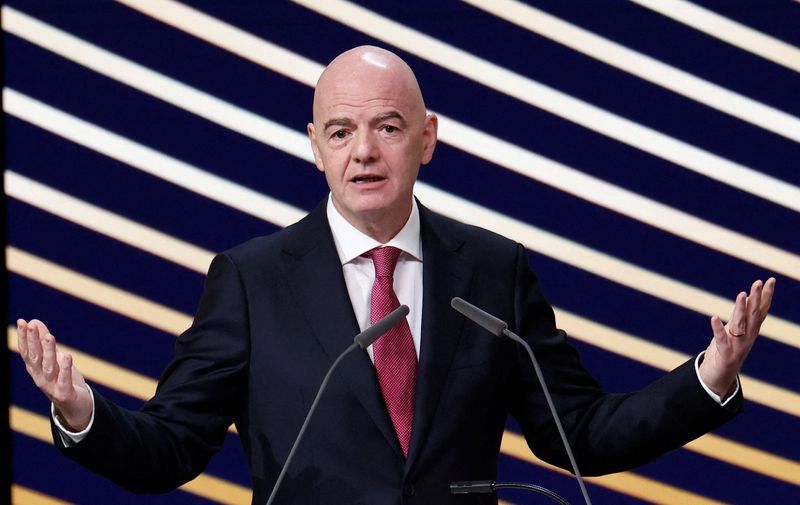
The most serious challenge to FIFA President Gianni Infantino's authority has arrived from an unexpected quarter: two of the sport's most influential women leaders. Wales' Laura McAllister and Norway's Lise Klaveness, serving as the only female members on UEFA's executive committee, have stepped into the spotlight as vocal critics during what may be the defining crisis of Infantino's tenure. Their emergence as central figures in the resistance against the FIFA leadership raises broader questions about gender representation in global sports governance, a sector historically dominated by male administrators with little appetite for meaningful reform.
The immediate trigger for this governance upheaval was Infantino's ambitious push to establish FIFA Football Enterprises, a private equity-backed commercial venture designed to reshape how the world governing body monetises the sport. The scheme collapsed under sustained opposition from UEFA and other regional confederations, with several national associations, beginning with Wales, withdrawing their support for Infantino's re-election campaign. The rapid spread of dissent through FIFA's own institutional structures suggests deeper fractures within the organisation's leadership and decision-making processes that extend well beyond this single commercial proposal.
McAllister, who holds the position of UEFA vice-president, frames the current turmoil as symptomatic of systemic governance failures at FIFA. When asked about the possibility of a woman leading world football, she expressed cautious optimism tempered by realistic assessment of the entrenched power structures. She acknowledged that whilst female leadership would represent progress, the path to the FIFA presidency remains complicated by factors far more significant than individual merit or capability. The global political landscape within which FIFA operates, she suggested, contains formidable obstacles that transcend simple questions of gender qualification.
Klaveness, now president of the Norwegian Football Association, received notable public validation when former FIFA President Sepp Blatter declared that the time had come for women to assume the sport's highest offices. This intervention, whilst symbolically significant, underscores the gap between rhetorical support for female leadership and the structural realities that continue to marginalise women in international football governance. Of FIFA's 211 member associations, only 10 are currently led by female presidents, a statistic that reveals the depth of gender imbalance within the sport's administrative hierarchy.
What distinguishes McAllister and Klaveness in this conflict is not merely their gender but their explicit emphasis on values-driven governance. Both women transitioned from international playing careers into football administration, bringing professional credentials and philosophical frameworks shaped by their work within women's football. McAllister holds a background in political science, whilst Klaveness trained as a lawyer, equipping both with analytical tools to dissect FIFA's structural problems. They argue that their commitment to football's foundational principles—accessibility across all levels, elimination of political interference, and resistance to privatisation—stems directly from their developmental experiences within the women's game, an environment historically more focused on inclusive grassroots development than commercial extraction.
The governance crisis extends beyond the failed private equity scheme. McAllister identified multiple controversies that have progressively undermined confidence in Infantino's leadership: FIFA's involvement with the failed European Super League project, geopolitical complications surrounding World Cup hosting decisions, and most notably, the rescinding of a red card shown to American striker Folarin Balogun following direct intervention from United States President Donald Trump. This last incident exemplifies the kind of political interference that McAllister argues has corroded FIFA's institutional integrity and public credibility. Each incident reinforces her contention that fundamental governance problems run through FIFA's organisational DNA.
McAllister's proposal for a potential boycott of FIFA events received unanimous backing during UEFA's emergency session, indicating the breadth of institutional support for the resistance movement. Yet she cautioned against viewing female leadership as a straightforward solution to these deeper problems. The question of whether a woman could secure the FIFA presidency requires consideration of international political alignments far beyond UEFA's traditional sphere of influence. Any serious presidential challenge would necessitate backing from football associations across Africa, Asia, and other regions where cultural and political dynamics differ significantly from European contexts. McAllister argued against attempting to force the issue through revolutionary tactics, advocating instead for patient, incremental momentum-building.
The contrast with other international sports bodies illuminates FIFA's relative backwardness in gender equity. Michael Payne, formerly of the International Olympic Committee's marketing division, noted that the IOC has prioritised gender equity for two decades, culminating in the appointment of Kirsty Coventry as its leader. The Olympic Games now feature equal participation between male and female athletes, a structural parity that FIFA's World Cup has not approached. This comparison suggests that football's governance structures have lagged significantly behind other major sports in embracing gender-balanced leadership and operational philosophies. The disparity reflects both historical institutional inertia and deliberate choices about what kinds of reform receive priority within football's power structures.
For McAllister, the current crisis represents an opportunity to assert football's authentic values against commercialisation and politicisation. She emphasised that the sport exists fundamentally for universal participation, from grassroots communities in developing nations to elite international competition. Private capital involvement and geopolitical interference represent existential threats to football's legitimacy as a genuinely democratic institution. This perspective, shaped by her background in women's football where resource constraints necessitated principled decision-making, offers a philosophical counterweight to FIFA's increasingly corporate governance model. The resistance that McAllister and Klaveness have mobilised operates simultaneously on practical and ideological registers.
The road toward female leadership in global football governance appears distant despite recent momentum. McAllister's strategic emphasis on gradualism rather than confrontation suggests her assessment that revolutionary rhetoric may actually impede progress toward meaningful change. Building sustainable support across diverse regional confederations requires careful relationship-building and consensus-generation, processes that demand patience and political sophistication. Yet the very fact that female voices have become central to this governance debate, rather than peripheral, marks a subtle but significant shift in how football's power structures acknowledge and engage women's leadership.
Looking forward, the outcome of FIFA's current crisis will likely determine whether this moment generates lasting institutional reform or becomes another episode in the sport's cycle of governance controversies followed by superficial adjustments. McAllister and Klaveness have demonstrated that women leaders can command attention and mobilise institutional support around substantive governance issues. Whether this translates into structural changes regarding female representation, or whether football's male-dominated hierarchies successfully absorb and neutralise this challenge, remains uncertain. What seems clear is that the sport's global governance cannot remain indifferent to questions of gender equity and democratic legitimacy that extend far beyond FIFA's boardrooms.

