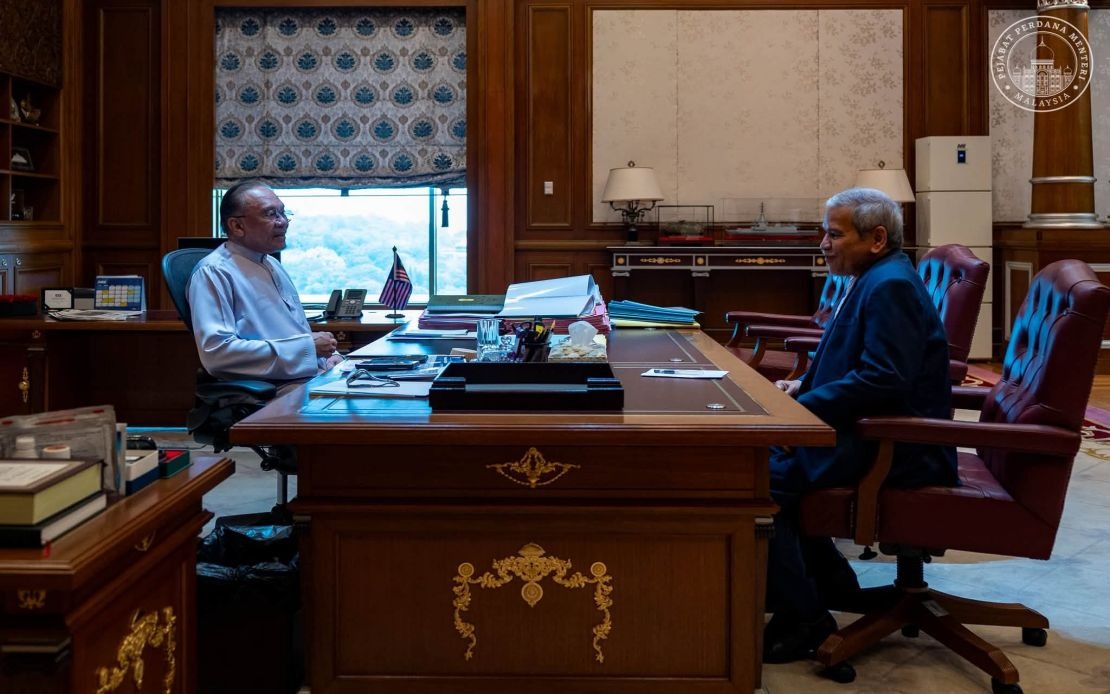
Prime Minister Datuk Seri Anwar Ibrahim has stressed that the Federal Land Development Authority must be continuously reinforced as a critical institution dedicated to enhancing the living standards and dignity of settlers across the country. Speaking during a meeting with newly appointed FELDA chairman Tan Sri Ahmad Badri Mohd Zahir at his Putrajaya office, Anwar outlined his vision for an organisation that remains responsive to the needs of its beneficiaries while adapting to modern economic challenges.
The elevation of Ahmad Badri to helm FELDA marks a transition in the authority's leadership following the conclusion of Datuk Seri Ahmad Shabery Cheek's tenure on June 30. Ahmad Badri formally assumed his position effective July 15, taking charge of an institution responsible for managing thousands of settler families whose livelihoods depend on land schemes spanning the country. His appointment comes at a time when FELDA faces pressure to demonstrate relevance and deliver tangible improvements to its constituents.
Anwar, who holds the additional portfolio of Finance Minister, articulated a comprehensive approach to FELDA's future that balances immediate welfare concerns with long-term institutional sustainability. His emphasis on ensuring settler welfare remains harmonious with efforts to strengthen economic competitiveness reflects an acknowledgement that mere social support without robust business performance would ultimately undermine the scheme's viability. This dual focus represents a nuanced understanding of the pressures facing development authorities in delivering both social objectives and financial returns.
A significant dimension of Anwar's remarks concerns the younger generation of settlers, a cohort increasingly facing distinct challenges compared to their parents who initially benefited from FELDA schemes. The Prime Minister's explicit attention to generational concerns suggests government recognition that newer settlers encounter different obstacles, from market access difficulties to skills gaps in contemporary agriculture and commodity trading. Without specific initiatives targeting youth retention and entrepreneurial support, FELDA risks becoming an ageing institution with dwindling relevance to Malaysia's evolving rural economy.
The MADANI Government's pledge to provide comprehensive support underscores a policy commitment extending beyond ceremonial endorsement. For Malaysian readers familiar with FELDA's historical trajectory—from its establishment as a flagship poverty-alleviation programme to its current challenges—this reaffirmation carries weight particularly given previous administrations' mixed track records in resource allocation. Strengthening an institution requires sustained funding, policy coherence, and political will, elements that have occasionally been inconsistent in FELDA's governance.
The appointment of Ahmad Badri himself carries implications for FELDA's strategic direction. His assumption of leadership presents an opportunity to reset institutional narratives and operational priorities. The courtesy call format, while ceremonial, served to publicly establish the incoming chairman's relationship with the highest political authority, potentially signalling that FELDA will receive executive-level attention and support in navigating its challenges and modernisation efforts.
FELDA's challenges are multifaceted and require consideration of both immediate welfare and longer-term structural viability. Commodity price volatility, climate change impacts on yields, land degradation, and competition from mechanised operations all threaten settler incomes. Simultaneously, demographic shifts, rural-urban migration, and generational disengagement present institutional sustainability questions. Any genuine strengthening programme must address these interconnected pressures systematically rather than through piecemeal interventions.
The emphasis on remaining relevant for future generations speaks to a broader transformation imperative. Contemporary settlers and their descendants may pursue agriculture differently—through value-added processing, sustainable farming techniques, or diversified income streams—requiring FELDA to evolve from a traditional land-distribution model toward a comprehensive rural development platform. This metamorphosis cannot occur without deliberate institutional investment and capability building across multiple dimensions including technology, market access, and financial services.
Anwar's framing of FELDA as an institution serving the people echoes the MADANI Government's populist orientation, positioning the scheme within broader narratives of shared prosperity and equitable development. This rhetorical emphasis assumes particular significance given rural constituencies' traditional political importance and their varied experiences with government support mechanisms. For settlers evaluating government commitment through tangible outcomes rather than statements, implementation will ultimately determine whether such policy pronouncements translate into improved circumstances.
The transition in FELDA leadership, combined with Prime Minister's articulated priorities, may catalyse discussion about the authority's modernisation pathway. Questions regarding appropriate technology adoption, market-oriented governance structures, settler representation in decision-making, and resource optimisation will likely feature prominently in Ahmad Badri's tenure. Success in addressing these areas could position FELDA as a model for contemporary development institutions balancing social objectives with economic sustainability.
Regional perspectives on FELDA's evolution carry relevance for Southeast Asian agricultural development more broadly. As countries throughout the region grapple with rural transformation amid globalisation and climate pressures, FELDA's experiences—whether successes or setbacks—offer instructive lessons for policymakers designing development schemes. Malaysia's approach to settler welfare and institutional modernisation may influence regional discourse around land reform and rural development programming.
Anwar's commitment reflects understanding that institutional strength derives from sustained attention to settler concerns while maintaining organisational effectiveness. This balanced approach, if implemented coherently, could position FELDA as a relevant development institution for coming decades. However, realising this vision requires translating political commitment into concrete resource allocation, operational improvements, and responsive governance structures that demonstrate tangible benefits to settler communities across Malaysia's diverse agricultural landscapes.

